Paint Schoodic

To see more paintings, learn about workshops and classes, and more, visit my website.

Tuesday, May 31, 2022

God Save the Queen

Here in the countryside, her subjects love her.

Shop window display in Cumbria

Every small town we’ve walked through has been decorated for the Jubilee. That’s not with big-box generic décor, either, although there are Jubilee flags and bunting everywhere. Every little shop window and many, many front gardens sport tributes from the heart—handmade signs, memorabilia from the Coronation, and many, many teacups of the kind your grandmother collected.

A laundromat in Haltwhistle, Cumbria

It's not my country, she’s not my Queen, but the sentiment chokes me up. This is England’s famous red wall, the Labour heartland that went Conservative in the last election. In other words, it’s in political flux. There are both conservative and workingmen’s pubs in these villages, but none of that touches the Jubilee. The Queen truly transcends politics in a way Americans don’t understand. This Jubilee is her celebration.

Every pub is decorated for the Jubilee.

I am an unabashed fan of the Queen. She reminds me of my mother and all the women of her generation—stoic, composed, hardworking, redoubtable and dignified. I miss them, terribly.

The Jubilee is tied with memories of WW2, which are made more poignant by the current Ukraine war.

The Washington Post opined recently that the Queen should retire. We Americans are not entitled to an opinion (something we should practice saying regularly about a whole host of things). The British monarchy has had no impact on America for 250 years. Any road, the question of whether she’s ‘fit’ for the role is absurd. The modern monarchy is largely her creation, and for all we know she’ll keep on defining it.

The Queen Bee and her subject bees in Gilsland.

I will be in Yorkshire for the Jubilee celebrations proper, but there could be no better place to observe them than right here in Brampton, Cumbria—or any of the other little villages we’ve passed through. There will be prayer vigils and parties for the old people. Tomorrow night, there will be beacons lit across England, including along Hadrian’s Wall. These will range from “private bonfires to full-blown spectaculars with fireworks, choirs, pipers, and buglers.”

The Queen's corgis in a large yarn-bomb in Brampton, Cumbria.

I’ve been to Britain before, but always to big cities or World Heritage Sites. This time, I’m waiting out the rain in country bus stops and drinking in rural pubs. This England is to London as Pecos, NM is to New York. I had breakfast yesterday with a Shropshire farmer. We discussed the labor shortage, just as I might with my Maine neighbor.

In the window of an Indian restaurant in Brampton.

Two nights ago, we stayed at The Centre of Britain in Haltwhistle. It’s in a stone building that wraps around a 15th century Border Reivers' Pele Tower. It’s ridiculously atmospheric, and it’s for sale for a fraction of the price of a boutique inn in Maine. You’d have to deal with muddy boots, but if you want to throw over your current life for one in a small English village, email the proprietors here. The beer, I promise you, is very, very good.

Many people have pulled out treasured memorabilia from the Coronation in 1952.


Thursday, May 26, 2022

The care and feeding of your dogs

Poppy discovered the joys of manure, but my feet were thoroughly blistered.

The beautiful Northumbrian landscape.

This is what I’d call ‘hill-walking’ but my friend Kenny—who was raised on the shores of Loch Linnhe, just a hop, skip and a jump from Ben Nevis—thinks of as a doddle. Shortly after leaving the Tyne at Newburn, we started the long slog up to Heddon-on-the-Wall. There is no urban sprawl here—just long agricultural vistas and Constable skies.

These small Northumbrian villages are Cotswold-beautiful, built of golden-brown stone and perched on high hills with magnificent vistas in every direction. Still, all the beauty in the world doesn’t prevent one from being parched and in need of a pee by midmorning. There was a public house but it seemed a bit early, even for me.

The ever-polite British have deferred the 1900th birthday celebrations for the wall until September, so as to not take away from the Queen's Jubilee.

“Look for a Methodist church,” said Alison, and she was right. They had a bathroom, and they offered us coffee, tea, and cheese scones. We had a lovely sit in their garden before we went to look at our first section of unreconstructed wall. Thank you, lovely Methodists!

From there we walked a section of military road planned by Field Marshal George Wade following his inability to move artillery and troops cross-country in pursuit of Bonnie Prince Charlie. The old wall was torn out and used as the base for the highway. The British were pretty sick of the Jacobites by that point.

Our first glimpse of the wall since Wallsend.

After crossing the A69, we dropped down into a peaceful meadow where Poppy discovered the joys of cow dung. Poppy is a well-bred lass from Edinburgh but that didn’t stop her from rolling ecstatically. Fifteen minutes and a package of baby wipes later, we’d fairly evenly distributed the manure among our human persons, with only a moderate amount left on the dog.

Rural England is crisscrossed by public rights-of-way, but they’re shared with livestock. I don’t mind cows; they’re generally leery of people. Horses so far have been behind fences; that’s good as they’re far too canny to be trusted with daypacks.

Rudchester Farm.

At Rudchester, we crossed a sheepfold, the site of the fourth fort along the Wall, Vindobala. The only reminder of its existence was the unnatural flatness of the farmyard—and the ancient stone walls, undoubtably made of reclaimed stone. As we gathered to read the explanatory sign, Poppy found sheep manure and joyfully worked it with her muzzle.

I am an assiduous hiker who does 4.5 miles up Beech Hill every morning before breakfast. I’d hoped that would prepare me for this walk, but by midafternoon, my own poor dogs were blistered. They were sliding forward with every downward step. At lunch, Martha cleverly relaced my hiking shoes for me, but the damage was done. I limped the remaining distance.

The path is very well marked, and surprisingly busy.

Kenny is very kind. For the last four miles, he promised me that there was a pub just another half mile along.

It worked.

Tuesday, May 24, 2022

The perfect English holiday

I dipped my feet in the North Sea. It rained. I ate an ice cream. There was a dog. How much more British can you get?

Dipping my toes in the North Sea, with the requisite British dog. Her name is Poppy and she's a gem.

Last week, I wrote here and here that nothing lasts forever. In Britain, is sometimes turned on its head; antiquity seems to pop up everywhere.

The Moray Estate was built in the early 19th century on a steep slope above the Water of Leith. Ownership is by feu, a feudal land tenure system peculiar to Scotland. The freeholder is somehow a vassal to the mesne lord, in this case the Earl of Moray. This is all pretty vestigial at this point, but it seems to confer some rights, including the beautiful gardens of the Moray Estate.

Portrait of Dr. Martha Vail Barker, 2019, Carol L. Douglas.

I came to Scotland in 2019 to paint a portrait in one of these townhouses, located on Great Stuart Street. In the end it became as much a portrait of the rooms as of the subject. I’d heard the townhouse had sustained serious flooding last year, but the scale of the damage shocked me. There is nothing left of the rooms but the radiators, the fireplace and the wooden shutters. The ornate plaster ceiling friezes have been restored; but the floors are gone completely. The ground floor has been restored, with just a few fiddly bits left to finish, but the first floor is uninhabitable. Nothing lasts forever.

The Moray Estate was built to house Edinburgh’s rich and famous, but the only one that truly interests me is the Scottish Colourist, Francis Cadell, whose family home was at 22 Ainslie Place. Cadell used that interior in many of his paintings, so I play Peeping Tom whenever I walk by.

Interior, The Orange Blind, c. 1914, Francil Cadell

My goal for this trip is actually England, not Edinburgh. Yesterday, we traveled by train to Newcastle-upon-Tyne. The East Lothian landscape would serve up a lifetime of painting in itself. Quietly rolling, impossibly green, dotted with sheep and cattle, it lies along the North Sea. Unlike America, every inch of shoreline has not been coopted by the rich.

We spent the afternoon dutifully touring the Roman ruins of Segedunum. There are only so many clay pots and bronze brooches I can take, but the cavalry barracks were touching. Each man lived back-to-back with his horse in adjoining rooms and stalls. How do they know this? On one side of the wall were the remains of cooking hearths. On the other, horse piss and manure.

The Spanish City in its heyday.

The seaside holiday resort of Whitley Bay is dominated by the Spanish City, a pleasure hall that opened in 1910. It once included a concert hall, ballroom, funfair, restaurant, tea room and roof garden, but all are closed. Now there’s a gift shop, a restaurant, and a wedding venue.

I ate an ice cream on the lido and dipped my toes in the North Sea. It rained. In short; it was a perfect English holiday.

Today we start our walk in earnest—11.5 miles through Tyneside. We’ve been promised that this is the most boring part of the walk, as we’re essentially crossing the city. The upside, as I reminded my partners in this venture, is that we can lunch in a pub, and that will include a half pint of Newcastle Brown Ale.

Friday, May 20, 2022

Boys must be boys

The ick factor in art history is compounded by our own era’s obsession with sex and power.

The Milkmaid, c. 1600, Johannes Vermeer, courtesy Rijksmuseum

During Monday’s class, I zipped quickly through Vermeer’s oeuvre on line, when a sentence about Vermeer’s The Milkmaid stopped me cold. This is one of the most well-known paintings in western art, so familiar that it’s become background noise.

“For at least two centuries before the painting was created, milkmaids and kitchen maids had a reputation as being predisposed to love or sex, and this was frequently reflected in Dutch paintings of kitchen and market scenes from Antwerp, Utrecht and Delft. Some of the paintings were slyly suggestive, like The Milkmaid, others more coarsely so.”

This interpretation apparently came from a 2009 show at the Metropolitan, curated by the late Walter Liedtke, because most of the text was lifted verbatim from his catalog.

“The physical appeal of the ‘milkmaid’ is sensed naturally,” wrote Liedtke, “like the taste of milk or the touch of bread. Rough sleeves reveal bare arms, where the skin (unlike that of the wrists and hands) is rarely exposed to sunlight. The ruddy wrists and face, the woman's generous proportions, and her warmth, softness and approachability are qualities not found in Vermeer's more refined young ladies. They too are alluring, but the kitchen maid is frankly so.

Kitchen Scene, 1620s, Peter Wtewael, courtesy Metropolitan Museum of Art

There are certainly coarse Dutch kitchen scenes—the Peter Wtewael kitchen scene, above, is a compendium of every sex reference that can be crammed on a canvas. Dutch painting of this time was full of jokes and bawdy comic references. Frans Hals’ laughing faces contrast vividly with the rest of Europe’s dour demeanor in Baroque portraiture. Art history tells us that the Dutch drank copiously.

Yes, the 17th century Dutch Republic was Calvinist. Prostitution and adultery were against the law. That didn’t stop the Dutch from recognizing the realities of life, and laughing at them.

The Laughing Cavalier, 1624, Frans Hals, courtesy the Wallace Collection

But Peter Wtewael’s kitchen scene is the attraction of equals. That’s very different from the class abuse of men like Samuel Pepys groping their maids.

These paintings are no longer in middle-class Dutch homes. They have been moved to palaces and museums, where their caretakers and interpreters are the wealthy, educated and powerful. It’s no surprise that their own privilege subtly colors the work they analyze.

To Liedtke, the wide-mouth jug in The Milkmaid was a symbol of feminine anatomy. “By inserting a foot warmer and, next to it, a Delft tile depicting Cupid, Vermeer intimates that love and desire, as well as work, are burdens the maid must bear… Foot warmers do not heat rooms. They heat feet and, under a long skirt (as in Van Loo's Wooing), more private parts.”

Ick.

The Procuress, c. 1622, Dirck van Baburen, courtesy Museum of Fine Arts.

This is not to say that there wasn’t an erotic underpinning to Dutch art, or that servants weren’t the objects of male lust. “I am perfectly willing to believe that you are knowledgeable in the delectable art of preparing stews / But I feel even more appetite for you / Than for the stew that you are preparing,” read the French caption for an engraving of Gerrit Dou’s A Girl Chopping Onions.

It’s just that the ick factor is compounded by our own era’s obsession with sex and power.

Vermeer was just too intelligent to have played this game of simple parts. His mature paintings show keen psychological insight. His milkmaid is a dignified, moral presence. It’s obscene to suggest otherwise.

Wednesday, May 18, 2022

Romance or reality?

Be honest or sanitize the view? What’s actually there can be a hard sell.

Lobster Pound at Tenants Harbor, Carol L. Douglas, available.

I painted the above, of a lobster pound at Tenants Harbor, ME, just a few years ago. These days, a backhoe is clearing the property. This is no paeon to a lost way of life, because lobstering is a healthy $1 billion business in Maine (although it is currently is threatened by Federal regulation). It’s just an observation that things change. Paintings can be a way of marking what was once there.

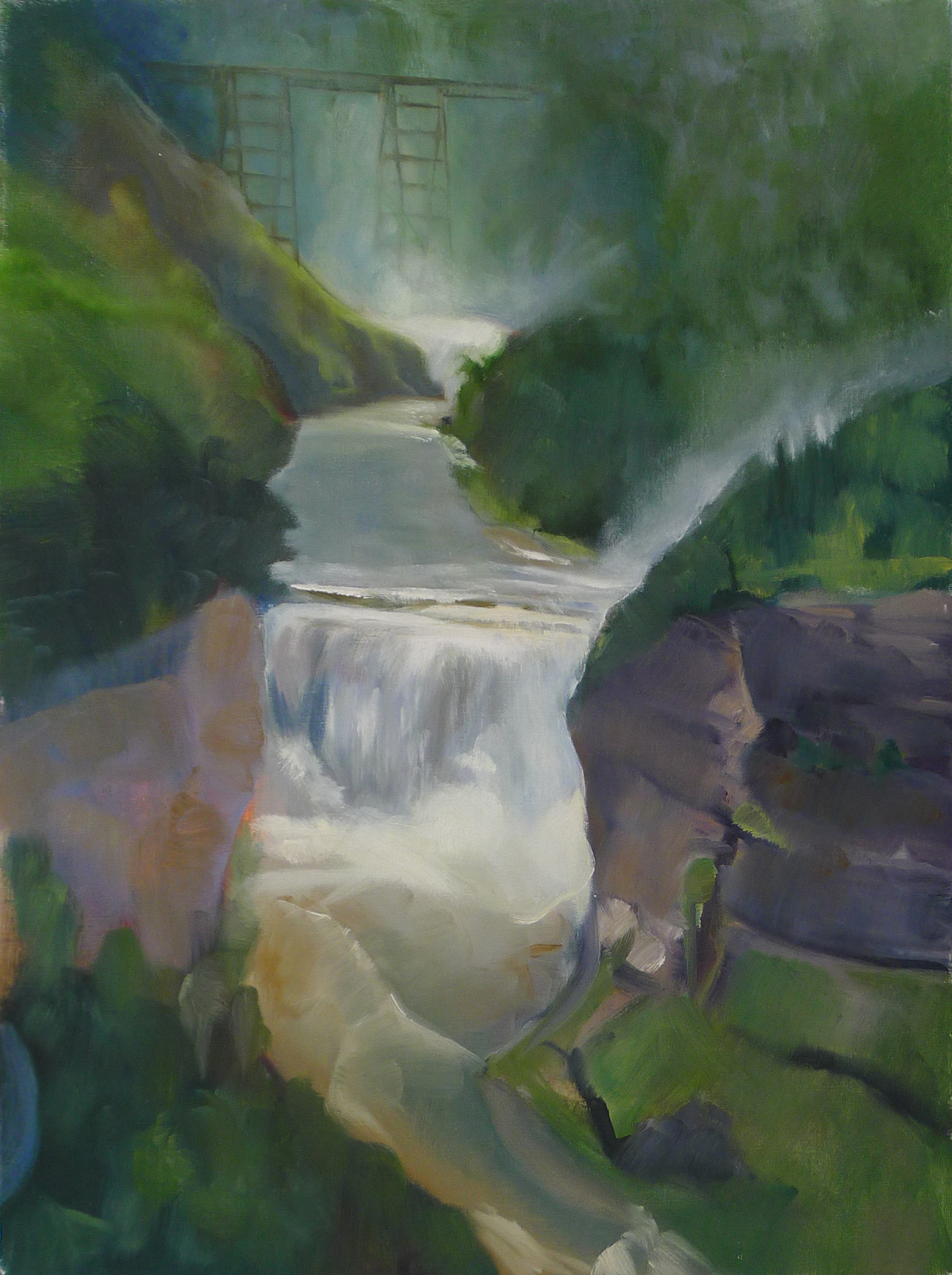
But that’s only if we’re honest. Years ago, I painted the upper falls at Letchworth (below). There has been an old steel railroad bridge above it for as long as I can remember. I wanted to minimize it as much as possible, as I thought it was an ugly, ominous intrusion into the landscape. Still, it needed to be there. It was as much a part of the place as the rocks and water.

Upper Falls at Letchworth, Carol L. Douglas, private collection

In 2017, the bridge was replaced with a newer, squatter, safer model. Last year, a visitor from New York saw my painting. “That’s the old railroad bridge!” he enthused. What I thought was annoying was, to him, a part of history.

Landscape artists—myself included—have a tendency to minimize the effect of people in the landscape and to paint what is already obsolete or rustic. We paint lobster boats but delete the shiny white cruise ships in the harbor. We delete cars, in part because they’re difficult to draw, and in part because they’re ubiquitous.

A 1917 postcard of a car accident below the Upper Falls, showing the railroad bridge. Eleven people were in that car when it tumbled off the gorge wall. Two died.

This has always been the case. Artists have the same ideas about what’s beautiful as the rest of humanity. There are exceptions, of course. Childe Hassam used carriages and cars as motifs in his paintings. George Bellows nearly rubs our face in the humanity of the early 20th century. But for the most part, landscape artists paint a romanticized, sanitized version of reality.

The new bridge changes the view forever.

In earlier times, that meant the horse manure and mud were removed from the street and steam engines and coal didn’t deposit soot everywhere. Today we excise power lines, fire hydrants, bus stops and plastic kids’ toys.

Why? Mostly, I think, because our audience demands it. Landscape art is in many ways an escape from reality. It is a reflection of what we as a society want, not what is.

Consider Daniel Greene’s series on the New York subway. Yes, we get a sense of its subterranean light, utilitarian architecture and fabulous tile walls. However, he omits the filth, dripping water, ubiquitous crazy people, and the overall crush of humanity. These are portraits of the subways as some future archeologist might see them, not as they really are.

Fishing shacks at Owls Head, Carol L. Douglas, available.

Would these have been better paintings had he included reality? I think so, but they might not have sold so well.

Attention to prosaic reality is not without its risks. There are exceptions of course, like Rackstraw Downes or Linden Frederick, but mostly it doesn’t pay. Buyers aren’t that keen on truth-telling.

I used to do an annual event with a painter who has a wonderful heart for working-class life. Year after year, he turned out well-designed paintings of local landmarks in all their utilitarian beauty. They languished at auction compared to highly romanticized views of sea and woods in gilt frames. Yet, by any critical standard in painting, they were superior paintings. There’s a lesson in that, and it’s not a pretty one.