 |
| As-yet-untitled landscape of New Mexico by Cindy Zaglin, acrylic on canvas. Light, bright, abstract, and ultimately it looks like the place felt. |
The working art world—as much as any clique—tends to be insular.
Art markets are provincial communities that are inclined to distrust outsiders
or new impulses. To really break out of the corner into which one has painted
oneself, to violate the community’s intellectual, technical or social standards,
can be tremendously difficult.
Because paintings are tangible objects, the culture of
painting is less subject to mass media than are other art forms, and there are
distinct regional differences. Painting
clubs and classes can be terribly restrictive. They draw their leadership and
jurors from a constricted pool, so members tend to conform to a narrow style to
be juried into shows or awarded prizes. That can be either conscious or
unconscious, but it inevitably leads to derivative or dated technique. When I
first went to Manhattan to study with her, Cornelia Foss
looked at my first exercise and said, “If this were 1950, I’d say, ‘Brava,
Carol,’ but it isn’t.” That’s what came of learning to paint in Buffalo.
Of course in its own way Manhattan can be as provincial as
anywhere else. Cindy Zaglin studied
at the Art Students League in New York. She has never been one to tie herself blithely
to someone else’s muse. “I was very unhappy. I was in class and would look at
everyone's realistic paintings and I could make mine look like theirs but it
didn't express me. I don't care about the small details. I wanted to paint
large swatches of color, use negative space, leave things out, replace things
with color, and I was scared to do that.”
The problem with abandoning community is that one needs new ideas,
and Zaglin struggles with how to maintain a healthy distance while still
learning from others. “I still sometimes think what I’m doing isn't ‘valid’. Sometimes I know when it's working; sometimes
I don't. I do want to learn from others including realist painters. Painting
freely or abstractly isn't just throwing colors or shapes on a canvas; you
still need to know how to draw.”
Then there’s the marketplace. Mid-level art buyers are a
curiously reticent bunch, embracing new things only after they have the imprimatur
of other collectors. Too many painters temper their inner vision to the
marketplace. We have all seen insipid artists sell while brilliant ones
struggle in the trenches.
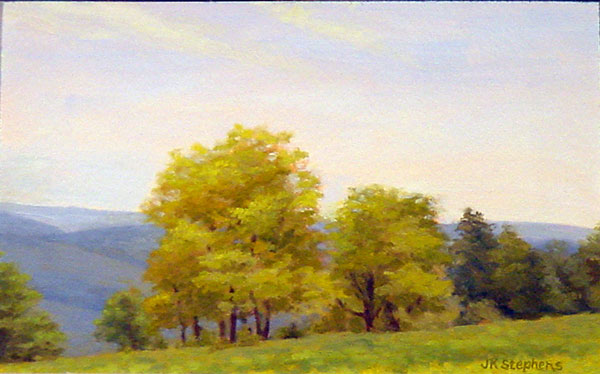 |
Spring Trees, oil on board, by Jean K. Stephens (image courtesy
Oxford Gallery)
|
A decade ago, Jean K.
Stephens was a respected Rochester landscape painter, with impeccable
technique born of a very disciplined mind and a passionate love of the land. I’d
heard she’d been through a painterly rite of passage; a mutual friend showed me
some abstractions she’d done that I found painfully honest. When I came across a
small nest
painting of hers at Shop One² at
Global Village recently, I wondered what made this seemingly established
painter give up what she knew, and perhaps more importantly, what she knew would
sell.
“I couldn’t not do
them,” she said of those early abstractions. She had undergone a process of
deep-tissue massage that, she said, brought her back to her birth experience. “I
woke up in the middle of the night and did something I never do: I just started
flinging paint. It was certainly not planned. It just spilled out that first
night,” she said. “The next morning I went in the studio and said, ‘What just
happened here?’”
What happened was more complex than a spiritual or
psychological discovery, since Stephens had recently moved, had entered
menopause, and had sold the rural property that had made her ‘big vista’
landscapes possible. Even as she’s moved past this work, she says it was and is
a “true expression of my feminine self.”
Stephens’ current work embraces both that feminine
expression and her capacity for realism. “I was in Maine with a bunch of
friends. We had rented a house and I was doing the typical plein air. On the
last day I looked down at my feet and said, ‘There’s the Great Mother!’ In our
trips to Maine, I had always loved the rocks, but I felt like this work was the
culmination of everything I had done to that point.”
So what happens when a painter known for her delicate,
luminous landscapes suddenly starts exhibiting rock paintings
that look like vaginas? “There’s always a risk in putting something different
on the wall,” acknowledges Stephens. “I can take that risk. I do the work for
me, but if people connect with it, that’s even better.”
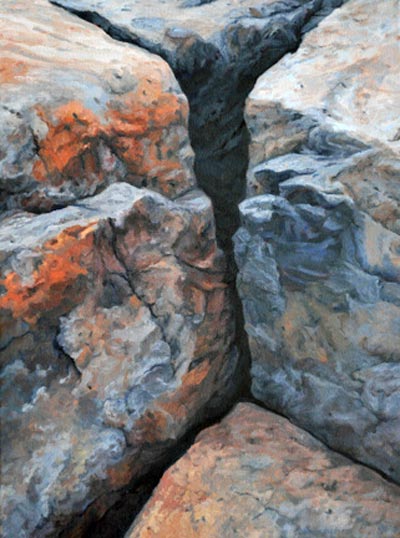 |
In and Out, oil on panel, by Jean K. Stephens (image courtesy of Oxford Gallery). The complete series can be seen here.
|
Zaglin expressed a similar sentiment. “While I want others to be connected with my
paintings I'm most interested in me being connected to my paintings. This year I
started caring less about what others thought and started trusting that I did
have a point of view.”
Last year was a time of personal crisis for Zaglin, and she thinks
the upheaval changed her work. “Afterward, I decided I was wasting time not
painting how and what I want,” she said. Which is, of course, true for all of
us.

2 comments:
Maine Milieu, with its cultural sensibilities, edges and vast sea/sky/mountains does evoke strong connection-- that is why it is a mecca for artists and those whose hearts and hands are farming, fishing or frolicking...
Here's a link that discusses the kind of shift and passion that your interview reflects: http://ecologywithoutnature.blogspot.com/2011/05/magical-causality-aboriginal-painting.html. It is about the "phenomenology of uncanniness" when an Aboriginal artist,Yukultji Napangati, who experienced major culture shock when leaving the bush,and captures dreams (of both her mother and herself) in her work. She doesn't capture the pictorial aspects of landscape, she finds the essence.
Napangati opens up to the patterns and paints: "owning you with its directives of sandhill, women, rituals, bush food, walking, singing, lines. You feel gripped by the throat with the passion of the imagery."
Glad you are back in the interview. More, please. P&L
When I was in Australia, the two 'schools' I found most compelling were the Heidelberg painters and the new Aboriginal painters. I was, in fact, just showing some of the latter to my student Brad Van Auken and will have to send this to him; he will greatly appreciate it.
Thanks for the kind comments.
Post a Comment