Paint Schoodic

To see more paintings, learn about workshops and classes, and more, visit my website.

Showing posts with label business of art. Show all posts

Wednesday, April 20, 2022

Selling paintings

What’s the next social media marketing trend?

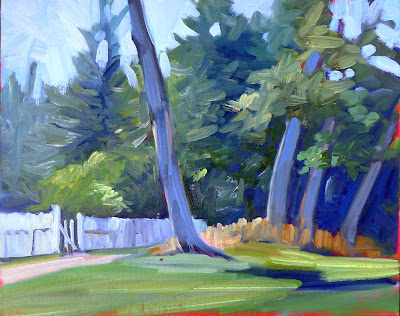
Main Street, Owls Head, available.

Last month I spent a few hours with Kicki Storm, who excitedly told me about the potential she saw in Instagram reels. I was buried in bubble-wrap at the time and more focused on getting a mountain of paintings into a U-Haul trailer. My pal Bobbi Heath, who carefully follows social media marketing, has talked to me about lookalike audiences for Facebook paid ads. I’ve tried them, but not to great success.

Ralph Waldo Emerson is credited with saying, “Build a better mousetrap, and the world will beat a path to your door.” I doubt that was true in the late 19th century and it’s certainly not true today. The successful artist has always had one eye focused on self-promotion.

Apple Tree with Swing, available.

Like you, I’m overcommitted, overstressed, and overwhelmed. There are lots of people out there interested in taking my advertising dollars, and I don’t have the market savvy to measure their claims. How do I negotiate this constantly-shifting landscape and still have time to paint?

The people who work in the field recommend that small businesses spend anywhere from 7-8% of their gross revenue on marketing. In actual fact, small businesses tend to spend more like 3-5% of gross revenues on advertising. That includes everything to put out their message, such as website hosting, Mailchimp, and other recurring costs. But it also inevitably means paid ads.

Spending that kind of money when you’re starting out can seem overwhelming, and it’s tempting to fall back on organic social-media marketing, which—by the way—is invaluable. But it’s an inevitable part of growth that you’ll need to learn about paid advertising somewhere along the way. The trouble is, there’s no easily-digested textbook.

Owls Head Fishing Shacks, available.

I’m seeing a shift in my advertising results this year, a decline in response. This may be an economic problem, as there are worrisome issues that might give people pause about big-ticket purchases. But it’s enough of a shift that I’m looking at different ad platforms, including print media.

Ten years ago, I thought print advertising was moribund, but I’ve noticed that I see consistent results from the Maine Gallery Guide. That’s emboldened me to dip my toe back into other print advertising.

At the same time, the cost-per-click on Facebook continues to rise. According to Wordstream , the average cost-per-click is now $1.72. That may not be a big barrier to LL Bean, but it is to an artist.

What Facebook used to be able to do superlatively was target customers. However, a global shift toward consumer privacy has made Facebook targeting more difficult.

Belfast Harbor, available.

As Facebook has grown into the juggernaut it is today, fine artists are now too small a market-niche for targeting. There aren’t even categories of ‘landscape workshops’ or ‘plein air painting’ in their current interest groups. When we tell it to match for people who are ‘interested in art,’ that’s too broad a brush.

Where does this leave us? Looking elsewhere. And that includes niche publications directed at artists.

Years ago, Bobbi Heath told me to never neglect my own lists. This shift in marketing is a strong reminder to build up your own lists so you can market directly from them. And I’m the pot-calling-the-kettle-black on this, because I haven’t had a sign-up box on this blog since the start of the year. I’ll get to it, I swear.

Friday, April 8, 2022

Constant overdrive

My strategic plan for 2022 seems to be in tatters. That’s the price of constant overdrive.

Skylarking, 24X36, oil on canvas, available.

At the end of last year, pastor Quinton Self challenged us to stop with the busy work and focus on what matters. That includes moments of rest. He and I are the same psychological profile (with the test scores to prove it), so when he zings me in a sermon, I figure he’s also talking to himself. In February, when he’d just finished a fast-paced, five-week teaching program on top of his other work, I asked him: “so, how’s that Sabbath rest thing going for you, PQ?” He smiled. It’s a constitutional problem for both of us.

Every year recently I’ve said, “this is the latest I’ve ever done my taxes.” This year’s record will stand. I can’t get much later and not file for an extension. That’s a terrible idea; it just prolongs the agony. What’s scary is that I didn’t even think about taxes until I was flying back from Phoenix two weeks ago.

Breaking Storm, 48X30, oil on canvas, available.

I had coffee with my Canadian pal Poppy Balser last week. I don’t really envy our Canadian neighbors their economic system. However, when I’m calculating income tax, I wish we could streamline our ponderous system and replace it with something like theirs. As a sole proprietor, I keep records on all kinds of things that are irrelevant to the average taxpayer—household repairs, utility bills, and the cost of operating my car.

It’s time-consuming and tedious, and I’m good with numbers. I can’t imagine what it’s like for my math-phobic fellow artists.

Admin is the curse of all sole proprietors. We write our own ads, maintain our own websites, do our own strategic planning, keep books, and somehow churn out a product. I am, for some reason, drowning in admin right now.

Wreck of the SS Ethie, 18X24, oil on canvas, available.

“Did I ever send you the materials for next year’s ad?” I asked Anthony Anderson of the Maine Gallery Guide yesterday. No, he replied, but if I can get it to him next week, I’ll be fine. I could hire my student Lori Galan or my old friend Victoria Brzustowicz to lay it out for me. Either of them would probably forgive me my hair-raising lateness. However, I don’t even have a clue what I want to say. And that ad is the most important one I’ll run all year.

Being in constant overdrive is corrosive. It forces a person to be reactive, batting balls back out as fast as they come in. Instead, intelligent people are proactive, thinking out a strategy and sticking with it.

I did that at the beginning of the year, by the way. It’s in tatters.

Beautiful Dream, 12X16, oil on birch panel, available.

But help is on the way. When we’re in overload, things have a way of falling on us and slowing us down. Another Canadian artist friend, Cathy LaChance, put it very succinctly when she was diagnosed with COVID this week: “My turn to be forced to rest.”

Call it the Universe, if you want; I prefer to credit God with this good design. 

The problem with frenetic people is that we are sometimes so busy we can’t hear the “still small voice” of God. That’s why it is often accompanied by the wind and earthquake (or COVID)—to get our attention.

I’d rather not wait that long.

Wednesday, March 16, 2022

Is painting dead?

Despite predictions to the contrary, paintings and books haven’t been replaced by their digital analogs.

Vineyard, Carol L. Douglas, 40X30, oil on canvas.

Yesterday I heard from Sedona Arts Center that my workshop there is sold out. Schoodic and my first section in the Adirondacks are also sold out. (Of course, that still leaves a lot of options all over the country, so don’t imagine you’re free of me—yet.)

But it is part of a bigger trend, and one that points out my current dilemma: teaching is fundamentally limited by the instructor’s stamina and time. I can teach about seven six-week Zoom sessions a year, and they are usually full. Between them and my workshops, I can give one-on-one instruction to a maximum of 300 students a year. That’s if there are no returning students, which there always are. And that’s while maintaining a killer pace, one I’m unlikely to sustain for many more years.

Tom Sawyer's Fence, Carol L. Douglas, available.

Teaching, as any person who’s done it can tell you, is very much a bespoke industry. It’s individual and personal. As I think about ways to reach larger audiences, I know that I will be sacrificing that intimacy in the process.

This blog started as an exercise in spreading instruction to a broader audience. By their nature, blogs are simply not well-organized or easy to search. Although I’ve covered everything you need to know in the fifteen years I’ve been writing, it takes good research skills to ferret out specific information, especially as I’ve shifted platforms a few times.

The downside of social media is that it has an incredibly short lifespan. As of 2021 it was estimated to be:

  • Twitter: 15 minutes
  • TikTok & Snapchat: Start decaying immediately unless viral
  • Facebook: 6 hours
  • Instagram: 48 hours
  • LinkedIn: 24 hours
  • YouTube: 20 days or more
  • Pinterest: 4 months
  • Blog Post: Over a year

That means few of us are getting past the headlines—or the advertisements. Some platforms, like Twitter, Facebook and LinkedIn, are gatekeepers for more incisive writing, but most social media posts are simple snapshots.

Bracken Fern, Carol L. Douglas, 9X12, oil on archival canvasboard

Americans now overwhelmingly get their news from digital media. In a recent Pew survey, 65% of respondents said they rarely read printed news. At the same time, only 20% of Americans are willing to pay for online news. That means most of us are getting our information in some kind of recycled format. Ouch.

Magazines are doing slightly better, but are still in decline. Print subscription circulations have fallen by 7% over the past two years, while single-copy sales are down 11%. The exception is specialty magazines, dedicated to niche audiences.

Best Buds, Carol L. Douglas, 11X14, oil on canvasboard

On the other hand, industry watchers were confident that book publishing would be moribund by 2022, and that hasn’t happened. Books remain a $27 billion industry in 2022. That compares to e-books, at $3 billion and—weirdly—sliding. Clearly, people perversely cling to reading on paper.

For art books, paper remains the only way to go. I can’t imagine curling up with my phone and browsing a text on Wayne Thiebaud, for example. His luscious, thick paint looks great in life. It looks decent with modern printing technology; it disappears on my computer screen.

In the same way, there’s something about handmade art that cannot be replaced with digital analogs. People have lots of time for digital media—movies, snapshots, television and video—but when it comes to hanging fine art on their walls, they like the feeling of hand-craft. Total sales of art photography were just $80 million in an art market of $64 billion in 2019—and in decline. Despite 137 years of commercially-viable photography, painters and printmakers aren’t obsolete. I have a feeling it’s not going to happen.

Friday, January 28, 2022

It was the best of tomes, it was the worst of tomes

I’m flailing around in the undergrowth in this new-to-me medium.

In Control (Grace and her Unicorn), oil on canvas, 24X30, is heading to Rye Arts Center for the month of March.

Last fall, I made the commitment that I’d spend a day a week this winter writing a painting book. That should be easy; after all, I’ve been blogging on the subject since 2007 on this platform (and still earlier on WordPress). I’ve almost as much experience as a writer as I have as a painter. Writing is an ‘unconsciously competent’ skill for me, or so I thought.

I have an outline and a plan. That’s the writerly equivalent of a value sketch, right? If I continue with the model of painting, I should then rough out each chapter (my underpainting, in big shapes), and then do a final pass for details.

Saran Wrap Cynic, 24X20, is heading to Rye Arts Center for the month of March

I’m not finding it works that way. I keep forgetting where I am, so I stop to reread what I already have. I then get sucked into editing. But if I forge ahead without checking my place, I inevitably repeat myself.

I need illustrations, especially of the exercises, so I stop to paint them. That’s probably a mistake, but I’m unsure of myself, blundering ahead.

I’m not clear on how long this book should be. I’ve gotten about 9500 words so far, and you, dear student, have just learned how to transfer your sketch to canvas. Arthur Wesley Dow wrote an exhaustive painting book, but I don’t think that will work for modern readers. We like looking at pictures.

Pinkie, pastel, 6X8, is heading to Rye Arts Center for the month of March.

After major surgery eight years ago, I amused myself during my recovery by writing a novel. I had no trouble leaving the hero on the edge of a precipice, taking a nap, and then jumping back to his rescue. Perhaps it was because I was temporarily benched with few other distractions.

I realized that writing just one day a week gives me too much time to forget what I’ve done. I’ve ramped that up to two days a week—just temporarily, mind you, until I find my groove. That’s definitely helped, but it wipes out any time I have for actual painting. Teaching currently occupies the better part of two days. Marketing owns another.

Ten years ago, I’d have felt terrible about that, as if I was a poseur—someone who talks the talk but doesn’t walk the walk. Right now, I’m treating it like a necessary evil, and taking my joy in painting the examples for the book.

The paintings are nestled all snug in their beds...

But, if after this predicted Nor’easter passes, one of my buddies texts me and says, “Carol, let’s go paint snow,” I’m outta here in a flash.

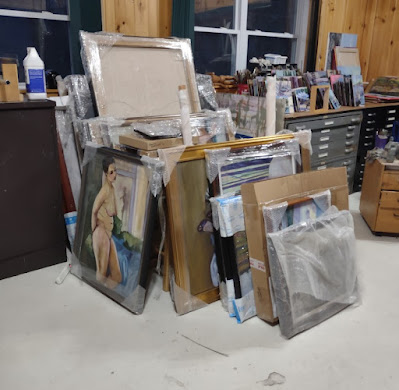
This week, curator Kicki Storm and I worked out the layout for my upcoming show at the Rye Art Center. The paintings are packed and waiting in the middle of my studio. The trailer is ready to roll. I’m chuffed to see these paintings heading down to a larger audience. If you’re on my mailing list, I’ll be sending you out the video tomorrow. If not, why not? Email me here, and I’ll fix that.

Friday, January 14, 2022

The glamorous life of an artist

It’s easy to forget I’m a painter when I’m up to my elbows in minutiae, but it has to be done. Still, so does painting or I’ve lost my raison d'etre.

Clary Hill Blueberry Barrens, Carol L. Douglas. This is one of the pieces I've decided (provisionally) should go to New York. Until I change my mind again, that is.

I’ve taken to carrying my to-do list around on my phone. This is probably good organizationally, but it burns a hole in my pocket. As is the way with to-do lists, it never gets any shorter. The advantage of lists on paper is that they’re easier to lose.

I had a visitor in my studio at the first of the year. “I’m drowning in admin,” I told her, as an explanation for the disorder. She’s a successful businesswoman and was, frankly, incredulous. “Admin what?” she asked. After all, I’m an artist. Everyone knows art isn’t about business.

At least they're neat. That's not always true.

In fact, it’s totally about business. That’s something you need to know if you’re contemplating crossing from amateur and professional status. It’s about taxes and inventory and planning shows a year or more in advance. It’s very easy to fall into a trap where your painting occupies less and less of your time, while you become more of an entrepreneur. If you want to make a living as an artist, the business of art has to be front-and-center in your consciousness.

I talked to Ken DeWaard on Wednesday. He was booting around Port Clyde looking at stuff (an important part of the plein air painter’s job, and best done with a cup of gas-station coffee in hand). I was torn. It was heavily overcast and pissing snow. On the other hand, talking to him was the closest I’d gotten to a brush all week.

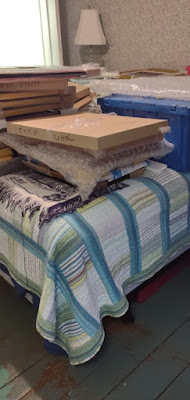
There's a queen-sized bed under all that stuff. By the time I was done, I had paintings stacked in all three bedrooms and the bathroom.

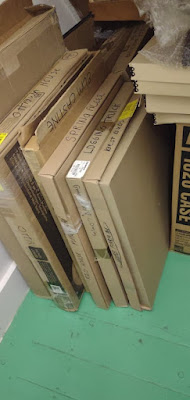
I was pulling every single painting out of my storage closets, choosing inventory for an upcoming show at the Rye Art Center in New York. It doesn’t open until March, but a good solo or duo show requires a lot of advance preparation. The paintings—which are huge—have come down to my studio, where their frames will get a beady-eyed examination before they’re wrapped for shipping.

Tom and Peggy Root have a show at Ringling College, called Parallel Visions: The Paintings of Tom + Peggy Root. “I told the art handlers that if somewhere in Georgia they are overtaken by a car with flashing lights, it just means I've changed my mind again about another painting,” said Tom. That indecision is a powerful impulse.

Once art gets to a certain point, ‘good’ or ‘bad’ or ‘brilliant’ is irrelevant. The real question is whether they support the narrative. Then there is the question of how the work will hang together. Paintings have to get along with their neighbors.

Meanwhile, the fiscal year has ended. People ask me why I do my own taxes. I counter that the tax preparation is the easy part (and I have Laura Turner to answer all my esoteric questions). It’s the record keeping that kills me. Today my 2019 records go up in the attic, to be replaced by pristine 2022 folders. It’s easy, but it takes time.

Sometimes all you have time for is a quick watercolor doodle, but that's better than nothing.

It’s easy to forget I’m a painter when I’m up to my elbows in minutiae, but it has to be done. Still, so does painting or I’ve lost my raison d'etre.

After I talked to Ken, I gave myself a good shake and went into my studio, where I spent 15 minutes with my watercolors, doing a quick-and dirty-sketch for 45 Day Triple Watercolor Challenge. That’s a Facebook group my students started last year to get us out of the doldrums. If I don’t need it right now, who does?

Friday, August 27, 2021

Painting after retirement

What’s the good of self-discipline if you can’t even figure out a plan? And the plan itself requires time, attention and work.

Morning at Spruce Head, 8x10 oil on canvas, $522 unframed. This was a class demo on color management, and I wish you could see all the color swirling through it, but my camera insists on flattening it out.

“I just cannot seem to create structure in my life now that it really is up to me and not something imposed by work or child-rearing,” wrote a student. “A—is doing great on her own. She’s launched into adulthood and all that entails. Bittersweet. And now for me to create my next chapter. Yikes.”

I’ve floundered several times in my life. When I transitioned to painting full time, I had no idea how to create artwork that wasn’t paired with words. I illustrated two books before realizing that children’s literature wasn’t my métier.

Many people grapple with issues of organization after retirement. Some fail. My father had passionate avocations, including painting. All his life, he managed to squeeze them into his free time. But upon retirement, he simple wasn’t able to organize himself. He found himself rooted to the spot, getting progressively more depressed and less productive.

Rosy sky at Owls Head, 8x16, oil on linenboard, $722 unframed.

I plan—like Wayne Thiebaud and Lois Dodd—to work into my dotage. That makes me singularly unqualified to give advice about retirement to anyone.

But making a good retirement seems—to me—to be much like self-employment. Obviously, you don’t need to work 80 hours a week, but you do need to create order, process and clarity in your day-to-day existence.

I’ve been self-employed since I was thirty. I vividly remember that feeling of shock when I sat down to my spiffy, brand-new computer (that I’d borrowed to buy) and realized that I had to go get customers, estimate the jobs and do the work, all on my own. I was terrified at the prospect of making sales calls. Knowing how to do the work is the first prerequisite to self-employment, but hardly the most important thing. The entrepreneurial spirit is more important and more elusive.

Skylarking II, oil on linen,18 x 24 inches, $1,855 unframed. 

I’m the grandchild of the Great Depression. I came of age during double-digit unemployment in my hometown of Buffalo, NY. I have all the traits of a successful wage slave—keep your head down, show up on time, do your work responsibly, don’t call in sick, don’t quit one job until you have another. None of them prepared me for self-employment.

A strong work ethic is a start, but deep passion is more important. Art is as much a calling as it is a job. That’s the only thing that takes you through the lean years.

As a one-man shop, I constantly struggle with questions of organization. I find a to-do list helps, but at this point in the summer, I’m hopelessly muddled and behind. I cannot work without structure, so I make structure a priority. But what’s the good of self-discipline if you can’t even figure out a plan? My mistake when I started out was not realizing that the plan itself required time, attention and work. I got it in the end, but more thought at the beginning would have saved me a lot of flailing around.

A certain amount of cheerful competitiveness helps. It keeps your eyes focused on what the people around you are doing, which helps you see the path to excellence for yourself. That requires the courage to assess yourself squarely against others. You can either be envious and bitter that they’re ‘better’ than you, or you can learn from them. The choice is yours, but to me it’s a no-brainer.

Friday, May 28, 2021

Open-air gallery opens

Growth in painting sales is almost all online, which means that we either learn a new way of doing things, or we retire.

Belfast Harbor, 18x14, oil on canvasboard, Carol L. Douglas

This weekend my open-air gallery at 394 Commercial Street opens for the season. It’s a soft opening, meaning that the brilliant Aubrie Powell isn’t making any noshes (sorry about that). I’ve been so busy painting that I forgot to do any advance marketing. Them’s the travails of a one-man show.

To make up for that, I’m having a 25% off sale. Yes, that’s any painting in the gallery, including my newest work. That’s an unheard-of discount, only made possible because I’m my own boss. Traditional galleries don’t have sales. That’s because they operate on a consignment basis. They must clear discounts with every artist they represent. In addition to that being a daunting task, artists operate on notoriously narrow margins.

Why am I still doing open-air when COVID restrictions are ending? I found I like the warm light, soft breezes off Rockport harbor, and the less-restrictive space of my side yard. My former gallery space is now rigged up as a Zoom teaching studio. COVID changed my workflow permanently. It drastically winnowed my galleries. I especially rue the closure of Kelpie Gallery in Thomaston and Maine Farmland Trust Gallery in Belfast. Both were wonderful galleries with curatorial vision and purpose.

COVID showed us the weakness of the traditional gallery model. Growth in painting sales is almost all online, which means that we either learn a new way of doing things, or we retire gently into the night. I’m not ready to go there yet.

Beautiful Dream (Rockport), 16x12, oil on birch, Carol L. Douglas

One thing I do not miss is getting damaged frames back from events and galleries. I spent a long time on Thursday taking adhesive labels off the backs of frames and this afternoon I’ll be touching up dings. Anyone dealing with art should know to not use tape or other permanent adhesives anywhere on a painting or its frame. Thank goodness for Goo-Gone.

My summer hours will be:

  • Monday—open this Memorial Day, otherwise closed
  • Tuesday—noon-6
  • Wednesday—noon-6
  • Thursday—1:30-6
  • Friday—noon-6
  • Saturday—noon-6

You can text or call me at 585-201-1558, or message me here.

Fish Shacks, Owl's Head, 14x11, oil on canvasboard, Carol L. Douglas

Thursday’s opening is later because I teach plein air in the mornings.

As you all know, I teach a variety of workshops, in Acadia National Park, Arizona, New Mexico, Wyoming, Florida, and right here in Maine aboard the schooner American Eagle. That’s enough to satisfy anyone’s wanderlust, but for those who are looking for something here in the Rockland area, I want to recommend two of my plein air buddies.

Eric Jacobsen is new in town, but a familiar face on the national art scene. He will be teaching Painting Expressive Landscapes through Coastal Maine Workshops from July 13-16. Ken DeWaard will be teaching Design! Essence! Design! there from August 9 to 13.

I paint with these guys frequently and I know their character well. They’re patient and kind and they know their craft, so I’m sure they’re good teachers.

Wednesday, April 7, 2021

Signs of recovery?

The post-COVID world is uncharted territory. Navigating it successfully will require local knowledge and lots of common sense.

Blueberry Barrens, 24X36, oil on canvas, Carol L. Douglas

Easter Sunday was the anniversary of my arrival back from our ill-starred trip to Argentina. I left one America and returned to another. It was a nation largely without toilet paper. A year later, the phrase ‘flatten the curve’ is mostly forgotten. We still don’t know how we’re going to reintegrate our society, but the possibility seems to be there.

My mother was a fan of investment guru Peter Lynch He was famous for the phrase, “invest in what you know.” Lynch believed in the street-smarts of Average Joe. He thought individual investors were potentially more capable stock-pickers than fund managers, because they could see the impact of new products on their day-to-day lives. (On the other hand, he famously bought Dunkin’ Donuts stock because he liked their coffee, so he wasn’t always right.)

Bridle path, 11X14, oil on canvasboard, Carol L. Douglas

Any small gallery or artist in business after a year of COVID is navigating uncharted waters. Our local knowledge and our street smarts are going to stand us in good stead, if we listen to that inner voice called ‘common sense.’

I started teaching virtually on April 28 with the coaching and encouragement of my friend Mary Byrom. The following month, I bought an annual subscription to Zoom. It’s had a tremendous return on investment. For most of the past year, my two classes have been waitlist-only.

Best buds, 11X14, oil on canvasboard, available.

Lynch’s worldview was, in fact, borne out in a small way in this tiny niche business. Long before the big art publishers realized the market for virtual learning, teachers like Mary and me were teaching on Zoom.

As I approach the one-year anniversary of my virtual classes, I’m seeing a slight softening of demand. My street smarts are tingling again.

  • Is this the beginning of a return to normal, where we take classes in real life?
  • Have bigger vendors vacuumed up the demand for virtual instruction?
  • Does the approach of good weather mean people would rather paint outside?
In a slippery landscape, we must tread carefully. We should understand why there’s a shift before we start reacting (if indeed any response is necessary). But I’m cautiously hopeful that this is a tiny step toward normalcy, where we can go to school, church, and each other’s’ homes with the free-and-easy nonchalance of the past.

By the way, there are two openings in Monday night’s session starting next week. If you’re interested there’s more information here.

Wednesday, March 24, 2021

Another gallery bites the dust

The galleries and artists who will succeed now are the ones who can sail the internet, constantly shifting tack and adjusting their sails.

Blueberry Barrens, Clary Hill,  oil on canvas, 24X30, available.

This week I learned that a fine coastal Maine gallery, associated with two other exhibition spaces besides its home shop in Belfast, is closing this Friday. Their gallerist, whom I like and admire, is now unemployed.

This gallery had a good reputation among knowledgeable art connoisseurs, but was hampered by its physical space. It simply could not host visitors in a safe, socially-distanced manner. Maine’s business season is ruthlessly short, so they wisely closed before the season opened.

Bracken Fern, 9X12, oil on canvasboard, available.

This is the third gallery I’ve been associated with that’s closed since the start of the pandemic. I’m not taking credit; it’s the times. But I’ve hated to watch them close.

I was halfway through writing this when I received an email cancelling a plein air event for the second year in a row. “The driving force is finding hosts for our artist friends who travel great distances... In addition, we cannot be sure what restrictions will be lifted, or re-enforced come July 1,” wrote the organizer.

Let’s be brutally frank here: it’s unlikely that the events or galleries that miss a second season will survive. Their customers will move on to other venues, other products, and other interests. 

Beaver Dam, oil on canvasboard, 11X14, available.

These changes are no surprise to those who watch the art market. Although no systematic count has been made of attrition in galleries, the American art market is estimated to have shrunk 24% during 2020. That’s the worst contraction since the crash of 2008. There’s one light in all this, but it’s a dim one: online sales doubled in 2020. It’s clearly the direction in which art sales are moving.

"Build a better mousetrap, and the world will beat a path to your door" is a quote attributed to Ralph Waldo Emerson. It may have been true in the 19th century, when economies were local, but it’s not true now. In modern America, the quality of your product is no more important than your marketing skills.

Home Farm, oil on canvasboard, 20X24, available.

That marketing happens increasingly on social media. The difficulty is that social media is relatively new, so it is constantly being tweaked. Its constantly-shifting algorithms mean that yesterday’s strategy won’t work today.

Compared to most artists, I know a lot about digital marketing. That’s not very good, because compared to the worst-run big box store, I know almost nothing at all. I’m a one-woman shop, and I don’t have all day to research and tinker with my website, email, blog and Instagram. I can’t even fix the deficiencies I know about, because I also need to paint.

But I know that the galleries and artists who will succeed now are the ones who can sail the internet, constantly shifting tack and adjusting their sails. There is no other answer.

Friday, March 12, 2021

Artist with the soul of an accountant

There are some unique lessons to be found in the detritus of our COVID-year returns.

Cerro Fitz Roy and Cerro Electrico, painted in my extended sojourn in Patagonia last year. Available.

I like to tell people I'm an artist with the soul of accountant. This isn't really true; I'm just making fun of my painting. I hate bookkeeping as much as the next guy.

This time of year, my accountant friend Laura Turner is doing a lot of tax returns. She likes it because each one is a small bit of history. I don’t share her enthusiasm for slogging through the minutiae of the tax code (which changes constantly), but auditing your own books does take you back.

Last year I wrote a lot of refund checks—$4,550.40 worth, to be precise. These were deposits for workshops, and they all went in a flurry in late Spring, as we realized the world was not going to open back up again. They represented future payments as well. Compared to others, my losses were small, but for me they were painful.

Cliffs, painted in Patagonia last year. Available.

My computer tells me to whom I issued those refunds. More than 80% of them turned around and bought something else from me during 2020—another workshop, a class, or a painting. There’s a lesson in that, one we can learn from our retail neighbors.

Modern big-box stores are open and easy about taking returns. Buy it, take it home and contemplate it. If you don’t like it, return it. My late friend Gwendolyn used to call it “buying on the American plan,” which tells you it’s not universal. It’s possible here because these retailers work in volumes so large that the cost of this goodwill gesture is relatively small.

Powerhouse on the Rio Blanco, painted in Patagonia last year. Available.

That is not true for the sole proprietor, whose operation may include unrecoverable deposits and expenses. But it’s still a good idea to issue refunds cheerfully when you can. It establishes your integrity and goodwill.

I’m conservative by nature. I prefer to do business as I always have. But in April 2020, I was forced to rethink that. Every gallery I did business with was closed, either permanently or temporarily.

I made my first diffident step in buying a license for something called ‘Zoom’. By June, I was confident enough to convert that to an annual license. It was the best investment I’ve ever made.

Rain, painted in Patagonia last year. Available.

That month, I also bought a party tent and opened an ad hoc gallery in my driveway. I went on to have the best sales year I’ve ever had. Nobody is more surprised about that than me, but it speaks to a second essential truth: we usually have to be smacked upside the head to make positive change.

I think citizens should prepare their own tax returns so they have a notion of how the tax code actually works. My fellow Americans don’t agree; in 2018, only 43% of electronic filers did their own returns. Even those who use a tax preparer are responsible for laying out the bones of their story. Garbage in, garbage out, as they say.

I always hover above the ‘send’ key for a few moments, hoping I’ve remembered every important thing. Itemized returns are never perfect; there are always bits and bobs you mislaid and just don’t recall. But hopefully, I’ve written it more as a memoir and less as a novel.

Friday, February 12, 2021

You want to be a professional artist—are you sure?

Every artist, if he or she is completely honest, has two parallel thoughts going at once: the first says, “I am the greatest genius in the history of painting,” and the second says, “I totally and completely suck.”

Skylarking, by Carol L. Douglas, 24X36, available.

If I can get my social media specialist to manage the admin, I’m going to do an online workshop on going professional. That means how to sell work, how to present yourself, how to use social media to advertise, and where and when to show. But before you sign up, I want you to consider carefully whether or not you really want to go that route.

My friend Nancy is a retired art teacher and an excellent painter. A few years ago, she asked me how she can sell paintings. Honestly, I can’t believe that the sheer grind of selling will make her happy, when she has so many other things occupying her time: a husband, grandkids, friends, travel. Selling is a tremendous amount of work. And it doesn’t validate the quality of her work—that stands on its own.

Midsummer, by Carol L. Douglas, 24X36, available.

I spend at least half my time on marketing. It’s what the experts say you can expect. In addition, I pay someone to do some of my online marketing for me. I’m still always behind. For example, my website is in dire need of updating. The successful painter is first and foremost an entrepreneur, not a painter. You work long hours, have your finger in everything, and nothing is ever finished.

I’ve been painting since I was a child, and I can honestly say that nothing else is closer to my ‘true’ work. However, I spent years avoiding becoming a professional because I didn’t believe I could make a living doing it. I’m happy to have proved myself wrong. But it’s been difficult. I had no models for entrepreneurism. I’ve had to figure it out by trial and error.

Ottawa House, by Carol L. Douglas, 14X18, available

I’m not sorry I made the transition. Honestly, I don’t have many other marketable skills. However, there’s one thing that’s changed for me. I no longer paint for the pure joy of it, but as part of an effort to create and develop a business.

Does that make me insincere? I don’t think so. Every painting is a communication between the artist and his audience. Sometimes, the way the audience says, “I love it” is by getting out its collective checkbook. Nobody questions that when a musician cuts a best-selling album, but for some reason painters can beat themselves up about selling out.

Jack Pine, by Carol L. Douglas, 8X10, available. 

There are moments in every job that are tremendously rewarding. I didn’t begrudge my doctor his fee because he fist-bumped me when he finally figured out that I had cancer. I love hard work myself. My favorite job after painting was waitressing. Should I not have been paid because I had a good time doing it? That would be nuts. But there is that perception about the arts in general, that we’re having too good a time to justify a paycheck.

The marketplace can be very cruel. Every artist, if he or she is completely honest, has two parallel thoughts going at once: the first says, “I am the greatest genius in the history of painting,” and the second says, “I totally and completely suck.”

To succeed, you need to silence those voices. Instead, just tell yourself, “I have a product, and I’ll test whether there’s a market for it.” As personal as painting is, you’ll suffer if you let the marketplace be a referendum on your inner self.

Friday, December 4, 2020

The Power of Ten

A strong work ethic is a good thing, but sometimes it gets in the way of our real work.

Soft September Morning, by Carol L. Douglas.

Everyone has bad weeks, including me, although I’m usually so annoyingly chipper that it’s hard to tell. This week was a challenge to my sang froid; nothing major (thank God) but a concatenation of little things.

I started the week feeling bloated and out of sorts from too much holiday. My studio is a mess. Then there are the usual stresses of the Christmas season. Like many of us, I suspect, I went back to work on Monday morning in a deflated mood.

On Monday night, I managed to drop my still life—a pie plate filled with water and warm wax—directly into my laptop’s keyboard. I turned it over and shook out the water. My students are smarter than me; they told me to stop our Zoom class and dry out my laptop. My long-suffering technical support department (my husband) disassembled and dried it for me. Other than the sound and mouse, it appears to be working. However, since both of these things are critical, I’ve got a new laptop in my near future.

Add five or six more tealights, then dump in your keyboard. It turned out to be a lousy idea in so many ways.

Of course, I wasted hours of our time. And that made me grumpy. It’s backed up, but shopping for a replacement and recreating a work environment is no simple matter. In the past, this might have thrown me for days.

The Power of Ten is a simple game I play with myself to overcome a bad mood, inertia or paralysis. If I’m facing a mountain of laundry, I tell myself I’ll fold ten items. If my dining room table is covered with papers, I tell myself to file ten of them.

Mess? What mess?

This is not a way to fool myself into doing more; I do stop at ten. It’s a method of staring down what gets in the way of my real work. Like everyone else, I’m the product (in part) of my childhood programming. A strong work ethic is a good thing, but sometimes it gets in our way. Mine tells me I have to finish my chores before I can paint. Doing just a little work gives me permission to ignore the bigger mess.

Taken into the studio, that means I pick up and put away ten things. My suitcase on the floor that still has stuff from my Tallahassee workshop? That counts as six items, once I’ve put them back where they belong. The pile of frames that Colin Page gave me? That will be eight of today’s items.

Over a week, of course, I’ve managed to put away fifty items. Imperceptibly, order is being restored. More importantly, I’ve not stopped and spent a day cleaning my studio; instead, I’ve painted.

My ten brush strokes took the form of branches on this canvas, which I keep around just for fun.

My problem Tuesday was not just disorder, but worry and distraction about my laptop. That can completely derail me. So, I applied a variation of the Power of Ten to my palette. First, I laid out fresh paints; that always helps. Then I told myself I could make just ten brushstrokes. Voila! I’d eased the transition to real work.

Ten brushstrokes is a great limit when you’re having trouble concentrating. It’s also helpful when you’re confused about how to finish a painting. It makes you stop and think intentionally about each mark you make. That stops you from noodling, which has been the death of many fine paintings. Limit yourself, and see how quickly your mind zeroes in on the real issues.

Wednesday, August 12, 2020

Confidence is key for women artists

Do you allow yourself to believe you’re good at what you do? If not, why not?

Campbell's Field, by Carol L. Douglas. At the time I painted this, I thought I was a pretty poor painter. 

I rudely eavesdropped on a conversation about negotiating salary. The speaker, thirty-something, was describing input from friends and family. “Dad said, ‘ask for the highest figure in their range,’ and Steve said, ‘ask for $5000 more.’” The negotiator—a woman—asked for $1500 more. She low-balled herself. At her age, I would have done worse. I’d have meekly accepted whatever was put on the table.

The gender pay gap is more complicated than simple sexism. It starts with college graduates’ first jobs. Part of this is based on the college tracks women prefer (non-STEM) but part of it is simple confidence. The responsibility for that rests with us, as women. No manager has ever insisted that a candidate take more than what was first offered.

Bridle path, by Carol L. Douglas. Same vintage.

The confidence gap is even more of a challenge in the art world, where success is based on selling oneself. Frankly, women are lousy at it. I’ve written hereherehereherehere, and here about gender disparity in the art world, and it hasn’t gotten any better. The gap between men’s and women’s pay in the arts is worse than it is in the economy as a whole. That’s a clue that the gender gap is about far more than just majoring in STEM subjects.

My daughter and her husband have turned job stereotypes on their head. She’s a computer programmer; he’s a social worker. “When she knows she’s excellent at something, she’s very confident about it,” he says. That is new. As a recent college graduate, she was unsure. She allowed herself to be hired at the bottom of the pay range. She’s wised up and is working to narrow that.

Upper and Middle Falls, Letchworth, by Carol L. Douglas.

I often tell people I only know how to do two things well, and one of them is not cooking. I can paint, and I can write and teach about painting. In those narrow tracks, I’m competent. More importantly, I know it.

But I wasn’t always that way. Paintings I did twenty years ago are no less accomplished than my paintings today (albeit in a different style). Why did I feel then that I was a poseur and today I feel capable? What has changed?

In part, I was influenced by what others said about me. There are supportive communities and others that subtly undercut our self-esteem. Think back through recent interactions with your peers. Did they encourage you to take risks, or float good ideas for improvements? Or do they subtly discourage you? If the latter, perhaps you need new friends. (Family is not so easy to change, unfortunately.)

Lower Falls, Letchworth, by Carol L. Douglas

Sometimes the person who smack-talks you is not your so-called friend, it’s you, yourself. Your inner monologue has a critical impact on your confidence. Try to listen to your own commentary and analyze it dispassionately. If you find yourself constantly running yourself down, stop and redirect those thoughts.

Start by intentionally choosing a posture of thankfulness. I know of no more powerful tool to reframe our attitudes. In giving thanks, we focus on what’s right and good, rather than on what’s broken.

Women, in particular, are trained to be modest about their achievements. But there’s a fine line between humility and self-effacing meekness. Confident people take credit for their own achievements—to themselves as well as to others. As a teacher, I’ve noticed that people who were successful and confident in their careers bring that expectation of success into painting.

If you don’t have that, don’t despair. Instead, challenge yourself in some area that’s far outside your experience. Doing something risky and difficult is a great way to start to understand your own strength. The time I’ve spent alone in the wilderness has been a powerful spur to my own self-confidence. We send boys to camp to get filthy and learn to start fires without matches; we don’t send our daughters. We should.

Women are trained to be helpers and—as I mentioned before—that can be a trap. But it’s also a strength we can build on. I have found mentoring to be a great spur to my self-confidence, if for no other reason than that the people I’ve mentored admire me.

But there’s something to be said for plain old age. I think in some ways I’ve simply outlasted my insecurities. They’re exhausting, and at this age I have better things to do with my time.