Most of us use a mixture of modern and antique colors. We stand on the shoulders of giants, after all.
 |
| Best Buds, by Carol L. Douglas. Available. Like most modern artists, my palette is a combination of historic and modern colors. |
Minerals have been used as pigments since prehistory. What
our ancestors did with color is largely a mystery, but pigments and paint-grinding
equipment dating between 350,000 and 400,000 years old have been found in a
cave in Zambia.
Most of these earliest colors are warm, and most are named
after cities where they were mined and milled. Thus we have the siennas, from Siena, Italy, and the umbers,
from Umbria. Siennas are
warmer and lighter than umbers; the difference comes from the introduction of manganese to the umbers,
either naturally or in the milling process.
 |
| Vineyard, by Carol L. Douglas. Available. This painting could have been executed in purely mineral pigments, but it was not. |
This ancient family of pigments also includes red and yellow ochre. What they all have in common is the presence of iron oxide. In its most common form, that’s plain old rust.
The last pigment our prehistoric ancestors used was charcoal,
which they discovered along with fire. That comes down to us as modern ‘carbon
black.’
There is one cool pigment that was available to the ancients:
the semi-precious stone lapis
lazuli. This comes down to us as the pigment ultramarine blue, so named
because it came from ‘beyond the sea’. Needless to say, when you were grinding
up the family jewels for color, you used it sparingly.
 |
| Striping, by Carol L. Douglas. Available. The search for blue drove pigment synthesis. |
That limited palette frustrated our intrepid ancestors as much as it would frustrate us today. They experimented with synthesizing pigments as early as 2000 BC. The earliest of these synthetic pigments were Egyptian Blue, which we still only imperfectly understand, and lead white. By the time of the Renaissance, vermilion, verdigris, and lead-tin-yellow had been added to the paint box. These were made from mercury, copper and lead, and were all deadly.
Indian yellow is another pre-modern pigment. Legend
had it being produced from the urine of cattle on the Indian sub-continent. Its
actual source remains a mystery. Unlike its modern analog, it was fugitive
(meaning it faded).
The expense and rarity of lapis lazuli drove the discovery
of modern blue pigments. Prussian
blue was discovered by accident in 1704, and ultramarine was being
synthesized by the turn of the 19th century. Cobalt (cobalt and
aluminum) and cerulean (cobalt
and copper) blues are about the same vintage. I’m vastly oversimplifying here,
but scientists were tinkering with the whole notion of chemistry, mixing up minerals
to see what happened. And a lot of what happened were new pigments.
 |
| Marshall Point rocks, by Carol L. Douglas. Available. Impressionism would not have been possible without modern chemistry. |
In 1856, William Henry Perkin was attempting to make a cure for malaria when he accidentally created the first aniline dye, mauveine. This was the forerunner of hundreds of synthetic dyes and pigments, and the basis of modern organic chemistry.
It is no coincidence that Impressionism was
invented simultaneously with organic chemistry. It would not have been possible
without the new colors being synthesized in the laboratory.
The last explosion of color happened with mass
industrialization in the 20th century, as science searched for
coatings for steel. While cadmium
has been known as a pigment since the 1840s, it was rare. It wasn’t until
industrial chemistry found a way to isolate the metal in the 1930s that cadmium
became cheap enough to use as a pigment. Phthalo
blue is another pigment that is a by-product of industrial science.
Everything I know about color history comes from Philip Ball’s
Bright
Earth: Art and the Invention of Color, and Victoria Finlay’s Color:
a Natural History of the Palette. Of the two, I prefer the former, but both
are good reads.
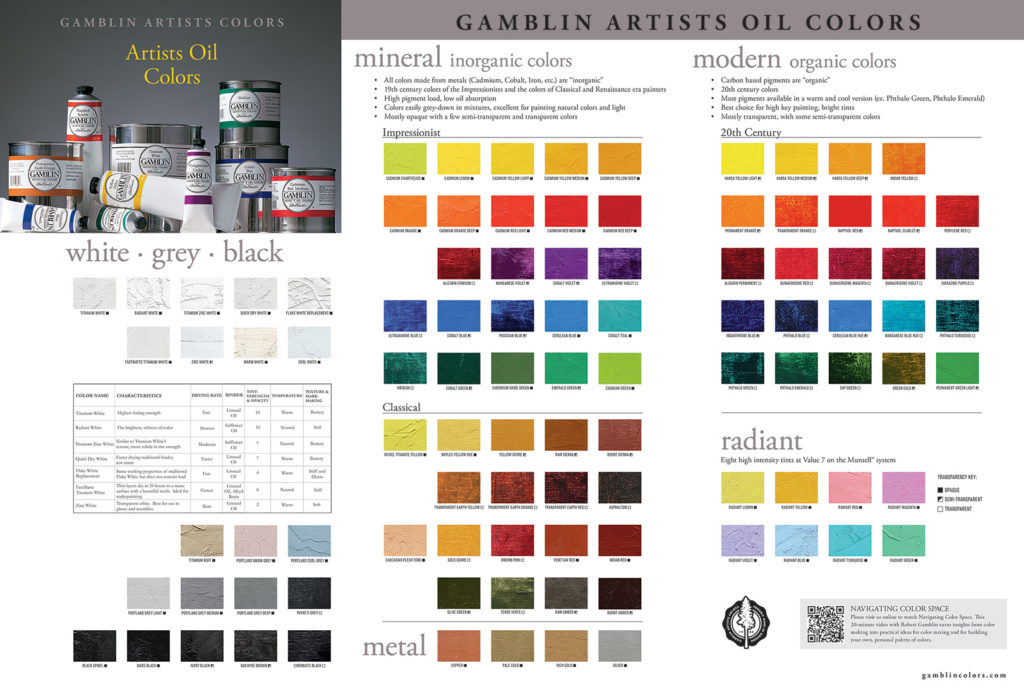
Gamblin publishes an excellent
chart of colors, classified as either mineral (Impressionist and Classical)
and organic (20th century). Your assignment is to look through your
paint box and list where your paints came from. Are they:
- Classical
- Impressionist
- 20th Century
If you’re using a classical palette, it will probably be made
of modern pigments, because most of the toxic or rare older colors have been
replaced. But these analogs have been designed to mimic the historic colors as
closely as possible.
If you’re trying to paint like Rembrandt, but are using Van
Gogh’s palette, you’re going to fail. Rembrandt painted indirectly, in
transparent layers, and Van Gogh painted alla prima. You need to match
your paints to your desired outcome.
That doesn’t mean that every pigment you use has to slavishly
match some historic period. Most of us use a mixture of mineral and organic colors.
We stand on the shoulders of giants, after all.