Paint Schoodic

To see more paintings, learn about workshops and classes, and more, visit my website.

Showing posts with label Age of Sail workshop. Show all posts

Wednesday, July 6, 2022

Change is an inevitable part of growth, but it’s not easy

We like certainty, but plans are to some extent illusory; things can and do change in an instant.
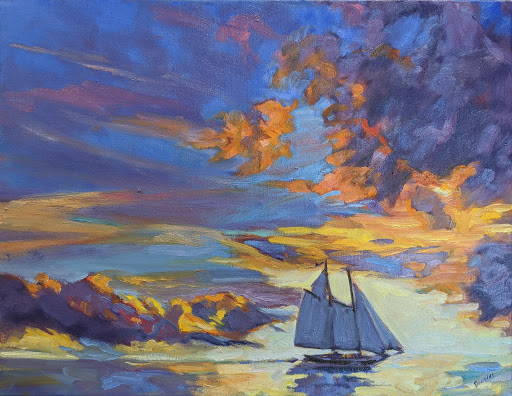
Sunset sail, 16X20, oil on canvas, Carol L. Douglas, available.

I’ve noticed a strange split this year—my east coast workshops are sold out, and my western ones are languishing. To be completely accurate, my Acadia workshop has sold out 1.5 times, because as people made plane and car reservations, they realized the difficulty and expense of travel to smaller markets. They dropped out and were replaced by others on my waiting list. I’m extremely blessed to have had a waiting list.

That list is now exhausted. I have a last-minute opening at my Acadia Sea & Sky workshop (July 31-August 5, 2022), because one of my students is waiting on a nitrogen oxide sensor and microchip for his GM truck. As GM has nearly 100,000 vehicles sitting in lots waiting for microchips, my optimism is dimming. I told him I’d ask if anyone wants his seat, so if you’re interested in a last-minute jaunt to Maine, let me know.

Owl's Head Early Morning, 8X16, oil on canvas, available.

This strange year, by the way, is not limited to just me, or to the painting workshop market. I’ve talked to people across the tourist industry in England and Maine and heard much the same laments. There’s an international labor shortage and things are still topsy-turvy from COVID.

It’s not that business is down—it’s not—it’s that it’s spotty and weird. We each have our own explanation. I’m hearing a lot about travel concerns, particularly the cost of rental cars. Another teacher says Zoom is killing his workshops. It’s easier to stay home and learn on one’s laptop.

Skylarking 2, 18X24, oil on linen, available.

At this point in the summer, my workshop schedule should be set in stone, but instead I’ve been dithering about my western workshops. After much agonizing (and advertising) I’ve decided to cancel Steamboat Springs and Cody.

That leaves only Gateway to the Pecos Wilderness, August 28-September 2. I kept it because it’s accessed through a major airport (Albuquerque), where I’ve found car rentals to be manageable.

Equally importantly, Our Lady of Guadalupe Abbey, which has inexpensive accommodations, did not burn down in the Hermit’s Peak wildfires this spring. I wish that last sentence was a joke, but this year has been a wild ride.

Beautiful Dream, 12X16, oil on canvasboard, available.

Lastly, there’s my second watercolor Age of Sail workshop aboard the schooner American Eagle, September 18-22. Although I’d have said Captain John Foss was irreplaceable, he’s made a mighty good stab at it in his replacement, Captain Tyler King. Tyler has the same equable temperament and top-notch sailing skills as John. When Tyler turns 70, I’ll be 107, and it will be time for both of us to retire.

Change is, of course, an inevitable part of growth, but it’s not easy. We like certainty, but plans are to some extent illusory; things can and do change in an instant. By not traveling so much in September, I’m making room for other opportunities. I can hardly wait!

Friday, September 24, 2021

Just another day in paradise

I’m not much of a photographer, but this trip inspired me to try.

Sunset, approaching our home-away-from-home, the schooner American Eagle.

The northeast’s best season is autumn, and we rolled into it while I was teaching aboard schooner American Eagle. Warm sun, blue skies, and light breezes meant that I kept telling myself, “I wish I could bottle this and save it for winter.” That, of course, is impossible. Instead, I soaked it up as well as I could.

Schooner Heritage soaking up the last of the sun at Pulpit Harbor.

This was my last workshop of calendar year 2021. I’m pretty chuffed at how well all my students have painted all year, and this week has been no exception.

Tidal flats on an unoccupied island. The beach is washed clean twice a day.

A photo is a poor approximation of an experience, but that and our memories are all we generally come home with. (Of course, my students also bring home paintings.)

The sky created crazy beautiful effects.

I’m not much of a photographer to start with. I tend to snap and let the pieces fall where they may. I don’t generally even pick up my cell phone when I’m painting. That’s not a philosophy, it’s sheer cussedness. I’ve had to ask Ken DeWaard if he has pictures after we’ve painted somewhere together.

Lobsterboat coming home at dusk to Isleford harbor.

This sailing trip was different. I came home with dozens of snaps on my cellphone. The sky constantly shifted its optical effects. Our fellow windjammers flew against a backdrop of blue-against-blue. Harbor porpoises wheeled alongside our boat. We stopped at Little Cranberry Island and walked its peaceful streets.

Bell buoy and the Bass Harbor Light.

Next week, we start a new session of Zoom and plein air classes. If you meant to enroll but haven’t, I have limited openings:

  • Monday nights, 6-9 PM EST, there is one seat left.
  • Tuesday mornings, 10 AM-1 PM EST, there are three seats left.
  • Local plein air, Thursday mornings, 10 AM-1 PM EST, there are many seats left.

If you want more information or to register, email me.

There are times when the ocean appears to be made of aluminum foil.


Friday, June 18, 2021

Welcome back to real life

Sailing is a great disperser of cares.

Practicing painting aboard American Eagle. What a fabulous group of students I had this trip!

I’m back from teaching watercolor aboard the schooner American Eagle—a little tanned, a little heavier (thanks, Matthew) and a whole lot more content.

Sailing is a great disperser of cares. You’re at one with the boat; you have to be, as ignoring her swings and rolls will cause you to fall down. That puts you totally in the moment, watching the sails, the waves, the shifts in air, and the amazing complexity of 19th century transport technology. Sail power is the original renewable energy resource. American Eagle has been ‘leave no trace’ since long before the slogan was thought up.

We all start at the beginning--how to mix color, how to see color, how to lay it down on the paper.

The gam—the annual raft-up of the windjammer fleet—was modified this year, as COVID made it unwise to scramble over each other’s boats. Instead, the windjammers dropped anchor near one another off Vinelhaven. A dinghy zipped around with grog. The captains devised a scavenger hunt over the water.

I have a crush on every boat, but I especially have a crush on American Eagle. She’s terrifically elegant and clean-limbed for a boat that started life as a fishing vessel.

Captain John Foss returning from the co-op with fresh lobster for our supper. 

I was rather surprised to see her little sister joining us. That was the Agnes & Dell, proudly flying the flag of Newfoundland and Labrador. She’s a smaller version of American Eagle, with the same proud curved prow and lovely rounded transom. At around 50 feet, she was being sailed by a crew of just two. That’s a manageable dream, I thought. My affections wavered just a tiny bit. But, no, as long as I get to sail twice a year on American Eagle, I don’t need a boat of my own.

Agnes & Dell was also built as a fishing schooner. She's almost as lovely as American Eagle.

At any rate, I was out there to teach watercolor, not moon over boats. It’s always a great time, and I’m blessed to be able to do it twice a year, in June and September. None of us knew how we were going to return from COVID, but this was a heartening start to a new season.

I had eight enthusiastic students. With a few exceptions, they’re all at the beginning of their artistic journey. It was a special privilege to help them with that. We painted, ate, and laughed—a lot. If you’re interested in the September trip, or any of my other workshops, check my website here. There are still openings.

Dorothy hard at work next to the memorial to quarry workers at Stonington. Even the toughest painters get shore leave. 

On the subject of returning to reality, post-COVID, I’m having an opening at my outdoor gallery on Saturday. Somewhere in the middle of winter I started painting regularly with Ken DeWaardEric Jacobsen, and Bjὂrn Runquist. Inevitably, that’s influenced the way I think about and approach my work.

I’m looking forward to sitting down and have a glass of wine with you and talking about the past year. It’s been a sea change for us all, and I want to hear about it from your side, as much as I want to show you it from my side.

Welcome Back to Real Life opens from 2-6 PM, Saturday, June 19 at Carol L. Douglas Studio at 394 Commercial Street in Rockport, ME. The gallery hours are Tuesday-Saturday, noon to 6. Or email me if you want to make an appointment.

Wednesday, February 24, 2021

Why we love boats

People see boats as symbols of the human experience, which is why they’re so potent in art.

Skylarking, 24X36, oil on canvas, by Carol L. Douglas. Available.

I recently got a floor-cleaning robot. I find myself talking to it, usually cooing as I do to the dog. But this week it’s been avoiding a spot near the kitchen door, and I lectured it. “Mom, are you getting mad at your Bissell spin-wave?” my son asked.

Anthropomorphism means our inclination to assign human characteristics and personalities to non-humans. The word was first used by Xenophanes, which tells us that the urge to anthropomorphize our stuff goes back to earliest man. It’s one thing to talk to your dog (who may or may not answer) and it’s another to talk to your floor-cleaning robot, or to converse with Alexa.

American Eagle in Drydock (the winch), Carol L. Douglas, 12X16, oil on canvasboard, available.

I’m hardly alone. Humans are hard-wired to understand and interact with other humans from birth. When we come across something non-human, our impulse is to interact in the human terms with which we’re most familiar.

Complex machines are relatively modern. It’s interesting that we overwhelmingly characterize them as female. That is, perhaps, a way of expressing trust in them (which is why it’s so important for car manufacturers to build ‘cute’ cars). Or, it’s possibly because they do our grunt work for us. Thanks, Mom.

Boats, on the other hand, are almost as old as humankind itself. We traditionally call them ‘she’, even when they’re named after a crusty old Admiral. The roots of this tradition are lost in the mists of time. It may come from the idea that a goddess protects and guides a particular ship (as in a figurehead). Or, it might be an artifact of a precursor language, where nouns had gender.

Breaking Storm, Carol L. Douglas, available through Folly Cove Fine Art.

But people see boats as symbols of the human experience, which is why they’re so potent in art. They sail through calm waters and storms. They narrowly escape destruction, or they are, in fact, wrecked on the shoals of misfortune. They are elegant and lean, floating on the breeze, or they’re stout little working boats like me.

Most of us spend far more time in cars and planes than we do in boats, but paintings of boats predominate in art. All three modes of transportation are elegant. All three have their romance. So why do people love boat paintings so much?

It’s, in part, tradition, but it’s also the confluence of wind, water and sky. Even without a vessel, the ocean is a pretty magical place.

Sunset sail, Carol L. Douglas, available through Folly Cove Fine Art.

A friend recently painted her first boat, and told me the experience left her flat. I laughed and said they were my favorite subject. She thought that she perhaps ought to take my boat workshop to understand why. That’s as good a lead-in as any to the idea of painting aboard the schooner American Eagle. I teach two workshops aboard her—in June and in September. The information is here.

But Ann might be disappointed, because we don’t focus on sails and rigging. Rather, it’s a sort of traveling-sketchbook experience, where we capture quicksilver impressions of the ever-changing, watery world of Penobscot Bay. It’s all about the light, and the light never changes more quickly than it does on the ocean.