Paint Schoodic

To see more paintings, learn about workshops and classes, and more, visit my website.

Showing posts with label change. Show all posts

Wednesday, July 6, 2022

Change is an inevitable part of growth, but it’s not easy

We like certainty, but plans are to some extent illusory; things can and do change in an instant.
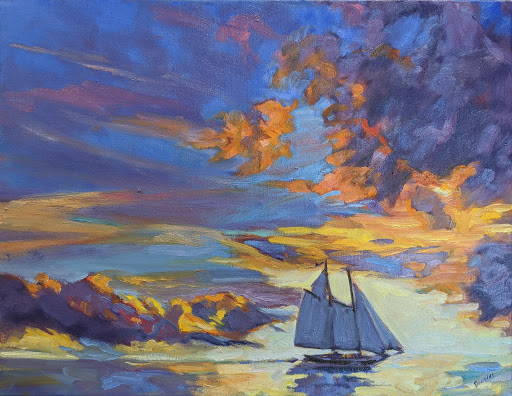
Sunset sail, 16X20, oil on canvas, Carol L. Douglas, available.

I’ve noticed a strange split this year—my east coast workshops are sold out, and my western ones are languishing. To be completely accurate, my Acadia workshop has sold out 1.5 times, because as people made plane and car reservations, they realized the difficulty and expense of travel to smaller markets. They dropped out and were replaced by others on my waiting list. I’m extremely blessed to have had a waiting list.

That list is now exhausted. I have a last-minute opening at my Acadia Sea & Sky workshop (July 31-August 5, 2022), because one of my students is waiting on a nitrogen oxide sensor and microchip for his GM truck. As GM has nearly 100,000 vehicles sitting in lots waiting for microchips, my optimism is dimming. I told him I’d ask if anyone wants his seat, so if you’re interested in a last-minute jaunt to Maine, let me know.

Owl's Head Early Morning, 8X16, oil on canvas, available.

This strange year, by the way, is not limited to just me, or to the painting workshop market. I’ve talked to people across the tourist industry in England and Maine and heard much the same laments. There’s an international labor shortage and things are still topsy-turvy from COVID.

It’s not that business is down—it’s not—it’s that it’s spotty and weird. We each have our own explanation. I’m hearing a lot about travel concerns, particularly the cost of rental cars. Another teacher says Zoom is killing his workshops. It’s easier to stay home and learn on one’s laptop.

Skylarking 2, 18X24, oil on linen, available.

At this point in the summer, my workshop schedule should be set in stone, but instead I’ve been dithering about my western workshops. After much agonizing (and advertising) I’ve decided to cancel Steamboat Springs and Cody.

That leaves only Gateway to the Pecos Wilderness, August 28-September 2. I kept it because it’s accessed through a major airport (Albuquerque), where I’ve found car rentals to be manageable.

Equally importantly, Our Lady of Guadalupe Abbey, which has inexpensive accommodations, did not burn down in the Hermit’s Peak wildfires this spring. I wish that last sentence was a joke, but this year has been a wild ride.

Beautiful Dream, 12X16, oil on canvasboard, available.

Lastly, there’s my second watercolor Age of Sail workshop aboard the schooner American Eagle, September 18-22. Although I’d have said Captain John Foss was irreplaceable, he’s made a mighty good stab at it in his replacement, Captain Tyler King. Tyler has the same equable temperament and top-notch sailing skills as John. When Tyler turns 70, I’ll be 107, and it will be time for both of us to retire.

Change is, of course, an inevitable part of growth, but it’s not easy. We like certainty, but plans are to some extent illusory; things can and do change in an instant. By not traveling so much in September, I’m making room for other opportunities. I can hardly wait!

Friday, April 1, 2022

Growth and change

How does one find one’s purpose as an artist? Should we build that into how we think about our work?

Ravening Wolves, 24X30, oil on canvas, is as close as I get to didacticism these days.

“How have you grown as a painter in the last ten years?” a student asked me.

My drawing and brushwork aren’t much different, but my color choices have certainly changed, as has my ability to relax into abstraction. That doesn’t seem like much growth for a decade’s work.

In intangible ways, however, I’ve changed a lot—I’m far less anxious about the outcome, and less didactic in my subject matter. I’ll never focus on figure as I was doing a decade ago. Although I’m proud of the work I did about women’s issues, I’ll never paint that subject again. Which reminds me: this is the last weekend you’ll see Censored and Poetic at the Rye Arts Center; it ends Saturday night.

Main Street, Owl’s Head, 16X20, oil on archival gessoboard

Ten years ago, I was still wrestling with the legitimacy of my calling. Those of you who were raised thinking that art wasn’t a ‘real’ career understand that. Today, I barely remember the question. I’m an artist because it’s all I know how to do.

Which leads me to the second question I received this week: “How does one find purpose? How have artists done it over time? Should we build that into how we think about our work?

“I see people at figure sessions banging out the exact same thing over and over. I get the impression, from talking to them, that they have been doing that, or variations of that, for years on end. And they aren't that good. Why do these people show up? Something to do?”

Spring Greens, 8x10, oil on canvasboard

I’m the last person to denigrate regular practice, and figure is one area where that is particularly important. If I had the time right now, I’d go to my local life drawing class myself. It’s good exercise and I like the people who attend.

But I have known people who never progress past that. They were taking classes 25 years ago and are still doing that today. Some are stuck because they have day jobs. Some aren’t that skilled but enjoy the process. Some are excellent painters, but uninterested in making it a career. Amateur status is nothing to be sneezed at.

I’ve also had students who’ve just gone through a major trauma—an unwanted divorce or job separation. They were floundering and it gave them an anchor. Creativity is cheaper than therapy and for many it serves as well. When they worked out their next step, they moved on from art.

Midnight at the Wood Lot, 12X16, oil on canvasboard

But there are always that few who want to make art their life’s work. For them, the question of artistic purpose is critical. It’s inextricably bound up in one’s life purpose. Your work ought to be an expression of your thoughts or feelings, or it’s meaningless.

When I was younger, I thought that my purpose was didactic. Today, I’d be hard-pressed to put my mission statement into words, but it has something to do with glorifying Creation and helping people feel connected to it. That’s tied to my faith, but I don’t feel a need to preach through my paintings.

That, too, may change as I get older. One’s mission and calling in life is fluid. The important thing is to have the tools at our disposal to answer whatever comes up. And that’s where all those weeks and years in art class come in.

Wednesday, January 12, 2022

May you live in interesting times

History runs in fits and starts. So does your artistic development.

Breaking Storm, Carol L. Douglas

“Scotch and soda, jigger of gin…” crooned my husband early one morning as we trekked over Beech Hill. That’s a Kingston Trio song from 1958. It set Doug to musing that music changed a lot more in the three decades from 1960 to 1990 than it did from 1990 to the present.

That’s how history works. It’s linear, but it runs in fits and starts. There are long periods of stasis and then periods of rapid change.

The decade I was born in gave us portable coolers, the polio vaccine and birth control pills. It also gave us the integrated circuit. That, of course, changed the world.

In recent decades we’ve been coasting, building incrementally on the gains of the Computer Age. Then, bam! COVID. Change often comes as a complete surprise. It’s also often messy, difficult and painful.

Coast Guard Inspection, Carol L. Douglas

The years 1346–51 brought the Black Death to Europe. That in turn brought the end of centuries under the feudal system. Similarly, the Chinese Cultural Revolution was a decade of brutal paroxysm that finally obliterated the rigid feudal system of old China. As bitter and awful as the two 20th century world wars were, they ushered in modern society. Few of the unwitting participants in these cataclysms enjoyed them, but all of us who follow have benefitted.

That’s true of artistic change as well. It can be, frankly, disheartening. We’re potting along painting in the usual way, feeling like we’re turning out good work, and suddenly something shifts. Everything we paint seems horrible to us.

Wreck of the SS Ethie, Carol L. Douglas

This is an inevitable rest-stop along any creative journey. It’s important, because it signifies growth. You have three possible paths out:

  • Scuttle back to what you were doing before;
  • Quit and do something else for a while;
  • Find ways to quiet that awful voice in your head.

Obviously, I recommend the third path, but the other two are very common (and self-limiting) reactions. How can you avoid them?

Remind yourself of a basic fact: you haven’t suddenly forgotten how to paint. Dissonance is part of growth. Even experiments that fail are valuable; they’re an essential part of the painting process.

Stop wiping out the canvases you don’t like. Sometimes a painting is uncomfortable to look at because it’s pointing the way forward. It can seem like an awkward outlier when you do it. Five years later, you realize it was a bellwether and the best thing you painted that year. You’ll blunt your development if you wipe out everything that makes you uncomfortable.

Don’t seek validation through your friends’ opinions. They’re unlikely to see the potential in an ungainly effort. In fact, group-norming of any kind can be deadly to change. This is no time to be assessing whether something is ‘good’ or ‘bad’—it’s time to simply produce a lot of work.

Beautiful Dream, Carol L. Douglas

Discomfort with change can sometimes result in paralysis. If that's you, try falling back on strict exercises that force you to stop thinking about results and start thinking about process. That’s where “painting a day” exercises are invaluable. If you don’t feel like joining a formal one, make one up for yourself.