 |
| A 16th century fountain after the traditional Artemis of the Ephesians, in Tivoli. |
In the Book of Acts, Luke records an incident where Ephesus
rioted against Paul’s preaching. It gives us a great snapshot of Roman
religious practice in the first century AD:
“He says that gods
made by human hands are no gods at all. There is danger not only that our
trade will lose its good name, but also that the temple of the great goddess
Artemis will be discredited; and the goddess herself, who is worshiped
throughout the province of Asia and the world, will be robbed of her divine
majesty.”
When they heard this,
they were furious and began shouting: “Great is Artemis of the Ephesians!” Soon
the whole city was in an uproar….
The city clerk quieted
the crowd and said: “Fellow Ephesians, doesn’t all the world know that the
city of Ephesus is the guardian of the temple of the great Artemis and of her
image, which fell from heaven? (Acts 19:23-41)
 |
| A first-century AD copy of the original wooden cult-figure of Artemis, now destroyed. No bow and arrows for this girl. |
The rioters were not calling her “great” merely because of
her position; it was part of her proper name, distinguishing her from all other
deities called Diana or Artemis.
Artemis of Ephesus most likely descends from a pre-Hellenic fertility image
whose origins are obscured by time. Thus the breasts. But the Greeks were syncretic thinkers, so it's no surprise that they rolled the heavy, fertile goddess into the lithe hunter and thought nothing of it.
Artemis of Ephesus was a big wheel in cult circles. Her temple was one of
the Seven Wonders of the World, and she was served by a whole coterie of
servants, including a hereditary priestess, female slaves, eunuch priests, and
young virgins. (Of passing interest is the fact that Kallimachos asserted that
Ephesus was founded by Amazons, a story that might have some garbled resonance in the importance of Artemis' cult there.)
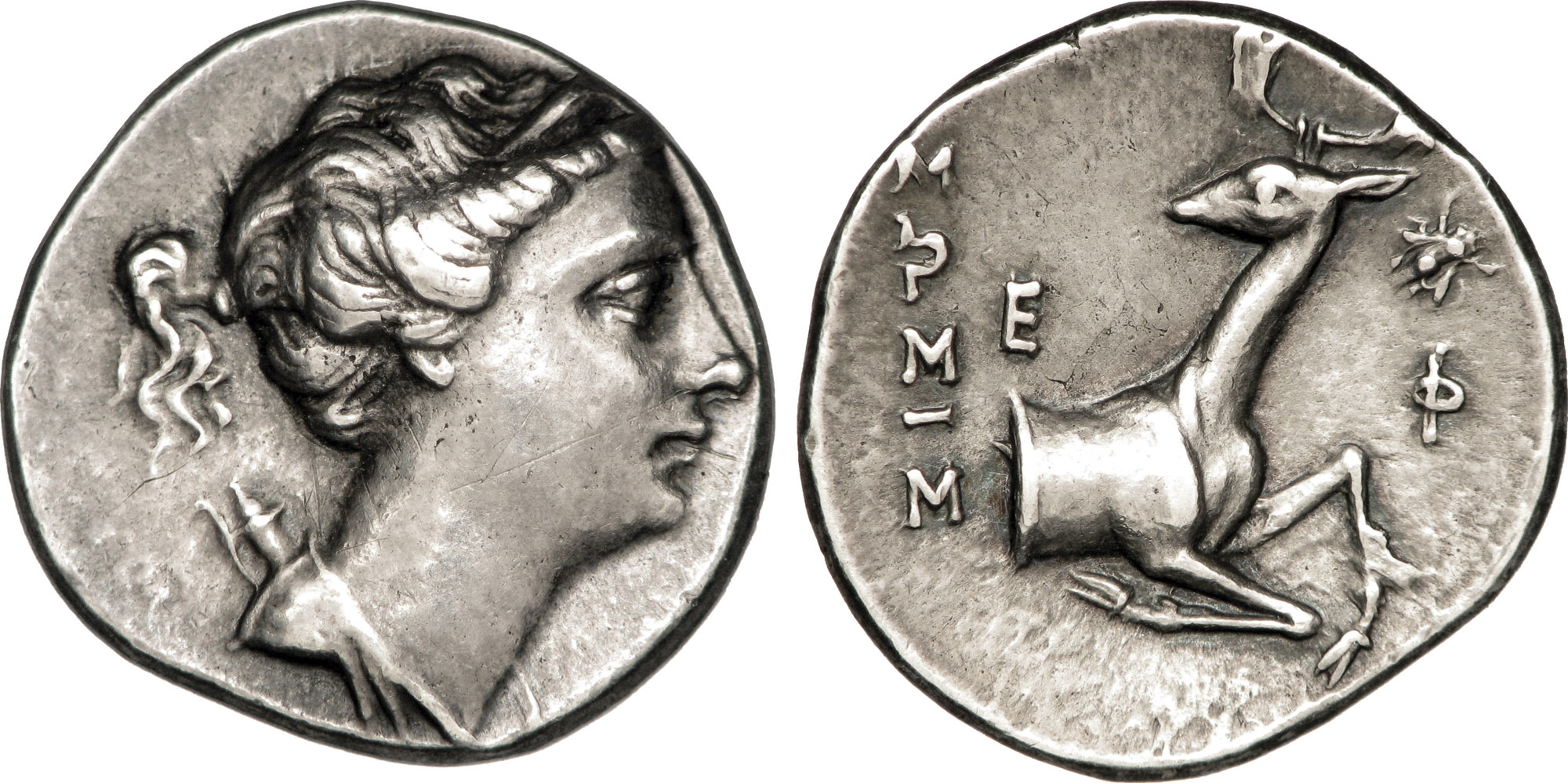 |
| Ephesian coin of Artemis, this time with her deer. |
Luke's account is the only written classical source for Artemis having fallen from the sky. However, “the image that fell from the sky” is a traditional
appellation for Zeus’s offspring. In some cases, it might mean that the
worshipped object was a meteorite, but since contemporary sources describe the lost
Artemis as wooden, that seems unlikely. This figure was destroyed by flood in
the eighth century AD. The images we have are copies. Perhaps their makers were among the very rioters Luke described in Acts.
Let me know if you’re interested in painting with me in Maine in 2014 or Rochester at any time. Click here for more information on my Maine workshops!
