Paint Schoodic

To see more paintings, learn about workshops and classes, and more, visit my website.

Showing posts with label Bjorn Runquist. Show all posts

Friday, December 10, 2021

In praise of large paintings

It’s a mistake to think of our large canvases as drugs on the market. They’re often the most important work we do.
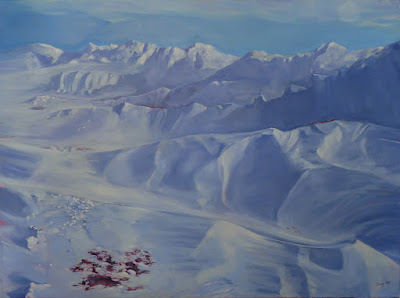
Winter Lambing, 36X48, oil on canvas, $6231 framed.

Björn Runquist told me about the perambulations of a large work, 72” high, as we hung paintings at Bangor Savings Bank yesterday. It takes time to sell a major painting, so it’s no surprise that his canvas is more well-traveled than some of my friends. Like actors, these big works ‘rest’ between gigs. They can take up almost as much house-room as a twenty-something between jobs.

My out-of-work canvases live in the closets of our guest room. That’s an improvement, because until this house, we didn’t have a guest room; we just had lots of bedrooms for our numerous children. Then, my inventory was stored behind a false wall in my room. It was the antithesis of House Beautiful, and it irritated me every time I saw it. My husband studied aesthetics as undergraduate, but it never bothered him. Go figure.
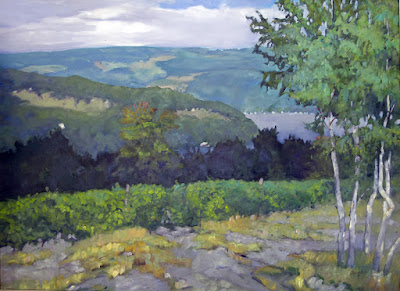
Vineyard, 30X40, oil on canvas, $5072 framed.

There are many large canvases in my storage, because I love to paint big: God + Man, which I did originally for a solo show at Roberts Wesleyan College, and a whole slew of nudes that were censored at Rochester Institute of Technology. The latter will be going to the Rye Arts Center in New York in March, for a duo show with sculptor Anne De Villemejane.

We artists love to paint big, but it’s easier to sell smaller paintings. They fit better on people’s walls, and they cost less money. Still, it’s a mistake to think of these large canvases as a drug on the market. Because they require such careful thought, they’re often the most important work we do. It makes sense to think of them as an asset that should be carefully rationed into the marketplace, rather than as large, bulky objects we trip over, that we’re only too happy to sell to the first comer.

Breaking Storm, 30X48, is available through the Camden Public Library this month.

Surplus art is our lot in life. For example, Ken DeWaard counted up the unfinished work in his studio at the end of the summer and announced he had something like 145 unfinished canvases in his studio. I haven’t counted mine, but it’s something similar; we’re like musicians in that we must constantly practice. We might finish or paint over them; we ruthlessly cull them before we show them, or we’d never have room for them all.

Between changing out the show at Camden Library and hanging paintings at the bank, I have moved a lot of paintings from place to place. It’s an excellent opportunity to bring the nudes out for an airing, as they need to be cleaned and rewrapped before they travel down to New York. “I hope you sell a lot of them!” my friend Marjean exclaimed. She’s speaking from the housewife’s standpoint here; she’d really like to see that closet better-organized.
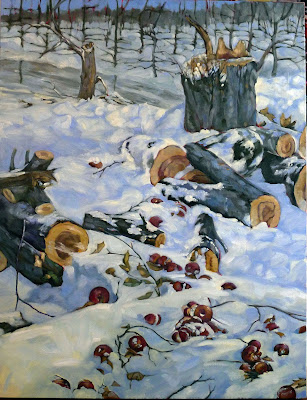
All Flesh is as Grass, 30X48, oil on canvas, $6231 framed.

I’m just thrilled to have an opportunity to show those paintings again. The lot of women worldwide wasn’t great when I painted them, and it hasn’t gotten any better. 

Meanwhile, I’ll be at Camden Public Library tomorrow from 1 to 3, for a reception for Fantastic Places and Magical Realms. The work ranges in size from 6X8 to 30X48, so there’s something suitable for every space and budget. Stop by and I’ll give you your Christmas treat.

Monday, July 26, 2021

Monday Morning Art School: simplifying values

Thinking about the landscape as a series of planes will help you create depth in your painting. 

Ice Bound Locks, John F. Carlson, courtesy Vose Galleries

When Eric Jacobsen told us that he was teaching the theory of angles and consequent values in his recent workshop, I was baffled by the big words. “What’s that when it’s at home?” I asked him. Ken DeWaard was equally confused, responding in a torrent of emojis.

“C’mon, guys, it’s John F. Carlson 101!” Eric exclaimed. Björn Runquist immediately checked, and announced that there was nothing about any angles on page 101. (Actually, it’s in chapter 3; I checked.)

It’s no wonder that Eric’s no longer returning our calls.

Sylvan Labyrinth, John F. Carlson, courtesy of Virginia Museum of Fine Arts

All kidding aside, Carlson’s Guide to Landscape Painting is a classic. His theory, although it has a high-flown title, is actually quite intelligible to even the meanest intellects (and you know who you are, guys).

“Every good picture is fundamentally an arrangement of three or four large masses,” Carlson began. That’s as good an organizing principle as any in art. Value is what makes form visible, so we should see, translate, simplify and organize form into value masses.

Carlson wrote that any landscape would contain four groups of values bouncing off three major planes:

  • The horizontal ground plane;
  • The angle plane represented by mountain slopes or rooftops;
  • The upright plane, which is perpendicular to the ground plane, such as trees.

In the middle of the day—our most common circumstance for painting—the value structure would be as follows:

  • The sky is our light source. It should be the highest value in our painting.
  • The ground plane gets the most light bouncing off it, so it should be the next-lightest plane.
  • The angle planes such as rooftops or mountain slopes, are the next lightest planes.
  • The upright objects in our painting, such as trees, walls or people, should be the darkest value element.

Snow Lyric, John F. Carlson, courtesy of The Athenaeum


That doesn't mean that the shapes are crudely simplified, as a glance at Carlson's own paintings confirms. The shapes can be beautiful, elegant, complex, and lyrical without too much value overlap.

Thinking about the landscape as a series of planes will help you create depth in your painting. However, it can be tricky to see the landscape as a series of planes rather than objects. It can be helpful to keep each value group completely separate, with no overlap of values, but, in reality, there will always be overlap.

Your assignment is to find a photo among your own snapshots and reduce it to a series of four values. Then paint it.

As you try to integrate this idea into your painting, exaggerate the separation of planes.

Of course, there are many circumstances where this doesn’t hold true—where the sky is leaden and darker than a snow plane, or when the fading evening light is hitting the vertical plane rather than the ground. But understanding it will help you paint the exceptions in a more arresting way.