 |
| Portrait of King George III, 1779, by Sir Joshua Reynolds |
The Age of Revolution was a time of great change in the
intellectual and political life of Europe and America. Portrait
painting—previously considered an inferior art—rose in prominence. On the one
hand, portraits reached a peak of representational virtuosity. At the same time,
they became overwhelmingly symbol-laden and propagandistic.
The majority of Europe still lived under kings who ruled by
Divine Right. Those kings generally were painted in the full splendor of their
office, with their authority spelled out with symbols like crown, scepter and
orb.
 |
| Portrait of Queen Charlotte in Her Coronation Robes, 1779, by Sir Joshua Reynolds |
Alone among his fellow monarchs, George III’s Divine Right
had been clipped by the British Constitution. His authority was also inevitably reduced by the
loss of the American colonies. Sir Joshua Reynolds’ portrait of him shows him overwhelmed
by his coronation robes and by the looming darkness of Westminster Abbey.
Likewise the character of Queen Charlotte in her matching portrait is reduced despite
her royal setting. She is restrained and modest; in short, a model housewife of
her period.
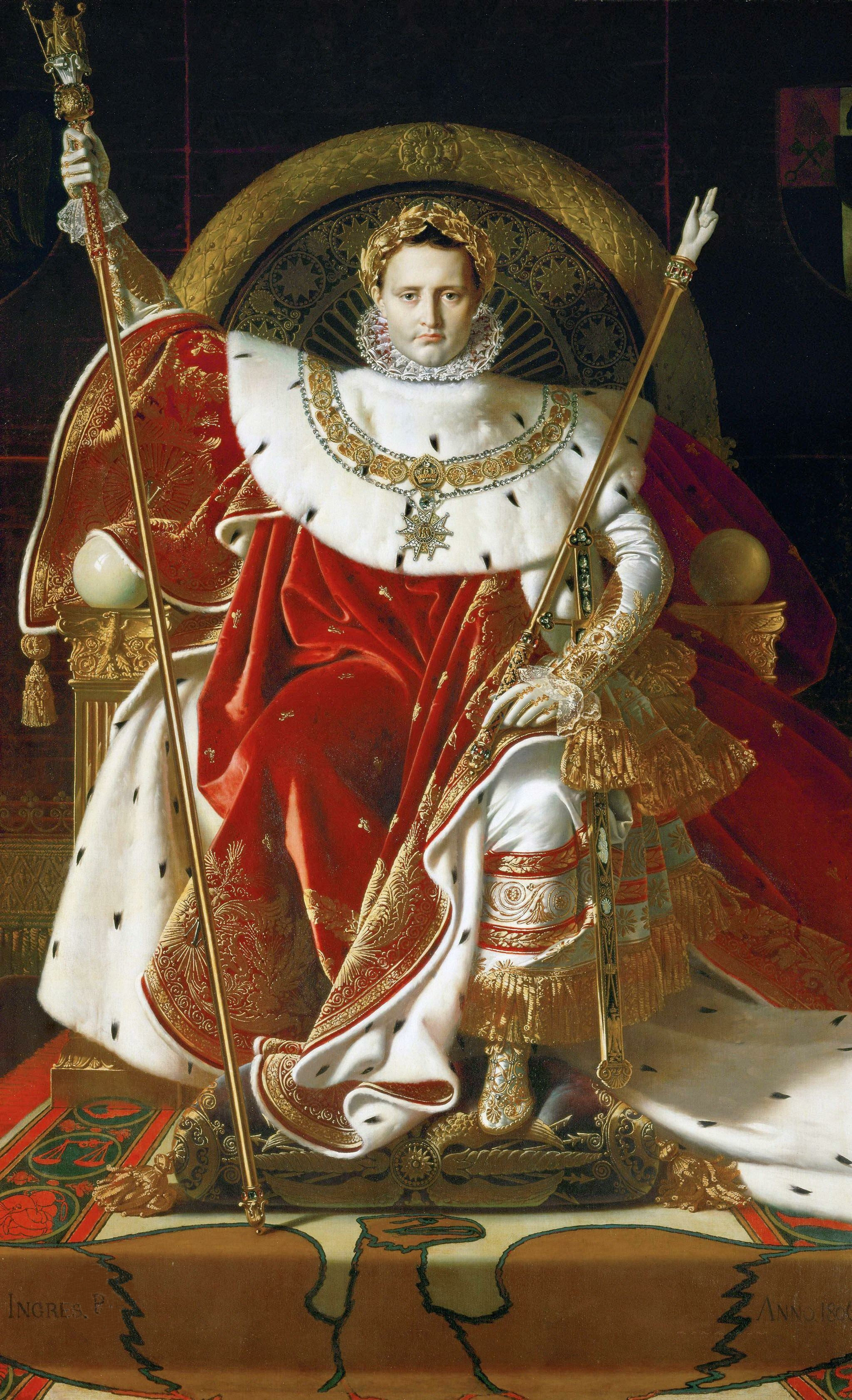 |
| Napoleon on his Imperial throne, Jean-Auguste-Dominique Ingres, 1806 |
Contrast this with the power and authority radiating from Jean-Auguste-Dominique
Ingres’ radical, domineering portrait of Napoleon Bonaparte. Ingres drew together
an absurd variety of classical allusions to lend credibility to the upstart
Emperor of France.
In his right hand Napoleon holds Charlemagne’s scepter; in
his left is the hand of justice. He is
crowned with Caesar’s golden laurel wreath. His ermine hood, velvet cloak, and
satin tunic all conjure imperial imagery, as does the eagle on the carpet
beneath his feet. Because the Ghent Altarpiece was in the Louvre at the time
Ingres painted, it is presumed that he modeled the pose on its central figure, The
Almighty.
.jpg) |
| George Washington (Lansdowne Portrait), 1796, by Gilbert Stuart |
Gilbert Stuart, the image-maker for the new American states,
chose the opposite symbolism to portray George Washington, showing him as a
sober and industrious workman creating a new age. In the new democracy, crown
has morphed into cockaded hat, orb and scepter into a dress sword representing
democracy. The rule of law is paramount,
represented by both the books and the pen and paper on his desk.
This week I am writing about portrait painting during the late 18th and early 19th centuries. These posts are based closely on the Royal Academy of Art’s 2007
show, Citizens and Kings: Portraits in
the Age of Revolution, 1760-1830.
Let me know if you’re
interested in painting with me in Maine in 2014 or Rochester at any time.
Click here for
more information on my Maine workshops!

