 |
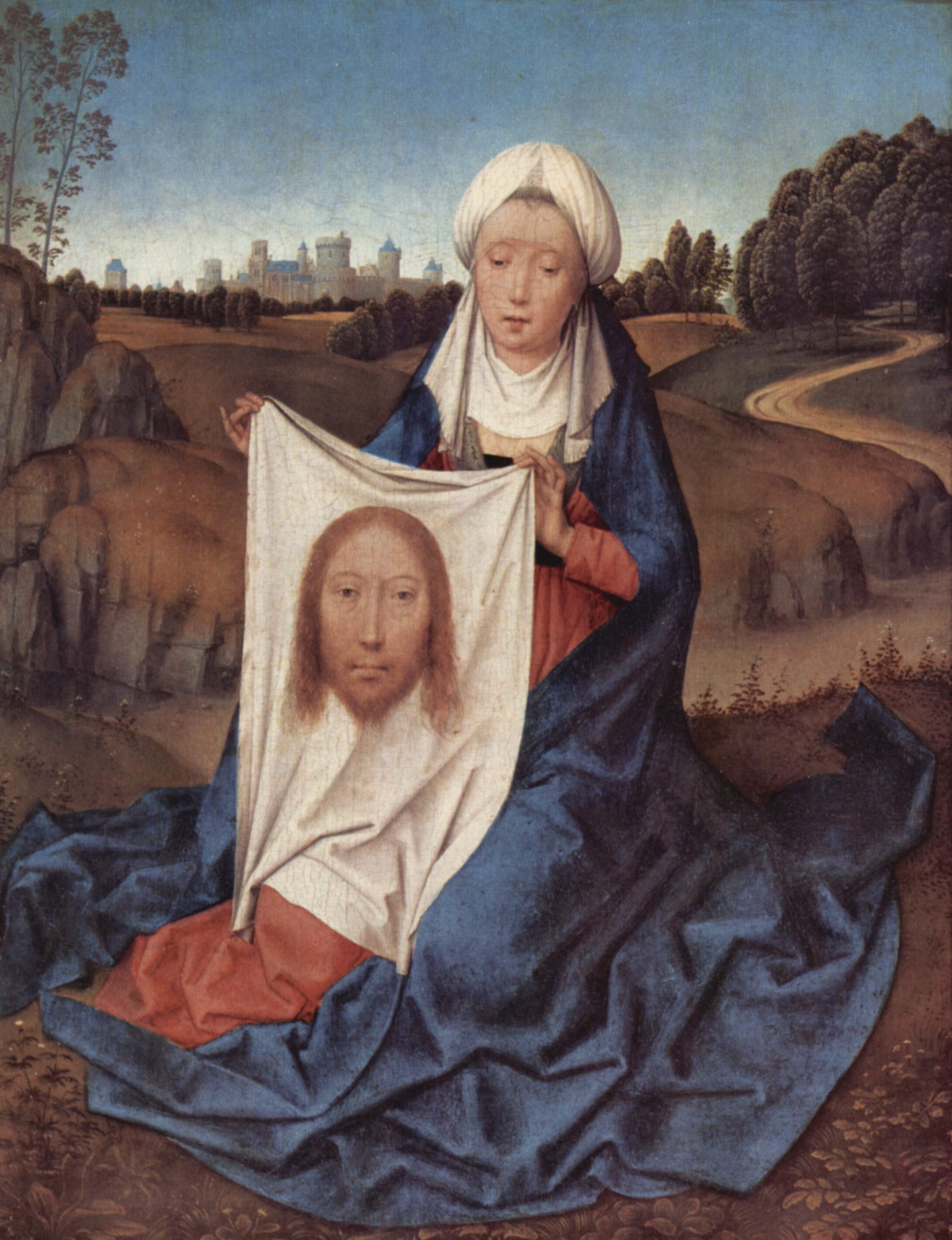
Diptych with Saint John the Baptist and St. Veronica, right panel,
by Hans Memling, c. 1470.
|
Nothing divides the Christian world faster than the subject
of idols. Protestants generally follow Clement of Alexandria, who wrote, “For
we are not to delineate the faces of idols, we who are prohibited to cleave to
them; nor a sword, nor a bow, following as we do, peace; nor drinking-cups, being
temperate.”
Catholic and Orthodox believers generally follow St. Basil
the Great, who asked, “If I point to a statue of Caesar and ask you ‘Who is
that?’ your answer would properly be, ‘It is Caesar.’ When you say such you do
not mean that the stone itself is Caesar, but rather, the name and honor you
ascribe to the statue passes over to the original, the archetype, Caesar
himself.”
Icon-painters follow a very strict (and relatively modern)
protocol, but there is a small class of them for which no human agency is
claimed: the Acheiropoieta, or “Icons
Made Without Hands.” These are always images of either the Virgin Mary or Jesus.
They are said to have come into existence miraculously or during the life of
Christ.
There are more of these than you might suppose. In
Orthodoxy, the most famous are the Image of Edessa and the Hodegetria. In
Catholicism, they include the Shroud of Turin and the Virgin of Guadalupe,
which sprang into existence in 1531 in Mexico.
Among these should be
counted a relic that went missing in the 17th century. In its day,
it was one of the most famous wonders of the Christian world, a symbol for the
Corporal Works of Mercy. This is the Veronica,
a strip of linen veil on which a compassionate bystander wiped Jesus’ face on
his way to the Cross.
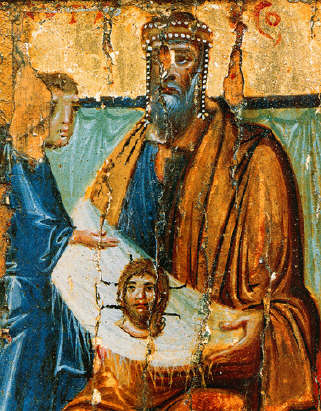 |
King Abgar receiving
the Image of Edessa. 10th
century icon at St Catherine's monastery, Mount Sinai.
|
The name Veronica is a conflation of Latin vera (true) and icon (image). It originally referred to the veil itself, but over
time was applied to the nameless woman who held it. Veronica became closely
identified with the Via Dolorosa and Stations of the Cross, but she is an
early-Medieval invention. By the end of the 12th century, pilgrims
were recording visits to the veil in Rome. By 1300, the Veronica was one of the
Mirabilia Urbis, or wonders of the
city, which pilgrims were expected to visit. It had its own chapel in Old St.
Peter's Basilica.
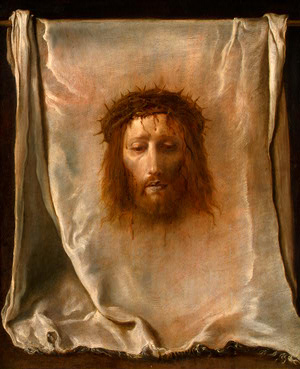 |
The Veil of Veronica, by Domenico Fetti, c. 1620
|
As with all icons, the Veronica was extensively copied by
free-lancers, until the 17th century when the Church threatened copyists
with excommunication and put the Veronica away for safe-keeping. Where it ended
up is a mystery. There’s a relic case in the Vatican (and some others scattered
throughout Europe) but nobody has seen the actual veil in a few hundred
years.
Let me know if you’re interested in painting with me in Maine in 2014 or Rochester at any time. Click here for more information on my Maine workshops!
