Understanding the major movements in western art will make you a better painter.
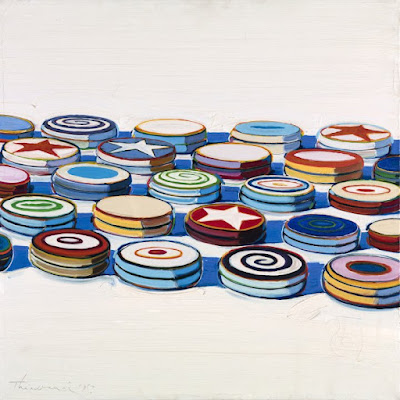 |
Yo Yos, 1963, Wayne Thiebaud, courtesy Albright-Knox Art
Museum. This, I think, is the first Thiebaud canvas I ever saw. |
Wayne Thiebaud passed away on Christmas Day at the age of 101. Thiebaud is best known for his pop-art still lives of everyday objects, but should be equally remembered for his superlatively-drawn landscapes. He worked right into his centenary year, and that in itself should be a lesson to us all.
I regularly haul him out in class as an example of paint
application, controlling edges, simplification and draftsmanship. Now he has
crossed over from being a working artist to being an Old Dead Master, but his
voice as a painter and teacher is not stilled.
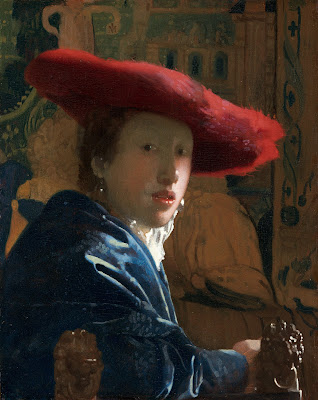 |
Girl with the red hat, Johannes Vermeer, c. 1665-7, courtesy
National Gallery of Art. No painting better demonstrates how to intentionally
control the viewer’s eyeballs. |
I had the fortune of growing up near a good art gallery which, moreover, was free. There were gaps in its collection, of course, because Seymour Knox was monomaniacal about abstract-expressionism. However, Paul Gauguin’s Yellow Christ, James Tissot’s trophy wife, the Buffalo newsboy, the little Charles Burchfield watercolors and huge Clyfford Still abstractions are all imprinted in my memory, stroke by stroke. I’m sure they’ve influenced my painting.
There is no substitute for time spent in art galleries, but
there is—equally—no substitute for time spent understanding the major movements
in western art. It will make you a better painter.
I think of this every time I meet a new student stuck in indirect
painting. It’s how I learned, since a small mania for Rembrandt had blossomed
in mid-century (and continues to throw up shoots here and there).
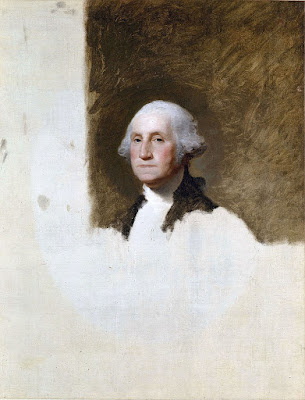 |
Portrait of George Washington (The Athenaeum Portrait),
1796, Gilbert Stuart, courtesy Museum of Fine Arts |
There’s absolutely nothing wrong with indirect painting, but in 2021, it’s a nod to the past. Perhaps some great genius will come along and divert the course of art history back to glazing (as, in a way, Andrew Wyeth did for realism). Or, more plausibly, an advance will be made in paint technology that drives a style change.
But right now, you may as well lecture in Attic Greek for
all the influence you’ll have if you pursue indirect technique. We’re in an age
of alla prima, bravura brushwork and brilliant color. One may be contrarian
and reject that, but it’s at least helpful to know where you stand.
I vividly remember my first class with Cornelia Foss. She set
me the task of drawing and painting an orange. When I was finished, she said, “If
this was 1950, I’d say, ‘brava’, but it’s not,” the implication being that I
needed to get with the times.
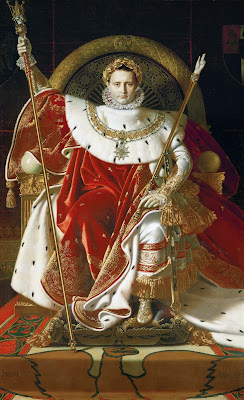 |
Napoleon I on his Imperial Throne, 1806, Jean-Auguste-Dominique
Ingres, courtesy Musée de l'Armée |
There’s probably not a lot that hasn’t been tried with oil paint. Tonalism involved a lot of dabbling, including glazing with experimental substances. Many canvases by Albert Pinkham Ryder and Ralph Blakelock have deteriorated beyond recognition. Knowing this would save a lot of anguish going forward.
Equally, there are brilliant technical skills that can be
best mastered from looking at Old Masters. Nothing demonstrates edge control
better than Vermeer’s Girl with a Red Hat,
for example. Some of my students are currently on an Edgar Payne journey.
They’ll learn more from studying his canvases than I can teach with all my
bloviating.
But, beyond that, art can teach social history as well as
any lecture. Think of Gilbert
Stuart’s unfinished
portrait of George Washington, the one which became our one-dollar bill.
Compare its austerity with its contemporary, Ingres’ Napoleon
I on his Imperial Throne and you have all the difference between the
French and American Revolutions in a nutshell. I don’t know what any teacher
could say that would improve on that.


