 |
| An outdoor toilet block in an orphanage in Port-au-Prince, Haiti. No lights, no doors and a pit toilet. (Photo courtesy of Douglas J. Perot) |
My friends have gotten a mighty
good laugh at Bic’s totally pointless For
Her ballpoint pens. But if you think all work of interior and industrial
designers is trivial, then consider this
story from Delhi, which tells us there is a link between the lack of proper
bathrooms and sexual crimes against women.
Women in the Bhalswa neighborhood have the choice of paying
a rupee to use a toilet in a communal toilet block, which is one of two serving
a thousand households in their neighborhood. When it isn’t open—which is
frequently—they are reduced to squatting in a nearby field.
 |
| The interior of a pit toilet in an orphanage in Port-au-Prince. Although there are no doors, the orphanage is secured and girls are safe when using it. This is not the case elsewhere in Haiti or many other parts of the world. (Photo courtesy of Douglas J. Perot.) |
In either case, the danger of molestation is high. Neighbors
estimate the rate of abduction from the toilet blocks to be about one a month,
and women using the field are frequently harassed or assaulted by men.
More
than half of India’s households don’t have sanitary facilities, and for the
lowest-caste Dalits, that percentage is far higher. More Indians have cell phones
than toilets. Considering how cheap cell phones are and how expensive bathrooms
are, that’s really no surprise.
Occasionally plein air
painters end up in a situation where they have to relieve themselves outdoors. Any
woman who’s done this has a small sense of the vulnerability of the third-world
woman without a bathroom.
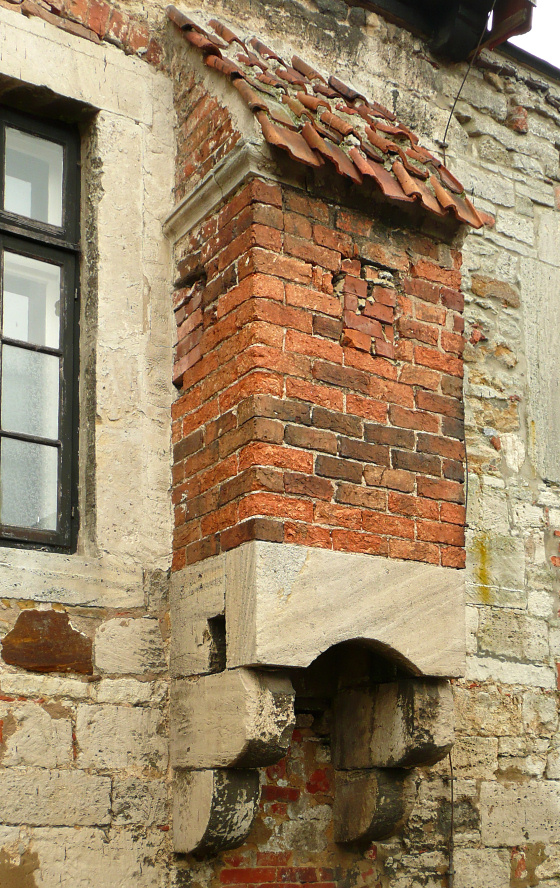 |
| Sanitary water and sewer lines have enhanced the development of private bathrooms but did not create them. Before there was running water in homes, there was the garderobe, which was a pit toilet that emptied outside the house. |
When we think of “bathroom design” in America today, we
think of clever storage, heated towel bars, and granite tiles. But these are very
recent innovations. My house was built with one family bathroom containing a
tub, commode and pedestal sink, and a half-bath on the ground floor. The doors
on both rooms were designed to lock, and the walls were covered with ceramic tile to facilitate cleaning. That was pretty much state-of-the-art in
1928.
 |
| A Toto Washlet and its remote control. |
Now there is the strange (to our eyes) toilet of Japan, the Toto
Washlet and its variations, which are
available in 72% of Japanese households. These toilet seats incorporate
posterior washing, feminine washing, seat warming and deodorization. Some
models raise and lower the seat automatically.
Modern bathrooms did not spring fully-formed from a scientist’s
brain. They were created iteratively, starting from the humble outhouse and
working forward. Most 20th century improvements were made by
industrial designers at the factory level and interior designers at the
consumer level, and the quick-and-easy solution that brings universal sanitary
facilities to the third world will probably come about in a similar way.
Let me know if you’re interested in painting with me in Maine in 2014 or Rochester at any time. Click here for more information on my Maine workshops!
