Paint Schoodic

To see more paintings, learn about workshops and classes, and more, visit my website.

Monday, February 28, 2022

Monday Morning Art School: the color of darkness

Painters spend lots of time thinking about the subtractive color system. We spend very little time thinking about the additive system. That’s a mistake, because this is the color of light.
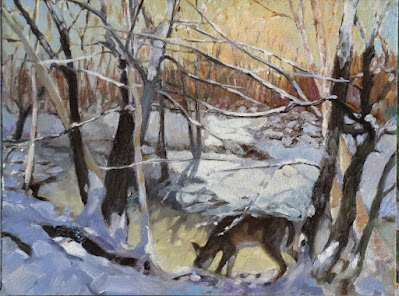
A deer I painted years ago as a demonstration for my class. Shadows are the complement of the morning light.

Every artist is familiar with the three primary colors: red, blue and yellow, and their complements, the secondary colors green, orange and violet. This is the fundamental color wheel for the subtractive color system, or what’s used for paint and ink.

There’s another set that became more important in the 20th century, with the rise of electric lights and then electronics. These are the so-called additive color primaries, which are red, green and blue. This color system doesn’t have a color wheel, but it does have complements, which are shown below.

Additive complements (left) and subtractive complements (right). Courtesy Wikipedia.

Painters spend lots of time thinking about the subtractive color system. We spend very little time thinking about the additive system. That’s a mistake, because this is the color of light.

For painters, color theory is a balance between natural light (additive color) and their paints (subtractive color). That’s mind-blowing but they’re not alone in this challenge. Despite working in an additive-color medium, many web designers still think in terms of subtractive color. This system has influenced our aesthetics since the 18th century, and we don’t let go of what ‘looks right’ easily.

But in practical terms, shadows are the absence of light. If light is full-spectrum, then its shadows will be full-spectrum too. That means a white light will cast a grey shadow.

However, natural light is far more complex than that. It seldom shows up with all wavelengths being equal.

Sunrise, or the so-called 'golden hour' on Beech Hill. The shadows are definitely blue.

For this reason, artists have a useful rule: shadows are the complement of the color of the light. In the north on a snowy morning, golden light casts blue-violet shadows on the snow. In overcast light, the shadows are vaguer and full-spectrum, meaning they appear greyer. That’s easy to see, and demonstrates an idea that you can then generalize to all subjects. Although you should never trust your camera for color, I have included two photographs that show this.

Midday at the same location, the light is diffuse and so are the shadows.

It's a mistake to get too attached to theory, however. For one thing, light is tricky. And for another thing, ‘primary color’ is another one of those constructs that we use because it’s useful, not because it’s absolute or provable. Our understanding and technologies are imperfect. CRT televisions of the 20th century were dull compared to modern LED screens. As technology got better, so did the color gamut, and what was considered ‘primary’ changed accordingly.

Most importantly, all these color systems are a dim mirror of the interaction of natural light and the human brain. Both are complex and imperfectly understood.

Light and shadows exist in the additive system, so your understanding of primaries is wrong if it’s based on what you learned in kindergarten. The complement of yellow in subtractive color is violet. The complement of yellow in additive color is blue. So, if the light is golden, the complement is more likely to be blue than violet.

At sunset, shadows appear black. There's color in those darks, but our eyes can't process it.

On the other hand, at sunset, the light is often red. The complement of red in additive color is cyan, but we almost never see any colors in the shadows at sunset. Instead, they’re just black, because we’ve hit the limit of what our poor rods and cones can process.

There’s a lot of latitude in what colors you can make your shadows, as long as you maintain the warm-cool balance. And—as always—all the theory in the world is no substitute for observation.

 

Friday, February 25, 2022

War and rumors of war

The violence and inhumanity of war is apparently a lesson that every generation needs to learn for itself.

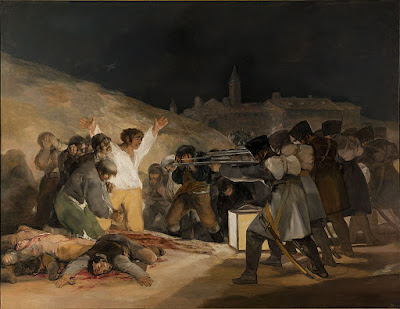
The Third of May 1808, 1814, Francisco Goya, courtesy Museo del Prado.

Francisco Goya was the most important Spanish artist of his day. His late painting, The Dog, was an icon for modern and symbolist painters through the 20th century. There’s a good reason: it prefigures modern art.

Goya became a court painter in 1786 and the First Court Painter to the Bourbon monarchy in 1799. This made him, in effect, a courtier of the Crown. As expressive as his painting was, he wrote nothing about current affairs.

In 1808, Napoleon turned on his former allies and occupied Spain. He forced the abdication of the King and installed his brother Joseph Bonaparte on the throne. Spaniards rejected French rule and fought a long and bloody guerrilla war to oust them.

The Third of May 1808, 1814, Francisco Goya, courtesy Museo del Prado.

The war started with the Dos de Mayo Uprising, the reprisals to which were memorably recorded by Goya in his masterpiece above. This was painted in 1814, after the war ended. Whatever his private thoughts, Goya meant to stay alive and working.

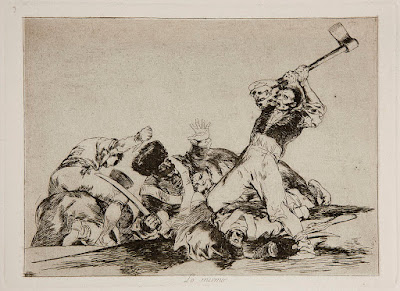
Goya remained in Madrid through the conflict. His ruminations resulted in a series of prints called The Disasters of War. That’s a modern title; Goya’s only written comment was on a proof-set, where he wrote, “Fatal consequences of Spain's bloody war with Bonaparte, and other emphatic caprices.” In using the word caprichos, which also translates as ‘whims’, Goya said a mouthful.

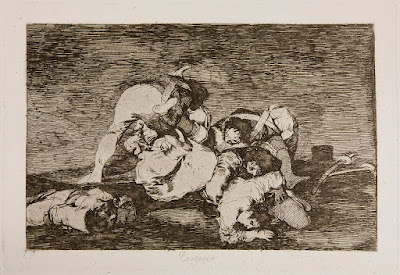
Plate 10: Tampoco (Nor do these). Spanish women being raped, Francisco Goya from The Disasters of War, courtesy Museo del Prado.

The Disasters of War is a series of 82 prints, finished between 1810 and 1820. They are an expression of revulsion against the violence of the Peninsular War, an outpouring from the gut against the inhumanity of war. There is no polemic about the causes of the conflict, despite the fact that Goya retained his position in the Bourbon court while working on them. They were private works, and not published until 35 years after his death. Their influence has been incalculable.

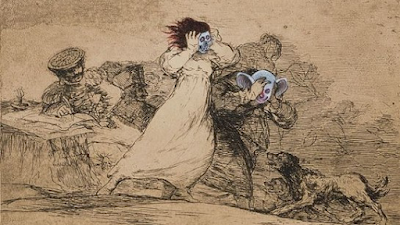
Fast forward to 2003 and a pair of British art enfants terrible, Jake and Dinos Chapman. They purchased a folio of the Disasters of War and set about systematically defacing it with cartoon figures drawn over Goya’s art. They called this appropriation work, Insult to Injury and the overall show Rape of Creativity.

One image of Jake and Dinos Chapman’s defacing of Disasters of War, which they retitled, What is this hubbub?

“Drawings of mutant Ronald McDonalds, a bronze sculpture of a painting showing a sad-faced Hitler in clown make-up and a major installation featuring a knackered old caravan and fake dog turds,” is how the BBC described the show at the time.

For this twitting of human suffering, they should have been spanked and sent to their rooms. Instead, they were nominated for the Turner Prize.

The Chapmans were born in the 1960s. They have lived through the longest period of peace in modern British history. The Disasters of War might have seemed funny to them, but it would not have amused those who remembered the convulsions of the two great 20th century European wars.

That kind of generational amnesia is an odd function of the human mind. It’s the only possible explanation for why we get into war over and over again.

I hadn’t meant to write on this subject, but the war in Ukraine couldn’t have happened without the slow forgetting of the violence and inhumanity that is war. Apparently, it’s a lesson that every generation needs to learn for itself.

Wednesday, February 23, 2022

In control

Every day, in every way, things are not necessarily getting better.

In Control (Grace and her unicorn), 24X36, is one of the paintings that's going to Rye Arts Center's Censored and Poetic: the works of Carol Douglas and Anne de Villemejane, March 2022.


A visitor to my studio recently asked me about the gender disparity in painting. “Eighty percent of art students are women,” I said—and that may be a low estimate. “But 80% of the top cadre of professional painters are men.” That, too, may be a low estimate.

“Why?” she asked. I was stumped for an answer. If I’d thought about it at all, I’d have attributed it to change—women moving up through the atelier system to take their rightful place in the art world. But since the 19th century women have studied and practiced painting with great seriousness. There were more girls in art class when I was young, and the earning disparity didn’t disappear when we came of age.

Michelle Reading, 24X30, is one of the paintings that's going to Rye Arts Center's Censored and Poetic: the works of Carol Douglas and Anne de Villemejane, March 2022.

This is not anecdotal. There have been many studies worldwide that document this phenomenon. The most exhaustive was done in 2017. It analyzed 1.5 million auction transactions in 45 countries, and found a 47.6% gender discount in prices. The discount was worst (unsurprisingly) in countries with greater overall gender disparity.

Do women drop out, practicing art as dedicated amateurs rather than professionals? No; 51% of practicing visual artists are women.

Are women’s paintings somehow more ‘girly,’ and therefore less attractive to buyers? In blind studies (with the artist’s name excised), participants could not guess the gender of the artist. Women's art sells for less because the signature is feminine. Period.

The Beggar, 36X48, is one of the paintings that's going to Rye Arts Center's Censored and Poetic: the works of Carol Douglas and Anne de Villemejane, March 2022.

My childhood chum Cynthia Cadwell Pacheco was a professional ballet dancer. While she was traveling around the world, her mother regaled me with stories of the culture of submission, abuse and body-shaming that the corps de ballet were subject to.

It’s a miserable career choice for women, but, ironically, serious ballet used to be a women-led art form. That was before it spun money. Today, it’s a multi-billion-dollar business. As it has grown in economic importance, women have been pushed out of leadership. Today’s companies are run by men, the work is choreographed by men, the jurors are men, and the big bucks go to men. Let that be a lesson to you if you believe that every day, in every way, we’re getting better and better.

“Despite the fact that girls outnumber boys 20 to one and pay most of the fees in ballet schools, and despite the audience and donor base being 70% women, female artistic directors are paid 68 percent of what their male counterparts earn,” wrote Elizabeth Yntema.

Saran Wrap Cynic, 20X24, is one of the paintings that's going to Rye Arts Center's Censored and Poetic: the works of Carol Douglas and Anne de Villemejane, March 2022.

Our culture actively discourages boys from dancing. That’s foolish and unfair, and it leads to a tremendous imbalance in dance classes. If there is a boy at all, he won’t lack for principal roles, no matter how execrably he dances; the great classical ballets require male dancers. No wonder boys in the dance world grow up thinking they’re the cock of the walk.

No other legal American industry is as gender-skewed as ballet, but the visual arts do share some of its daft values. You only have to compare the career of Lois Dodd with her contemporaries to see that.

Identifying the problem is only the first step. What can we do about it? Young artists might choose a gender-neutral nom de pinceau, but that perpetuates the problem. Women’s role in the arts will only be as strong as women’s role in the greater culture. I’m old enough to have seen some remarkable changes in society, but I’m also alive to the very real risk that we can move backwards, just as the dance world has.

Sunday, February 20, 2022

Monday Morning Art School: is that painting finished?

Our hectoring superegos are not always the best judges of painterly quality.

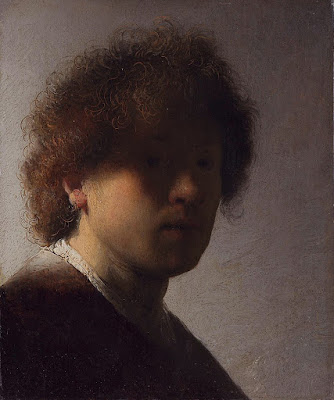
Self Portrait with Disheveled Hair, 1628-29, Rembrandt van Rijn, courtesy Rijksmuseum

In my studio, there are more than a hundred unfinished paintings in drying racks. I’d feel bad about that, except that most plein air artists I know store up unfinished pictures like squirrels store nuts. We say we’re going to work on them during the winter, and sometimes we do. Other times, we just go out and start more paintings.

There is another stack on the other side of my studio. These are paintings I’ve either decided aren’t first rate or that I won’t ever bother to finish. I periodically go through them with the intention of winnowing them down. Often, I’m surprised that they’re actually not bad at all.

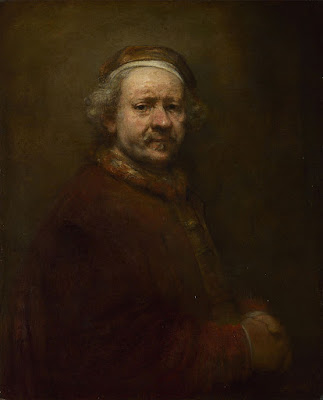
Self Portrait at the Age of 63, 1669, Rembrandt van Rijn, courtesy National Gallery, London

“Ah, a procrastinator,” you might say, but you’d be wrong. I’m actually disciplined in my work habits. I’ve just learned to trust my subconscious more than I did as a younger person. Twenty years ago, I thought a painting was finished when it achieved the effect I was striving for. Today a painting is finished when I’m sick of working on it. I’ve learned to be less critical of myself. My hectoring superego is not always the best judge of painterly quality.

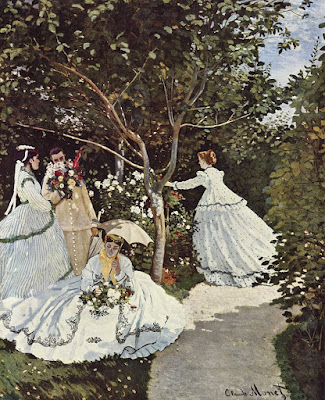
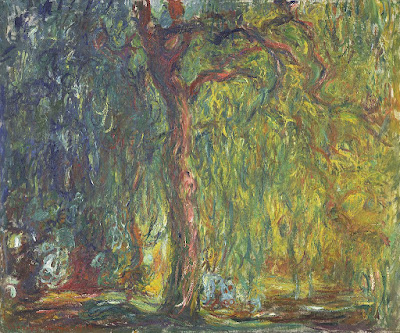
The division between brilliantly-raw and plain-unfinished is highly subjective. That line often changes over the course of an artist’s career. Paul Cezanne’s paintings of Mont Sainte-Victoire done in the 1880s are significantly more refined than those done from 1904-6. Rembrandt’s youthful Self Portrait with Disheveled Hair is an amazing exercise in chiaroscuro, but the brushwork is much tighter than his Self-Portrait at the Age of 63 (the year of his death). The changes in Claude Monet’s final paintings are usually blamed on his failing eyesight, but they are also the culmination of a career-long path toward looser, more audacious painting.

Women in the Garden, 1866–1867, Claude Monet, courtesy Musée d'Orsay

That is not to say that every artist becomes looser as they age. Grant Wood painted in the same precise style until his death of pancreatic cancer at age 51. Of course, we have no idea how he might have painted had he lived longer. The same is true of Caravaggio, who only made it to 39. On the other hand, Titian, who lived until his late eighties, spent his last years as an impossible perfectionist. He returned to older works and repainted them, fixed up copies made by his students, and kept some paintings in his studio for more than a decade of tweaking—all of which must give art historians the vapors.

The difference lies in what drove these artists in the first place. Cezanne, Rembrandt and Monet were never interested in a high degree of finish, but rather in the effects of paint. The culmination of their efforts was looseness. In contrast, Caravaggio, Titian, and Wood were what we call linear painters, interested in creating the illusion of three-dimensional space through careful modeling. For them to suddenly become interested in dynamic brushwork would have been a complete repudiation of their life’s work.

Weeping Willow, 1918–19, Claude Monet, courtesy Kimball Art Museum

One of the cliches of art instruction I particularly hate is, “Not another brushstroke! Don’t overwork it.” Nobody else can tell you positively that your painting is finished, because nobody else knows your intentions. We can engage you in dialog and help you clarify your thinking. But the only legitimate judge of whether you’re done is you, the artist. 

I have found that when I can’t finish a painting, the best thing I can do is to set it aside. Sometimes, my skills aren’t up to the effect I was trying to achieve, and I need to practice. Sometimes I don’t know how to finish it, and I need to think. Sometimes it’s a lousy painting, and it belongs in the reject pile. And sometimes a period of reflection reveals that the painting was, in fact, finished all along.

Friday, February 18, 2022

How long did it take you to become a genius, anyway?

Mastery is a moving target. Occasional moments of greatness are a byproduct of that continuing struggle.

Autumn farm, evening blues, oil on archival canvasboard, Carol L. Douglas

“How @#$% long does it take great painters to learn to paint?” asked a student recently, with only the slightest hint of frustration in his voice. “I’m not looking for affirmations,” he added. “I really would like some perspective.”

In the age of apprenticeships and less-flexible standards of art, that was an easier question to answer. Titian started his apprenticeship somewhere around age 10-12, and finished it around ten years later. Diego Velázquez did a six-year apprenticeship starting at around age ten. Peter Paul Rubens did a 7-year apprenticeship starting at age 14. The British portrait painter George Romney did only four years, but he started at age 21, with watchmaking and drawing experience under his belt. Most women at this time studied with family members.

Vineyard, oil on canvas, 30X40, Carol L. Douglas

These budding artists made learning their craft a full-time occupation during their apprenticeships. They were also responsible for elements of painting we don’t bother with today, such as preparing panels and grinding pigments, along with the scut-work of any successful business. In addition, their master (or more probably, his wife) taught them the necessary skills for living.

By the end of the 18th century, the apprenticeship system was dead. Painters were more likely to come up through atelier training. Many artists of this period, including Édouard Manet and Vincent van Gogh, came from affluent families. They had the liberty to direct their own destinies and well-heeled friends to buy their first paintings.

Mary Cassatt is typical in that she had a good liberal education (including exposure to great art in Europe) before enrolling at the  Pennsylvania Academy of the Fine Arts at the age of 15. She spent four years there. It was not coincidence that atelier training took about as long as a humanities degree; artists had transitioned from being craftsmen to intellectuals.

Midsummer, 24X36, oil on canvas (plein air), $3188 unframed, Carol L. Douglas

By the 20th century, the down-and-dirty craftsmen in the art world were illustrators. Norman Rockwell also spent four years studying art, but he didn’t have the advantage of a Grand Tour. He started art school at age 14 and was working for Boy’s Life at 18.

The 20th century was a confused time for art education in the western world. Grant Wood is representative of mid-century painters in that he moved around through various schools and collectives learning his craft. Andy Warhol, on the other hand, had a BFA from Carnegie-Mellon. Those who came up outside the formal art world, like Jasper Johns, still put in a lot of years perfecting their craft.

There have always been outliers. N.C Wyeth had a fairly typical art education for his time, with Howard Pyle and others. However, when it came to the next generations, Andrew Wyeth and grandson Jamie Wyeth were both tutored at home. This hearkens back to historic family painting dynasties like the Brueghels or Gentileschis.

Termination Dust, oil on archival canvasboard, Carol L. Douglas

We love stories of instant success, but most, like Grandma Moses, were working hard at art for decades before their discovery. Moses spent a lifetime doing fine needlework until her arthritis forced her to take up a brush at age 78.

My student’s question presumes there’s a point at which the painter says, ‘whew, I’ve made it!” Every credible painter I know is simply striving to be good at what he or she does, but the goal keeps moving. Greatness is merely a by-product of that continuing struggle.

Historically, masterpiece had a specific meaning. It was a work produced to earn membership in one’s guild. Velazquez’ first Waterseller of Seville was such a painting, done to prove that he was good enough to hang out his own shingle. It was the start of his professional life, not its culmination.