Our hectoring superegos are not always the best judges of painterly quality.
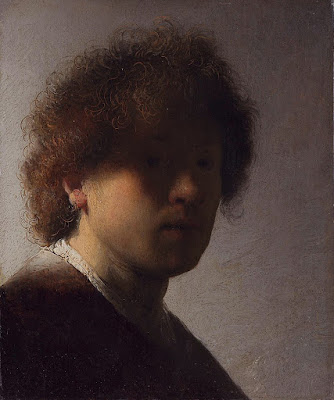 |
Self Portrait with Disheveled Hair, 1628-29, Rembrandt van
Rijn, courtesy Rijksmuseum |
In my studio, there are more than a hundred unfinished paintings
in drying racks. I’d feel bad about that, except that most plein air artists
I know store up unfinished pictures like squirrels store nuts. We say we’re
going to work on them during the winter, and sometimes we do. Other times, we
just go out and start more paintings.
There is another stack on the other side of my studio. These
are paintings I’ve either decided aren’t first rate or that I won’t ever bother
to finish. I periodically go through them with the intention of winnowing them down.
Often, I’m surprised that they’re actually not bad at all.
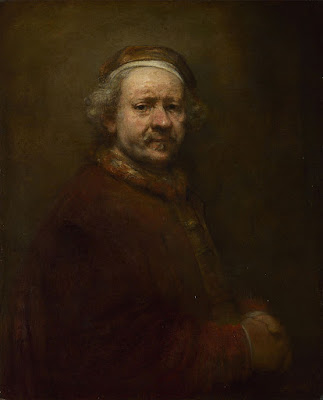 |
Self Portrait at the Age of 63, 1669, Rembrandt van Rijn,
courtesy National Gallery, London |
“Ah, a procrastinator,” you might say, but you’d be wrong. I’m actually disciplined in my work habits. I’ve just learned to trust my subconscious more than I did as a younger person. Twenty years ago, I thought a painting was finished when it achieved the effect I was striving for. Today a painting is finished when I’m sick of working on it. I’ve learned to be less critical of myself. My hectoring superego is not always the best judge of painterly quality.
The division between brilliantly-raw and plain-unfinished is
highly subjective. That line often changes over the course of an artist’s
career. Paul Cezanne’s paintings
of Mont Sainte-Victoire done in the 1880s are significantly more refined
than those done from 1904-6. Rembrandt’s youthful Self
Portrait with Disheveled Hair is an amazing exercise in chiaroscuro,
but the brushwork is much tighter than his Self-Portrait
at the Age of 63 (the year of his death). The changes in Claude Monet’s
final paintings are usually blamed on his failing eyesight, but they are
also the culmination of a career-long path toward looser, more audacious
painting.
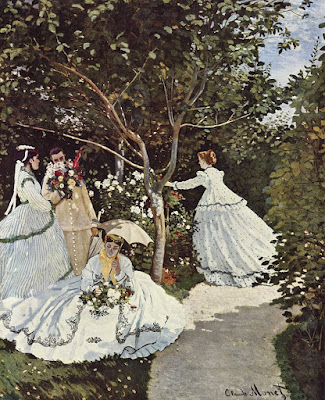 |
Women in the Garden, 1866–1867, Claude Monet,
courtesy Musée d'Orsay |
That is not to say that every artist becomes looser as they age. Grant Wood painted in the same precise style until his death of pancreatic cancer at age 51. Of course, we have no idea how he might have painted had he lived longer. The same is true of Caravaggio, who only made it to 39. On the other hand, Titian, who lived until his late eighties, spent his last years as an impossible perfectionist. He returned to older works and repainted them, fixed up copies made by his students, and kept some paintings in his studio for more than a decade of tweaking—all of which must give art historians the vapors.
The difference lies in what drove these artists in the first
place. Cezanne, Rembrandt and Monet were never interested in a high degree of
finish, but rather in the effects of paint. The culmination of their efforts
was looseness. In contrast, Caravaggio, Titian, and Wood were what we call linear
painters, interested in creating the illusion of three-dimensional space
through careful modeling. For them to suddenly become interested in dynamic
brushwork would have been a complete repudiation of their life’s work.
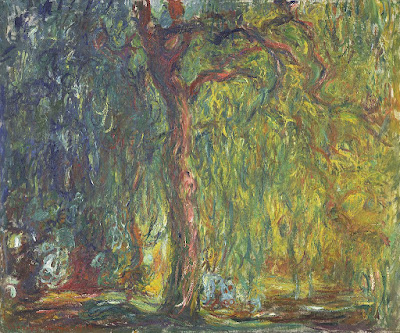 |
Weeping Willow, 1918–19, Claude Monet, courtesy Kimball
Art Museum |
One of the cliches of art instruction I particularly hate is, “Not another brushstroke! Don’t overwork it.” Nobody else can tell you positively that your painting is finished, because nobody else knows your intentions. We can engage you in dialog and help you clarify your thinking. But the only legitimate judge of whether you’re done is you, the artist.
I have found that when I can’t finish a painting, the best thing I can do is to set it aside. Sometimes, my skills aren’t up to the effect I was trying to achieve, and I need to practice. Sometimes I don’t know how to finish it, and I need to think. Sometimes it’s a lousy painting, and it belongs in the reject pile. And sometimes a period of reflection reveals that the painting was, in fact, finished all along.


