 |
Nadia Jelassi with two of the figures from her sculpture, Celui
qui n’a pas.
|
Until her arrest in August of last year, artist Nadia Jelassi was unknown in the West. (As of this writing, she doesn’t even have a Wikipedia entry.) She might have remained unknown, but for her arrest on August 17, 2012 in Tunis for ‘breach of the peace and moral standards.’ She faces a five-year prison term.
Tunisian women prior to the Arab Spring revolution enjoyed
secular freedoms we don’t associate with an Islamic state, including access to
higher education, the right to divorce, and freedom from the hijab. This was by
no means feminism as Americans understand it, but it was not the locked-down
oppression of benighted fundamentalism, either. Women played an unprecedented
role in the protests that brought down the Tunisian government, so the rise in religious
zealotry in the power vacuum that appeared after the revolution was particularly
sad.
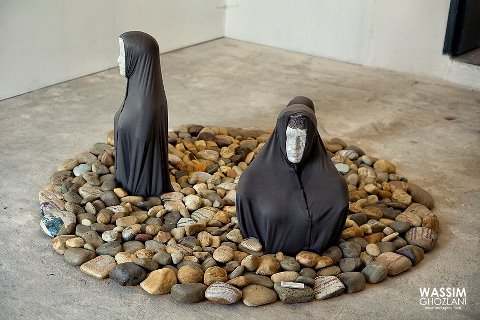 |
| And the work as a whole. |
Jelassi’s sculpture, “Celui
qui n’a pas,” above, is an emotional response to the position she and other
Tunisian women find themselves in. It obviously references the threat of
stoning, which unfortunately makes it an implicit criticism of shariah. (Stoning
is a legally-sanctioned punishment in Saudi Arabia, Pakistan, Sudan, Iran,
Yemen, the United Arab Emirates, and some states in Nigeria.)
“Unlike what I used to do, it was not nuanced. I needed to
shout, to express something raw. But I don’t think I sacrificed sculpture,” said
Jelassi, who says her controversial work was a continuation of the textile
portraits she had been producing.
“Celui qui n’a pas”
was shown without controversy at the El Abdelleya gallery in Tunis until July 10,
when one Mohamed Ali Bouazizi photographed works in the gallery that he personally
considered “religiously offensive.” He took these images to a suburban mosque,
where he gathered up a group to return to the gallery. This small mob was
blocked by a larger one of the artists’ supporters.
Although Bouazizi attempted to foment violence against the
gallery, he was not responsible for her arrest. The following day, a wave of violence
sparked across Tunisia, prompting a police response and curfew. “Nobody lodged
a complaint against me,” said Jelassi. “It was the State Prosecutor, the
representative of the Justice Minister who opened the case.”
Jelassi’s protest was emotional and unscripted. Compare her
to Chinese dissident artist Ai
Weiwei. He has long been known in the West as a visual artist; his work has
been shown and is in prestigious public collections worldwide. To westerners,
his sculpture and photography are not dissident, but to Chinese eyes, his work
is inherently rebellious, because he magnifies the forms and traditions of the West
rather than those of China. Our first instinct is not to say, “Oh, that’s so Chinese!”
but to say, “Oh, that’s so contemporary!” The refusal to conform to the ideals of the government, to put himself outside the Chinese propaganda machine, was his fundamental rebellion.
 |
Dropping a Han Dynasty Urn, Ai Weiwei, 1995, three gelatin silver
prints, each 148 × 121 cm.
|
But while Ai’s visual work is subtly anti-Chinese, his major
protest took the form not of visual art but of intentional political theater. On
January 10, 2006, he began to compose daily essays critical of the Chinese government.
These rapidly attracted an international following. By mid-2009, he was being
investigated by the Chinese government, and his communication with the outside
world was completely suppressed in July of that year.
(As so often happens with political activism, the government’s
attempts to suppress Ai’s work contributed to its success. He has been the
subject of a book and a movie, and he is as visible in his absence as he was
while blogging.)
Last week, I wrote about the limits of audacity as a virtue
in art. Absent a message, it is nonsensical. But audacity is the necessary springboard
for a genuine cri de coeur. All over
the world, there are suffering people, but very few among them can use their
talent to give voice to that suffering.
What a high calling that is.

No comments:
Post a Comment