Paint Schoodic

To see more paintings, learn about workshops and classes, and more, visit my website.

Showing posts with label Albrecht Durer. Show all posts

Friday, May 1, 2020

Arbitrary distinctions


What is art? What is illustration? Does it matter?
Trick-or-Treat! From my brief period illustrating; prints available (DM me).
“I am trying to understand the difference between a painter and an illustrator,” writes a reader.

Paint is a just a medium. You can use it to illustrate, or you can hurl it in meaningless patterns. Conversely, you can illustrate with any two-dimensional medium, including pencils, ink, photography or cut paper. The difference is in intent.

An illustration is usually a visual accompaniment to a text. However, that’s not always true. There are illustrated books (Albrecht Dürer’s Passions, for example) that do not need words at all. There are many children’s books with no words. In fact, one could argue that all of western religious art is illustration. The text (the Bible) was just not written down. Either the intended audience was illiterate or they all knew the story anyway.
Gas Station, by Carol L. Douglas. From my brief period illustrating; prints available, DM me.
Illustrators are usually hired by writers or publishers. The work is limited in scope and concrete in character. Fine artists have no middleman between them and the market. They can be as obscure as they wish. But fine artists certainly work on commission, and illustrators often work on spec, so even that distinction is hazy.

There was a time when this question mattered to me. I was trying to make the jump between graphic design and painting full time. I did it by writing and illustrating two books. We are all born with an innate ability to imagine pictures, but I’d disciplined my artistic sensibilities to be subservient to the client. It took these stories for me to loosen up and find my focus. It’s never been a problem since.

Girl in Closet, by Carol L. Douglas. From my brief period illustrating; prints available, DM me.
But there’s an insidious way in which this question is sometimes asked. What’s implied is that fine art is somehow better than other forms of artistic expression.

Yes, illustration is a fine craft rather than a fine art. Like tapestry, jewelry, carving, etc., illustration has a practical purpose aside from beauty. Paintings have none, unless you’re using them to plug holes in the wall. If you want to know if you’re an artist or craftsman, ask yourself if your finished product has any tangible purpose. If it’s useless, you’ll know you’re an artist.

The problem lies in assuming that either one is more important than the other. Our modern viewpoint comes from the 19th century Cult of Genius, which mistakenly put fine artists in the category of intellectuals instead of tradesmen.

Kitchen Table, by Carol L. Douglas. From my brief period illustrating; prints available, DM me.
This is why plein air painting gets so little respect, by the way. It rejects the idea that fine art is primarily an intellectual activity. Instead of making great statements, plein air painting has a lowly and practical view of the world. It seeks to make pictures that make people happy.

There’s never been any distinction between fine art and illustration in terms of quality. If there ever was a gap, it was bridged long ago, starting with the unknown monks who illuminated books before the printing press was invented.

With the advent of industrialization, individuality and beauty was stripped from the objects we use every day. Brilliant craftsmen-artists like William Morris, Charles Rennie Mackintosh, Margaret Macdonald, and the Roycroft Movement closed the gap between art and function once again. And who in this world would argue that N.C. Wyeth  and his peers of the Golden Age of Illustration are not among the world’s greatest artists?

Thursday, September 18, 2014

Why are art babies so ugly?


The Haller Madonna, Albrecht Dürer, 1498
We interrupt this regularly-scheduled programming to address the age-old question of why babies in paintings are often deformed, distorted, and generally ugly. (And, BTW, this phenom isn’t limited to Renaissance babies, no matter what the current meme says.) It isn’t because the artists can’t draw; I’ve included examples by superb draftsmen.

There are a lot of theories about this, covering context to symbolism to the possibility that earlier babies just were not that good looking in the first place.

The Baby Marcelle Roulin, Vincent van Gogh, 1888
Having had several babies myself, and having done a lot of figure painting, I think the answer is much simpler: babies make lousy models. They squirm and howl when they’re uncomfortable, and they won’t hold a pose. They have no muscle tone and very little neck, and they wobble. Pre-photography, the best the artist could do was limb in a few lines and return the pathetic little creature to its mother’s arms.

The Three Ages of Man, Titian, 1511
On the other hand, I’ve always wondered why so many Renaissance infants are pictured wearing jewelry. Didn’t they get the memo about choking hazards?

Newborn Baby in a Crib, Lavinia Fontana, c. 1583
Enough of this. I have a new little grandson to go visit. He arrived squalling into the world last night, and I haven’t yet begun to paint his portrait.


Message me if you want information about next year’s classes and workshops.

Monday, January 6, 2014

The genius isn't inside the camera

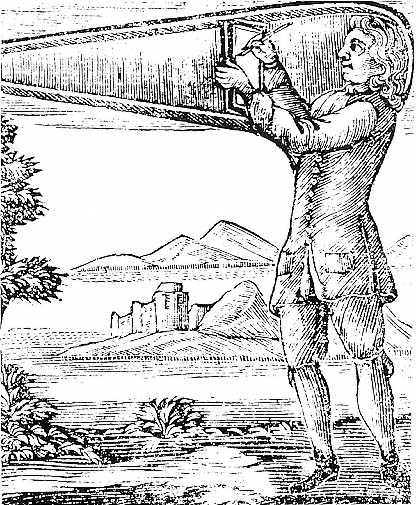
An artist drawing a seated man onto a plane of glass through a sight-vane, from the fourth book of Albrecht Dürer’s Four Books on Measurement.
Last month, a number of people sent me Vanity Fair’s piece on engineer Tim Jenison’s painstakingly-complex recreation of Johannes Vermeer’s The Music Lesson. Jenison faithfully built the room and objects depicted in the painting, and then repainted the scene using a version of a camera obscura. In the end, he discovered what any freshman art history student could have told him: yes, it’s possible that Vermeer used a camera obscura. He’d have hardly been alone.

Sir Robert Hooke’s portable drawing machine should be familiar (in concept) to any of my plein air painting students. There is nothing new under the sun.
The peculiar properties of the pinhole camera were known and described in antiquity from Greece to China. In the west, the principles behind it were analyzed and described by the eleventh century Arab scientist, Ibn al-Haytham. In the 13th century, Roger Bacon described the use of a camera obscura to watch solar eclipses. Leonardo da Vinci puttered with one, and even came up with a proto-telescope based on it:

...in order to observe the nature of the planets, open the roof and bring the image of a single planet onto the base of a concave mirror. The image of the planet reflected by the base will show the surface of the planet much magnified.

Above, A man drawing a can, and below, A man drawing a recumbent woman, in foreshortening through a frame with a network of squares on to a paper also with squares, in order to be able to reduce or enlarge proportionally, both from the fourth book of Albrecht Dürer’s Four Books on Measurement.
Filippo Brunelleschi (1377-1446), sculptor, architect, artist and engineer, is generally (and perhaps falsely) credited with the invention of linear perspective in art. He also created a device to demonstrate that perspective, which we call Brunelleschi’s peepshow, but which is in fact a version of a camera obscura:

“[He] had made a hole in the panel on which there was this painting; ... which hole was as small as a lentil on the painting side of the panel, and on the back it opened pyramidally, like a woman's straw hat, to the size of a ducat or a little more. And he wished the eye to be placed at the back, where it was large, by whoever had it to see, with the one hand bringing it close to the eye, and with the other holding a mirror opposite, so that there the painting came to be reflected back; ... which on being seen, ... it seemed as if the real thing was seen: I have had the painting in my hand and have seen it many times in these days, so I can give testimony. (Antonio di Tuccio Manetti)

A Man Drawing a Lute, from the fourth book of Albrecht Dürer’s Four Books on Measurement. 
Albrecht Dürer was not a visionary in the manner of Leonardo, but he was peerless in investigating and recording his experiments. Several woodcuts of drawing aids come down to us from him, so we know he used them. Nevertheless, using a camera obscura was not the only thing he could do; the man could draw brilliantly. Very few living artists today could duplicate his Young Hare or Large Piece of Turf, neither of which relied on optical tools.

Courtyard of the Former Castle in Innsbruck without Clouds, 1494, Albrecht Durer. Was it done with a drawing device? Perhaps. Does that make it less brilliant? I don't think so.
Ultimately, it doesn’t matter whether Vermeer used an optical device. That’s the one thing Tim Jenison’s experiment proves. It’s ultimately nothing more than a fair copy of a masterpiece, such as art students churn out every day. Vermeer’s incalculable genius is safely his own.

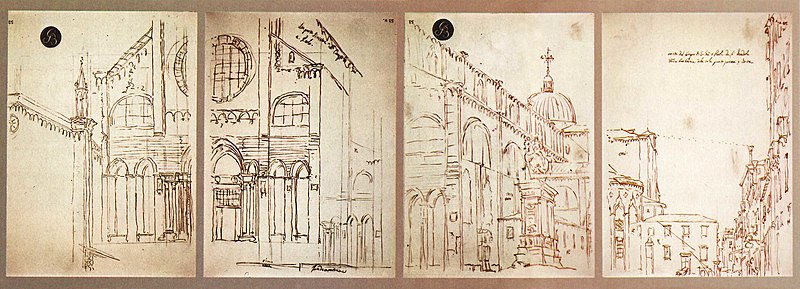
Artists used the camera obscura until the development of photography made it obsolete. Here are four camera obscura drawings by Canaletto from the early 18th century.


Let me know if you’re interested in painting with me in Maine in 2014 or Rochester at any time. Click here for more information on my Maine workshops!

Monday, December 16, 2013

Six Days of Advent: The Annunciation to Mary

The Annunciation Triptych, 1440, by Rogier van der Weyden, has the compressed version from the Gospel of Luke, almost in comic-book form—Zecheriah praying in his lonely temple, Gabriel surprising Mary while she reads Scripture, Mary meeting with Elizabeth, in whose womb the young John the Baptist leaps in recognition.
The story of the Incarnation opens not with the Angel Gabriel’s appearance to Mary, but with his appearance to an old temple priest. Zechariah reacted with all-too-human skepticism to the idea that his post-menopausal wife would give birth to a son who “will go on before the Lord, in the spirit and power of Elijah.” 

Virgin of the Annunciation, 1512, by Matthias Grünewald, also shows Mary at her studies, but clothed in the most exuberant pleats, which reinforce the ecstatic nature of the moment.
A few months later, Gabriel returned to Israel, this time to Nazareth in Galilee, to talk to a young woman who was engaged to be married.

In contrast, Antonello da Messina’s Virgin Annunciate, 1476, is taking the news with remarkable composure.
 “Do not be afraid, Mary; you have found favor with God. You will conceive and give birth to a son, and you are to call him Jesus. He will be great and will be called the Son of the Most High. The Lord God will give him the throne of his father David, and he will reign over Jacob’s descendants forever; his kingdom will never end.”

The angel Gabriel in Sondro Botticelli’s 1481 fresco seems to be leaning over an imaginary wall for a friendly chat.
“How will this be,” Mary asked the angel, “since I am a virgin?”

The angel answered, “The Holy Spirit will come on you, and the power of the Most High will overshadow you. So the holy one to be born will be called the Son of God. Even Elizabeth your relative is going to have a child in her old age, and she who was said to be unable to conceive is in her sixth month. For no word from God will ever fail.”

 “I am the Lord’s servant,” Mary answered. “May your word to me be fulfilled.” (from Luke 1:26-38)

In Hendrick Terbrugghen’s 1624 Annunciation, Gabriel has dirty feet.
Mary understood that being pregnant by someone other than her betrothed threatened her engagement, her reputation, and even her life (as she could be stoned for adultery). The early Renaissance painters would have understood her predicament better than we, for whom illegitimacy is no big deal.  If the Baby Jesus were conceived today, sadly, nobody would much notice.
Albrecht Durer’s Annunciation from The Life of the Virgin, 1502, sets the scene in an amazing series of arches that suggest the very heavens themselves.

Let me know if you’re interested in painting with me in Maine in 2014 or Rochester at any time. Click here for more information on my Maine workshops!

Monday, December 2, 2013

MacGyvered

One of Alexey Kljatov's exquisite snowflake photos.
Albrecht Durer was renowned for his skill in painting detail. There’s a legend that he was once asked by the artist Giovanni Bellini for the brushes with which he painted hair. Durer handed Bellini an unremarkable brush. 'I do not mean this, I mean the brushes you use to paint several hairs with one touch,' Bellini answered. Durer proceeded to demonstrate that it was all in the technique, not the tool.

A still life by Alexey Kljatov. He moves a flashlight around and then meshes images in Photoshop to make this effect.
Macro photos of snowflakes popped up all over my newsfeed last month. These were shot by one Alexey Kljatov. Evidently, in Moscow when you decide to take up macro photography you don’t run down to 42nd Street Photo and drop a grand or more on a new camera with interchangeable lenses. You buy a used Russian-made lens from an old film camera (currently available on ebay for about $25) and tape it to your decidedly down-range Canon Powershot, using a chunk of wood as a stabilizer and a black garbage bag to keep out light.

That's an old Russian-made SLR lens taped to an 'extension bellows' taped to a Canon Powershot, all stabilized with a piece of wood.

Kljatov’s snowflakes are detailed, luminous, and, most of all, fascinating. A similar hack he did to take telescopic shots of the moon rendered weirdly wavery but inviting images of our planet’s closet friend. When he’s not outside freezing, Kljatov does a series of layered still lifes using a handheld flashlight and lots of hours on his computer.

The moon, shot by Alexey Kljatov. In this instance, he used rubber bands to affix a telephoto lens to his Canon Powershot.
Kljatov’s camera is a 2007-vintage, mid-range Canon Powershot. In fat, sassy America, those cameras (if they’re still around) are used for nothing more than shooting snapshots of the passing scene.

Every once in a while I stop at my local art store to ponder the locked case of $250 watercolor brushes by the counter. Is it really necessary to spend so much money in pursuit of creativity? Or is creativity to be found in the exact opposite of such luxury?


Let me know if you’re interested in painting with me in Maine in 2014 or Rochester at any time. Click here for more information on my Maine workshops!