Paint Schoodic

To see more paintings, learn about workshops and classes, and more, visit my website.

Showing posts with label Ed Buonvecchio. Show all posts

Wednesday, January 5, 2022

All the plein air events, at your fingertips

Thinking about competitive plein air painting? Here’s a useful tool.
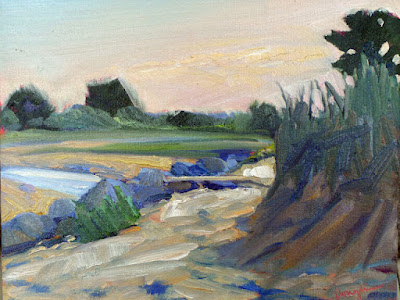
Beach Erosion, 8X10, oil on canvasboard, $652 framed, available through Ocean Park Association.

I met Chrissy Pahucki at a plein air event. She was standing in line with one of her children waiting to have her canvases stamped. Chrissy’s branding came naturally—she always had a kid trailing along. I once asked a show organizer how many years we’d been doing his event. “You can tell how long it’s been by how much Ben has shot up in height,” he answered.

All three Pahucki kids are grown now and Chrissy’s still doing the plein air circuit. In her spare time, she’s a full-time, award-winning middle school art teacher in Goshen, NY. About a decade ago, she created a website to direct-sell paintings called the Plein Air Store, and she still maintains it.

Quebec Brook, 12X16, oil on canvasboard, $1449 framed.

She also made this spreadsheet for applying to events. It’s a useful tool because it lays out application, notification and event dates in tabular form. That means a busy person doesn’t have to hunt through reams of material looking for a show. Unlike a magazine, it’s searchable. And it’s free. Thank you, Chrissy.

The plein air circuit is where I first met Mary Byrom, Bobbi Heath, Poppy Balser, and many other talented, hard-working and like-minded women. Like Chrissy, they’ve become valued friends. These events are much like the rodeo circuit; the same artists show up at them over and over. Artists compete with each other for prizes and sales, but at the same time, they’re supportive and friendly. That’s a good life lesson right there.

Plein air events teach you to search out beauty. There is something otherworldly about grey, soaking weather that you don’t realize if you only go out when it’s fine. The painting Sometimes It Rains, below, was painted during a complete washout at Ocean Park, ME. I tucked myself into the vestibule at the Temple and painted down Royal Street. Ed Buonvecchio set up right behind me and painted me with my little red wagon. Sometimes It Rains turned out to be one of my favorite paintings. Ed’s painting sold, although why anyone would want me on their wall remains a mystery to me.
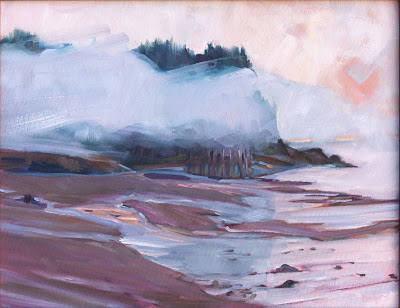
Fog Bank off Partridge Island, 14X18, oil on canvasboard, $1594 framed.

Sometimes there’s very little to work with. I once did an event in a coastal resort comprised of boxy modern houses shoved cheek-by-jowl along a strand. We were forced to find something beautiful, and the only way forward was to search shapes for a transformative angle or trick of the light. “You can make a good painting out of anything” is a good painting lesson and an even better life lesson.

Plein air events teach us to finish work. That last bit used to be my undoing. I once perseverated for years over a commission, to the point where it became a standing joke among my students. “Is that thing still there?” they’d ask as they trooped into my studio week after week.

Sometimes It Rains, 9X12, oil on archival canvasboard, $869 framed.

But plein air events allow for no such noodling. There’s an immutable deadline. You hand in work whether you think its done or not. A buyer or judge loves it for its unrefined energy. The adage that we spend 90% of our time doing 10% of the work is true in painting. It’s also true that we sometimes spend 90% of our time overworking that 10%.

Plein air painting is, simply, the most important art movement of our time. If you’re interested in it, I encourage you to dip your toe into the competitive process. Start with a regional show near you and see how it goes. Chrissy’s table is a good way to start.

Friday, October 12, 2018

The number one key to success as a plein air painter


It not only gets you through terrible weather, it keeps your brain supple.
Eventually, my easel fell into this manure pile. Of course.
The end of this week is dripping, sloppy and cool in the northeast. Nevertheless, there are painters trying to knock out paintings at events on Cape Ann and in the Hudson Valley. When they’ve committed to paint, they don’t have much choice but to succeed.

“100% chance of heavy rain tomorrow. more sun but much colder and windy on Friday. Cold and windy and cloudy on Saturday. Sunday there's a reception in Middletown; that's the day its sunny, but cold,” Elissa Gore noted on Wednesday. That’s a forecast that has the artist scrambling to pack every possible contrivance against the weather. Their only comfort is that every person in the event is facing the same lousy conditions.

Watch Her Paint! by Ed Buonvecchio. He painted this as we sheltered inside during a torrential downpour. (Private collection.)
Wind makes you wish you had five hands, because, outdoors, every item in your kit has the potential to go airborne. We can weigh down our easels, but umbrellas are useless. It’s difficult to clamp down a large canvas, so we switch gears and paint smaller. Or, we huddle in the lee of our cars, sacrificing the best view for what is possible.

Last week my class painted at a blueberry barren in Union, ME. The forecast was for fog, and when we arrived the clouds were kissing hilltops. My students’ value studies were developed accordingly. By 11 AM, the sky was clear, and the scene had changed entirely. It takes flexibility to salvage a painting in such radically shifting light. But it can be done.

Obstacles can include a garbage truck, as in here, in Manhattan.
Rain and snow are almost impossible obstacles for watercolorists. Even under cover, their paper just won’t dry. It’s almost as bad for oil painting. Once the moisture settles on your paints, any mixing creates a rigid emulsion of water and oil.

If you set up in a public place you stand the risk of something or someone getting between you and your view. It’s one thing if it’s a person. It’s another if it’s a delivery truck.

Or, a lovely boat is in harbor when you arrive and you decide to include it. You’re half-finished when you realize the lobsterman is preparing to leave. Even without people, boats move constantly on the water, and always according to their own mysterious plan.

Or the obstacles might be tourists, as here, in Camden harbor.
So how do you avoid coming home with a fistful of half-finished paintings? You learn to be flexible, to sub in other details for the ones that just vanished. You learn the cycles of places: the rotation of boats on their moorings, or when the food truck arrives and departs. You get creative about draping and bracing your easel to protect it. And, above all, you learn to paint fast.

All of those are signs of cognitive flexibility. This is the ability to switch your thinking or focus, or entertain multiple ideas or viewpoints at once. It’s an important part of learning and thinking. It’s one that declines through adulthood, sadly. The young brain is simply more plastic than the older one.

But your brain responds to exercise just like your body responds to yoga. The more you have to scramble, the better you get at it. Next time your easel falls down, remind yourself that you’re not just there making brilliant work. You’re exercising your cognitive flexibility.

Wednesday, July 18, 2018

How long did that take you?


Our actual painting time is a fraction of the total time we spend on our work.
The Stage Door, by Russel Whitten.
For the past four years, the third Wednesday in July has been the longest day in my calendar year. This year was no exception. It started at 6 AM, when I started writing for this blog. At 8 AM, I’d breakfasted and was in the field painting for the last day of Ocean Park’s Art in the Park. I finished at 1 PM, arranged my display and then set up my tools for Castine Plein Air (which starts this morning). From there, I returned to my host’s home, where I showered and dressed in respectable clothes. Then I packed my car. The reception ended at 7:30; at 7:42 I was pulling out of my parking spot. I did not even stop to eat.

I’ve driven into Castine when it lay enchanting under a full moon, and through dense coastal fog. Last night, a crescent moon hung low in the sky. “Midnight blue” is not advertising jargon; it’s the real color of the sky when there’s no ambient light and the stars seem to quiver in the night sky. It was beautiful but also very, very late when my friend Harry welcomed me back to his home.

Laundry, by Christine Tullson Matthieu
Recently a reader asked, “How do you stay awake for those long drives?” I find that singing is the best cure for sleepiness, so I do it loudly and enthusiastically. In fact, I sing so much that I’ve decided to form a NeedtoBreathe cover band, as I may be the only person in the world who can decipher their lyrics.

Temple, by Anthony Watkins.
Several people have asked, “How long does a painting that size take?” It’s a difficult question to answer. An 8X10 might take me three or four hours of actual painting time. That doesn’t include the time I spend setting up my palette, or dragging my gear across a beach, or the hours I spend driving or priming canvases and making frames.

Ocean Park Ice Cream Parlor, by Ed Buonvecchio.
Yesterday, Russ Whitten was trying to remember where he’d left a stack of watercolor paper. He spent precious time tracking it down, which cost him a final painting. That kind of thing happens because we’re tired, we’re hot, and we’re stressed. It has to be factored in to our schedule, as do equipment failures.

Some days it rains, by Carol L. Douglas
Two people asked me, “Of the five paintings you did for this show, which is your favorite?” It made me think about the values I was aiming for. In the end, I chose my rain painting. It was technically difficult and I think it captures the energy of that storm.

Based on that, I asked each of the other artists to choose their favorite painting to share with you. Meanwhile, I'm off to paint; our boards were stamped starting at 6 AM this morning.

If Rembrandt and Van Gogh could time travel


What would they think of modern painting in Maine?

Some days it rains, by Carol L. Douglas.
Last week, I wrote about Maine’s Art Museum Trail. A reader commented, “Standing in front of Rembrandt's Saint Matthew and the Angel at the Louvre, or Van Gogh's The White Orchard in the Van Gogh Museum in Amsterdam are sure to change one forever.” He’s right, of course, but were these two masters somehow superior to, say, Rockwell Kent?

I wonder what either artist would think of the contemporary work being done in landscape painting today. Both would have delighted in the wealth of pigments and materials at our disposal. That’s especially true of Rembrandt, who did so much with such a limited palette. Van Gogh was an admirer of the Primitivist Paul Gauguin; he would have understood that our contemporary painting style reflects the pace and shape of our lives. Both artists were misfits in their times and cultures. It is only retrospectively that they—and their styles—are lauded as brilliant.

Mostly, I think they’d like what they saw simply because mature artists tend to be very interested in other artists’ technique, approach and worldviews.

Ed Buonvecchio painted me painting the rain in the doorway of Ocean Park's temple. We oil painters have it a little easier in a deluge than watercolorists. Russ Whitten's solution was to run home and grab a hair dryer.
Russel Whitten and Christine Tullson Mathieu are having an especially tough time with the fog and rain at this year’s Art in the Park. It buckles watercolor paper and the paint never dries. This makes for extremely soft passages. Commiserating with Russ, I showed him the John Singer Sargent watercolor from Monday’s post, with its great amorphous, wet blob of darkness. In response, Russ told me that Andrew Wyeth, after seeing a Sargent show, came out and told the waiting critics, “I want to kill myself.”

It’s comforting to imagine a painter of his skill and stature reacting like that. We’ve all said something similar along the way.

Sea Mist, by Carol L. Douglas.
Why don’t artists see their own brilliance, but are keen to recognize brilliance in others? We know our own work too intimately to be impressed with it. The more one paints, the truer that becomes. Running down other artists is the province of amateurs.

“People strengthen each other when they work together, and an entity is formed without personality having to be blotted out by the collaboration,” Van Gogh wrote to Anthon van Rappard. That’s exactly what’s happened to this group at Ocean Park. This is our fourth year painting in a small ensemble.  We’re secure enough in our friendship to help each other.

It was inconvenient for painters and vacationers, but we needed that rain.
Meanwhile, the rain ended at midnight, and the last droplets are splattering down from the ancient trees overhead right now. That gives us a few hours before we have to pack our supplies, shower and deliver our work. Our show opens at 5 this evening at 50 Temple Avenue, Old Orchard Beach. If you’re in southern Maine today, come out to see us!

I’ve got one more workshop available this summer. Join me for Sea and Sky at Schoodic, August 5-10. We’re strictly limited to twelve, but there are still seats open.

Tuesday, July 17, 2018

Alone but not lonely


Technique is important, but it’s emotional power that draws people to paintings.
Reading, by Carol L. Douglas.
“I see artists who paint only flowers, only still life, only barns, only open landscapes, only portraits, only pets, only kitchen utensils, only books, only sailboats,” an artist said. “Why isn’t the artist painting more subjects, and trying new things?”

I’ve been painting long enough to have been there, done that. Some things I've tried simply don’t move me enough to focus on them. If I painted them, it would be only for mercenary reasons, and I don’t think that ever pays in the long run.

I paint still life when I can’t get out, but my interest is limited. Still, anyone who paints professionally ought to be able to paint a credible impression of almost anything in his or her line of sight.
Beach Grass (Goosefare Brook) by Carol L. Douglas
Ocean Park is typically crowded in the high season. If we were to be perfectly honest, our paintings would be full of people. I can draw people, so I don’t have much trouble adding them to my landscapes. Still, I don’t often do it. The problem is in meaning.

Yesterday, I set up downtown, looking at a table on a side-porch at the Curtis. There was nothing especially pictorial about the scene. But it had an evocative quality, suggesting a small, convivial party, relaxing after a day on the beach.

That’s the shell of sociability, and it’s as biographical as the clothes we wear. We recognize it in many places—a lonely writing desk, the objects in the console of another person’s car. In fact, much of still life is intended to suggest character that’s just briefly stepped away. Landscape can do exactly that, too.

Beach Toys, by Carol L. Douglas, 2017. In this painting, the figure is completely neutral, neither supporting nor distracting from the composition.
And yet the composition was still not satisfying to me. A person reading could add to the sense of stillness and anticipation, I thought. He or she should not be central to the frame, so I set a figure on the rail, feet dangling, a book in her lap. That was a mistake. The dangling legs interrupted the serenity of the scene. I turned the still androgynous figure to the right, in the classical languor of a Maxfield Parrish nymph. That didn’t work, either, because it’s a silly pose for 2018. However, it gave me the general bounding box of where the figure should fall.

A note: if you’re doing this, have a friend stand in the general area just long enough to make some marks to indicate their approximate height. Even the most perfectly-drawn figure will look ridiculous if it’s too large or small for the scene.

Later, Ed Buonvecchio and I went out to paint in the fog. It seemed like a good place to use my four-way flashers.
Why did I reject dangling feet and or a figure seated in a chair?  Either would have made a good subject for a painting, but they weren’t right for this one. I was feeling the terrific stillness of morning in Maine, and action and presence would have diminished that. In fact, too often, our last-minute tchotchkes end up damaging, not helping, our paintings.

As I was finishing, a lady carefully inspected my painting. It spoke to her on the same level as it spoke to me, so she commissioned me to do another version for her. There’s a lesson there for me: it’s not all composition or technique. People ultimately react to the emotional pull of place. Unless you feel it, they won’t, either.

I’ve got one more workshop available this summer. Join me for Sea and Sky at Schoodic, August 5-10. We’re strictly limited to twelve, but there are still seats open.

Wednesday, June 6, 2018

Two openings this Friday

You looking for me? This is where I’ll be this Friday.

Village at Camden Harbor Maine, Ann Trainor Domingue, courtesy of Camden Falls Gallery
I’ll start with Homecoming at Camden Falls Gallery, on Friday from 5-7 PM. This features the work of mixed media artist Ann Trainor Domingue and other gallery artists, of which I am one. I love Trainor Domingue’s work, which explores the interplay of family, friends, work and home in symbolic, playful, and non-realistic, terms.

I’m also looking forward to seeing owners Howard and Margaret Gallagher. They’ve been retailing art and craft in Camden for 37 years but decided to become official ‘snowbirds’ last winter.

“I don't want to say it's like migrating fish returning to their place of origin, but there's something really special about coming home to the gallery on the edge of Camden Harbor,” said Howard.

Ann Trainor Domingue was born in Fall River, Massachusetts and raised in Barrington, Rhode Island. Summer holidays spent on Cape Cod deepened her affinity for coastal estuaries, harbor towns, and the doughty New Englanders who earn their living from the sea.

Best Part of the Day, Ann Trainor Domingue, courtesy of Camden Falls Gallery
After graduating from Rhode Island College, Trainor Domingue had a successful career as an illustrator and art director. Two artist residencies from the Copley Society in Boston enabled her to return to Provincetown to paint after her escape from the corporate world.

Camden Falls Gallery is located at 5 Public Landing, Camden, ME. For more information, call (207) 470-7027 or email info@camdenfallsgallery.com.

Yellow dinghy (Camden), Ed Buonvecchio, courtesy of the artist.
Then I’ll amble down to Tenants Harbor to see Inspirations: 4 Paint Maine, featuring the work of Ed Buonvecchio, Suzanne deLesseps, Kathryn Baribeau, and Fran Scannell. Ed and I are good friends. We paint together at Ocean Park every year, and traveled to Nova Scotia together last year for the Parrsboro International Plein Air Festival. For some reason, this season has gotten away from me and I haven’t seen him yet.

Iced in at Rockport, Ed Buonvecchio, courtesy of the artist. This is a scene I know well.
Ed is from Camillus, NY, and has a BFA from SUNY Buffalo. An avid outdoorsman, he started painting in oils seriously while he and his wife Julie Richard lived in Arizona. “Plein air painting has been an extension of my love for nature and a way to study it. Painting is my way of sharing what I see and feel with others,” he said.

The show opens at Jackson Memorial Library, 71 Main Street, Tenants Harbor, ME, also from 5-7 PM. If you haven’t seen a show here, it’s worth the trip just to visit the library.

Wednesday, July 19, 2017

Tank half empty, week half full

A show and sale at Ocean Park tonight, and we are then off running to Castine.

Beach time, by Carol L. Douglas
“I’m not doing a preparatory sketch, a value study, nothing!” I announced to Ed Buonvecchio as I flopped down on a bench next to him and pulled out my tripod. It’s terrible practice, and I would never recommend it to my students.

Still, I can’t help smiling at the resulting painting. A passer-by smiled and said, “Now, that’s Ocean Park!” I believe in process, but I also hope to communicate some of the joy of the beach, the fog, and the sun. That’s why I paint in the first place.

It was the last of my six paintings for Ocean Park Art in the Park. I have no idea if they’re better or worse than last year’s. Nor am I overly worried. I’m not judgmental about others’ work; why would I do that to myself?

Cupholders are for cleaning brushes, right?
I’m going to spend the morning framing and digging out my car. Then I’ll deliver my work. If there’s time, I’ll paint one more painting, just for fun. Then I’ll shower, put on my party clothes, and head over to the show and sale.

That’s from 5-7 PM at the Ocean Park Temple. This 1881 octagonal frame structure is worth seeing. It's beautiful and redolent of 19th century values and tradition. Tonight, it will have the bonus of a very good wet paint show. (You can find it by programming 46-62 Temple Ave, Old Orchard Beach, ME in your phone.) I’ll be on the stage with Mary Byrom. No, we are not singing or dancing.

Beach toys, by Carol L. Douglas
Yesterday I was in front of the Ocean Park Soda Fountain at 8 AM. This building has exercised a mesmerizing charm on me this year. I set up to paint the beach toys on the gift shop side.

I’d like to tell you how many hours I painted “in earnest.” However, there was never any seriousness about it. I’ve painted in Manhattan many times, but never spoken with as many people as I did yesterday. Since they were at the beach, they were all happy. I think it comes through in my painting.

Talking with passers-by is part of what itinerant plein air painters do. If we didn’t like people, we’d be home in our studios, harrumphing along quietly.

The roof of the historic Temple at Ocean Park
Many people told me they saw a story about us in the Journal Tribune, and felt welcomed to talk to an artist. It’s rare that I see an immediate response to a news story like that.

A number of people also mentioned seeing my painting of Fort Point Historic Site in the Bangor Daily News, as part of the publicity for Wet Paint on the Weskeag. The preview and sale will be at the Kelpie Gallery in South Thomaston on August 13 from 4-8 PM.

But before that happens, I’ve got many miles to go. Tonight, after the last paintings are packed up and the Temple lights dim, Mary Byrom, Anthony Watkins and I leave for Castine Plein Air. We will roll into that quiet village a few minutes before midnight. Tomorrow we line up bright and early on the Village Green to have our canvases stamped, and we are off and running again.

Tuesday, July 18, 2017

Woman about town

The joys of a beach vacation: drying towels and an old-fashioned ice cream parlor.

Drying towels, by Carol L. Douglas
Cheney Cottage, built in 1881, is now owned by the Ocean Park Association. It includes the Prophet’s Chamber, where the guest preacher stays. A shuffleboard court graces the side lawn; it’s run by a fifth generation Ocean Parker. The rambling old cottage itself is holiday housing.

Accompanied by early-morning birdsong, I strolled down Temple Avenue. I was looking for a streetscape that would capture the leafy greens, genteel architecture and relaxed summer feel of Ocean Park. Bright drying towels on the rail at Cheney Cottage caught my eye. They reminded me of summer trips to Maine when my kids were young.

As always, I did a value sketch before I started. From there I transferred my drawing to a 9X12 canvasboard. I frowned; it was too small. I decided to scale it up to 11X14.

I must have needed more coffee or something, because when I was done, the house was the same size as on the 9X12, but with more foreground showing. 

The temptation in this situation is to add an object to the foreground to fix the bad design. I experimented with a figure, but it didn’t work. Adding objects as an afterthought usually makes things worse, drawing the eye away from the primary subject. 

No matter; the house sits under great mature spruces, so the lawn was dappled with light and shadow. Having more foreground turned out to be no problem at all.

One of the great joys of plein air painting is the people you meet along the way. Cheney Cottage is currently occupied by an extended family who vacation together every year. Many of them stopped to see what I was doing. I spoke with an aunt who now stays across the street. As the family grows, there’s no longer room for them all in the old place.

The composition that was not to be.
I’m staying in the “new” part of the park, where cottages date from the 1920s and 1930s. In some ways, the character of Ocean Park—like everywhere—is inexorably changing. A long-term resident lamented the new builds in town. “Someday, all the old places will be gone,” she said. But not any time soon, thank goodness.

In the afternoon, I revisited a subject I’ve painted twice before: the Ocean Park Ice Cream Parlor. Here in southern Maine, the land is low, level and sandy. That makes wandering around with one’s gear easier, but it makes sight lines more challenging.

It helps to know perspective drawing, even when you're feeling expressive.
No matter what angle I choose, the foundation of the ice cream parlor remains resolutely parallel to my picture plane. I’d explored the possibilities of that on Sunday with my surf painting, I didn’t want to do it again. I set up about three different paintings and wiped them out. Then a couple stopped to read the outside menu board. Idly, I sketched them on my canvas. I liked them, and built the rest of the painting to support them.

Over the afternoon, my figures morphed into a father and a child, and another person materialized. By 4 PM, both the painting and I were done.

What's for lunch? by Carol L. Douglas
In the evening we had a lively reception for the artists. I went home to nap, intending to go out with Russel Whitten to do a nocturne. But when I awoke at 8:15, my eyes were nearly as red as my shirt. I went back to sleep.

This morning, the fog is not limited to my head. Fog makes for good painting, so I’m heading out in a few minutes. If you’re in southern Maine this morning, stop to see me. You can get directions at Jakeman Hall, at 14 Temple Avenue.

Monday, July 17, 2017

Reunion

The aurora borealis didn’t show up, but my friends did. Our plein air event at Ocean Park is off to a great start.
The new sandbar, 10X8, oil on canvas, by Carol L. Douglas

I arrived in Ocean Park in a flurry of excitement. The sun has been kicking up an electro-magnetic storm and it was possible the Aurora Borealis would be visible as far south as Boston. While Ocean Park is two hours south of my house, I thought there was a good chance we might get a glimpse of them.

I’ve seen the Northern Lights many times, but never with paints in hand. I’ve painted them in my studio but I long to paint them en plein air.

Goosefare Brook oxbow, 8X6, painted last year. It's gone now.
To that end, Frank Gwalthney and I drove down to Rachel Carson National Wildlife Refuge. This 50-mile-long Federal preserve touches Ocean Park. In addition to sheltering sea birds, it also provides an oasis of dark sky in Vacationland. But, alas, there was no shimmering green light, merely beautiful stars.

I spent five weeks painting in Canada and Alaska last year and never saw them there, either. They are fickle and shy.

Still, it’s not what you don’t have; it’s what you do have, and what I have is a happy band of painters whom I treasure as friends. Anthony Watkins set up to paint the Ocean Park Ice Cream Fountain. The rest of us headed off to the mouth of Goosefare Brook.

The Heavens Declare, 48X36, oil on linen, by Carol L. Douglas. Once again, I miss the chance to paint Aurora Borealis in the wild.
We’d heard that the tides had scoured out a new channel for the brook, but I was unmoved. Goosefare Brook wiggles around in its basin annually. My skepticism was misplaced. The oxbow is entirely gone. Its hundreds of tons of sand now sit out in the ocean as a new sandbar off the creek’s mouth. This has created a tidal pool of still water, suitable for young kids and anyone else who doesn’t want to fight breakers.

We understand that the ocean is unfathomably powerful, but that tangible proof is more convincing than any number of warnings.

Straight-on breakers, 10X8, by Carol L. Douglas
Despite our slow start and happy chatter, we all managed to turn out credible first paintings. In a few minutes, I’m heading downtown to start my first painting of the day. I think it will be a streetscape. If you’re in southern Maine this morning, stop to see me. You can get directions at Jakeman Hall, at 14 Temple Avenue. (If you’re new to Ocean Park, you may need to set your GPS for Old Orchard Beach.)


See you soon!

Wednesday, July 12, 2017

Historic New England, two towns apart

Looking for me? I’ll be in Ocean Park and Castine next week.

Wadsworth Cove garden, 12X9, oil on canvas board, Carol L. Douglas
For plein air painters this is haying season, the time we are working flat-out. However, I’ve had company this week. My nephews are in school, so they can’t visit during the off-season. We shoehorned this visit in between my trips. I hit the road again on Sunday.

My first stop is historic Ocean Park, ME. This invitational event is small, featuring Russel Whitten, Ed Buonvecchio, Anthony Watkins, and Christine Mathieu—and me, of course. This year the lineup is augmented by the return of Mary Byrom. She’s a fixture in southern Maine painting.

Last year, Russ, Ed, Anthony and I ended up painting as an ensemble, larking about together as friends rather than competitors. It was an entertaining, productive plein air experience, and I can’t imagine how it could be better.

Curve on Goosefare Brook, 8X6, oil on canvas board, Carol L. Douglas
Ocean Park is one of about a dozen remaining daughter Chautauquas in the US. It’s the only remaining one in Maine. Another camp meeting site, the Northport Wesleyan Grove Camp Meeting, exists today as the Bayside Historic District in the town of Northport. If there are others in this state, I haven’t run across them yet.

This movement started in 1874 with the New York Chautauqua Assembly, initially to train Sunday school teachers, but eventually dedicated to adult self-improvement. Chautauquas were usually set up in the woods, on lake or ocean shores, within day-travel distance of cities. They provided a potent combination of preaching, teaching, and recreation, and they became a craze. Among my few family photos are pictures of my grandmother and her sisters at Chautauqua, NY, around 1910.

Ocean Park ice cream parlor, 12X16, oil on canvas board, Carol L. Douglas
Ocean Park was founded by the Free Will Baptists in 1881. Except for internet and electricity, its Temple, meeting halls, and library remain unchanged. Historic, pretty cottages line its streets.

The sale of work will be at the Temple on Wednesday at 5 PM, but the exciting part of the week is earlier, when the artists are at work. Our whereabouts are posted on a sign outside Jakeman Hall; come see us!

After we pack our tents on Wednesday evening, Mary, Anthony and I will be trundling north for the fifth annual Castine Plein Air. Castine is historically significant for entirely different reasons, but it’s an equally beautiful town.

Wadsworth Cove spruce, 6X8, oil on canvas board, Carol L. Douglas
Located at the mouth of the Penobscot River estuary, Castine predates Plymouth Colony by seven years. Much of the town is 19th century New England clapboard and whitewash. Established in 1794 and in the same building since 1833, the post office is one of the United States's oldest. Set far off the beaten track, Castine retains its small-town feeling even during summer tourism season. In fact, my only recommendation is that, if you want to stay over for the show, you reserve lodging now.

Castine has two excellent museums and a fine library that usually features an historical display, so it’s worth visiting on its own merits.


Castine Plein Air is juried and highly selective. With 39 artists painting within the confines of the town, you don’t need to check with the organizers to find us. We meet at the village green early on Thursday, and then paint until Saturday. The reception will be held from 4 to 6pm on Saturday, July 22.

Thursday, June 29, 2017

Slightly sloshy artist gets soaked

The only thing you can predict with certainty about this summer’s weather is that it will rain.

Just slightly soaked, I try again. Photo courtesy of Annette Koziel
Fishermen’s Memorial Park sits above the lobster fleet in Boothbay Harbor. It’s a sobering memorial; the list of lives lost at sea is long and a fresh wreath hangs on its bronze dory.  Behind the park rises the uncompromising white frame spire of Our Lady Queen of Peace Catholic Church, celebrating its centenary this year. Its vaulted ceiling is reminiscent of the ribs of the Ernestina-Morrisey, currently laid open in Boothbay’s shipyard. On the hour, Our Lady’s carillon peals earnest hymns across the water.

Our Lady of Peace Catholic Church.
Bobbi Heath, Ed Buonvecchio and I were meeting to demo for Windjammer Days. We’d planned to grab lunch in town and then paint at the Fire Hall, where a tent was set up for our convenience. However, we’re landscape painters. The best view of all was from the park and the church.

Clearly, everyone else thought so too. The place was mobbed. Late in the morning, one of my students, Jennifer Johnson, stopped by. We were just coming to grips with the idea that we couldn’t leave to get something to eat. Jennifer kindly volunteered to fetch our lunches. The restaurant was closed, so she brought us fresh vegetarian chili made with her own two hands. That, friends, is ‘supporting the arts.’

American Eagle, a tug, and an antique launch... clearly the best view in town.
“It’s going to be a great day,” Jennifer promised me. “No rain on the forecast.” Radar agreed with her. Large fluffy clouds marched in from the west. Our displays of work were set up, we were surrounded by interested people asking intelligent questions, and below us paraded a motley collection of fantastic winged angels, the windjammers for which the festival is named.

A young lad named Ben positioned himself next to me, trying to name the boats as they came in. “It’s just like identifying cars,” I told him. “You figure out the model from its shape and its details. Does it have a topsail? A bowsprit? A racing stripe?”

My sketch. The tide was on the turn, so the boats were swinging.
He was fascinated by the privateer Lynx. It’s an interpretation of an historic privateer built in 1812 to run British naval blockades. Its masts are severely raked, meaning they tilt. This term gives us the modern word rakish.

The boats and their adoring fans moved on. Ropy fingers of moisture started to spill down from the friendly cumulus clouds. “It’s raining there, there, and there,” I said to Ed and Bobbi. We’d barely repacked our gallery when the skies let loose.

Rain, again.
Annette Koziel, a friend and fan from Brunswick, arrived with the rain. She had a tarp in her car. We tossed it over my easel and ran for Bobbi’s car. Artists know that if Nature throws a passing shower, you use the break to find a bathroom.

At the Lobster Dock.
It stopped as quickly as it started. I mopped up and tried again. I picked up my brush and a second shower poured down. I can take a hint, I thought.

Lobster boats at Boothbay (unfinished) by Carol L. Douglas
I had an errand to run in Brunswick, so I headed south, taking me across the giant parking lot that is the Wiscasset bridge. Generally, I do sums in my head when I need to stay alert while driving, but Annette gave me a great tip. A small radio station broadcasts quirky, mid-century standards from an old tidal mill in West Bath. If you’re traveling up Route 1, try tuning your radio to 98.3.

Later, I heard from Jennifer. She was so sure it wouldn't rain that she left her windows open while she ran in the grocery store. Now, that's adventurous.

Tuesday, June 20, 2017

That vexing exchange rate question

In every important way, Canadians and Americans are indistinguishable. That artificial barrier, the border, makes our common life hard.

Poppy Balser's weir painting sold at the opening bell.
In 2012, the Canadian and US dollars were trading at close to par. Today, one Canadian dollar is worth just three bits (and a penny, but Canada no longer uses the penny). This isn’t the historical worst it’s been, but it’s close enough for discomfort.

The US dollar has also been weakening, but the Loonie has lagged even more. For both economies, this is in part because of central bank policies and in part because oil prices are down.

I benefited from the weak Canadian dollar when I crossed Canada last fall. The same dollar disparity hurt when I was trying to sell work in Canada.

Ed Buonvecchio painted the Cape D'or lighthouse. My photo doesn't do the painting justice.
We’d been told to price our work as usual by juror Bill Rogers. Even if he hadn’t said it, it’s my usual practice. It’s unfair to collectors and galleries to hop around when you price your work.

I was unsure how to apply the exchange rate. I ended up leaving the work at its American tag price. Even that was too expensive. There were five American artists in the festival. We were terrifically expensive compared to our Canadian peers.

My painting of the Parrsboro light was distinctively Nova Scotian; I wanted to sell it there. I dropped it to half its American price. It sold for $400.

From that, the venue takes 40%. This is a legitimate commission, and one every serious artist is happy to pay. That leaves me with a check for $240.

Mary Sheehan Winn painted Partridge Island.
But wait, there’s more. My bank is going to convert that and, assuming there are no additional currency fees, I will take home $181.25.

I know just enough about economics to understand that a strong American dollar hurts exports; a weak dollar helps exports. Growing up on the Niagara Frontier, I know there were years we went to Canada for gas and other years when Canadians came to the US to shop.

But I’ve never understood the exchange rate so personally.

Rockies at Canmore, Alberta. Christopher Gorey, of Ingonish, Nova Scotia, is a new painter to me. This wasn’t his festival piece, but it’s a good example of his great touch with watercolor.
There was another disparity in pricing, one that affected only Canadian artists. Artists who sell more than $30,000 per year are required to collect something called the HST, or Harmonized Sales Tax. They have to tack 15% on to the ticket price of their work.

The only time American artists collect sales tax is when we sell paintings directly to collectors. When paintings are sold through events or galleries, it’s the venue’s responsibility. The Canadian system would take some getting used to.

Marc Grandbois of L’Anse -St- Jean, Quebec City, is another painter I will keep track of. He caught the lowering sky over Two Islands beautifully.
Those of us who live along the border understand that in every important way, Canadians and Americans are indistinguishable. We have the same values, argue over the same disagreements, love the same landscape, drink the same coffee, shop at the same big-box stores, and (generally) speak the same language. NAFTA was supposed to make trading between us easier. In fact, between heightened border security and the disparity of our dollars, it’s harder than ever.

A pity, that.