 |
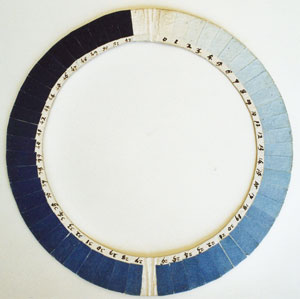
Saussure’s Cyanometer. Should put any fears of Prussian Blue being fugitive to rest; he made this in the mid-18th century.
|
How blue is the sky? Landscape painters know that this varies depending on where
one is standing, the season, the weather, and even the direction in which one
is looking. Local conditions also apply; for example, here the
sky directly to the north often fades to a softer blue from the water vapor
that hangs over Lake Ontario.
Then there’s the question of altitude. With the advantage of
modern travel, many of us have been to the Rockies. We know that the sky there
can achieve an aching blueness that is nothing like what we see here in the
east.
 |
Baldy Mountain, Montana
|
“Why is the sky blue” was not actually answered until the end
of the 19th century (which makes you wonder what earlier parents told their pesky
children). The question of why that blueness varies in intensity
was answered in the 18th century, and it was answered in part by
that peculiar little device at the top of this page, the Saussure Cyanometer.
Horace-Bénédict de Saussure (1740-1799)
was a Genevan aristocrat and physicist who grew up climbing and studying
nature. In 1760, he hiked the Chamonix
valley in France, making extensive notes and sketches, and climbed the Brévent,
which faces Mont Blanc, the highest point in western Europe.
 |
| A sky in the Steam Valley in Pennsylvania has a very different color. |
In the spirit of the times, he measured and recorded
everything he could. He was an inveterate tinkerer, making new instruments,
including a hygrometer, a magnetometer, an anemometer, a diaphanometer (to
measure the clearness of the atmosphere) and a eudiometer. He puttered with a heliothermometer—a
thermometer to measure the intensity of
the sun’s rays—and purportedly built the world’s first solar oven.
Alpine legend held that if one
climbed high enough, the sky turned black and one could see into the Void. Saussure understood, however, that the
blueness of the sky was an optical effect that was somehow related to the sky’s
moisture content.
Saussure dyed paper squares with Prussian Blue (which stains
terrifically dark) in every shade he could manage between white and black. He
assembled these into a numbered circle that could be held up to the zenith at a
standard distance from the eye.
 |
Descent from Mont-Blanc in 1787 by H.B. de Saussure, Christian
von Mechel, copper engraving, colored.
|
Saussure made an unsuccessful attempt on Mont Blanc in 1785. After two Chamonix men attained the summit in 1786, Saussure himself made the third ascent of the mountain in 1787. With a servant and 18 guides to lug his equipment, he reached the summit in 3 days. Saussure measured everything he could. The sky was the deepest shade he ever recorded, at 39 degrees blue (out of a rather confusing 52° circle).
Join me in
October, 2013 at Lakewatch Manor—which is selling out fast—or let me know if
you’re interested in painting with me in 2014. Click here for
more information on my Maine workshops!
