Paint Schoodic

To see more paintings, learn about workshops and classes, and more, visit my website.

Showing posts with label Kathe Kollwitz. Show all posts

Thursday, March 21, 2019

One messed-up dude

But Egon Schiele certainly could paint a lovely boat.
Segelschiffe im wellenbewegtem Wasser (Der Hafen von Triest), 1907, Egon Schiele, private collection
I have a hard time loving the work of Egon Schiele. Erotic paintings, emaciated figures, and anguished self-portraits leave me cold. I far prefer the Expressionism of Käthe Kollwitz and Gabriele Münter. They weren’t happy, either, but at least they had something real to complain about.

Then my friend Bruce McMillan introduced me to Schiele’s boat paintings. They don’t quite make up for all those tortured people, but they’re beautifully drawn and kinetic. Interestingly, the highest auction prices for Schiele’s work are not for his erotica, but for his landscapes, including the record-setting Häuser mit bunter Wäsche ‘Vorstadt’ II, which sold for $40.1 million in 2011.

Boote im Hafen von Triest, 1908, Egon Schiele, courtesy Landesmuseum Niederösterreich
There’s no question that Schiele was a prodigy. At 16, he was the youngest student ever to enroll at Vienna’s Academy of Fine Arts. After three years, he quit without graduating. In school and after, he was mentored by Gustav Klimt, who did much to advance his career.

“Klimt was an established star and Schiele a cocksure student when the two first met in 1908,” wrote Laura Cumming. “But it is immediately obvious… that their obsessions were already mutual.”

Klimt had innumerable affairs and fathered 14 children out of wedlock. But he was staid compared to his protégée, who was completely amoral in matters of sexuality. Schiele was incestuously attracted to his sister Gerti, to the great consternation of their father (who went on to die of syphilis himself). At age 16, Schiele took Gerti, then 12, by train to Trieste and spent the night with her. 

At 21, he met Walburga (Wally) Neuzil, age 17, one of Klimt’s models. Aspiring to leave ‘repressive’ Vienna behind, the couple moved to a small Bohemian village. Driven out due to their lifestyle, they moved to slightly-larger Neulengbach. There, Schiele was accused of seducing a young girl and making pornographic images available to children. Although the rape charge was eventually dropped, he spent a month in jail for the pictures.

Dampfer und Segelboote im Hafen von Triest, watercolor, pencil and gouache on Japan paper, 1912, Egon Schiele
Back in Vienna, he wrote a friend, “I intend to get married, advantageously. Not to Wally.” Instead, he’d picked out Edith Harms, from a good middle-class family. As a former prostitute and artist’s model, Wally was a professional liability. Schiele proposed that he and Wally continue their relationship, vacationing together every summer without Edith. Wally indignantly refused.

Four days after the wedding, Egon Schiele was drafted into the army. He was given a job as a clerk in a POW camp. There, he drew and painted imprisoned Russian officers, nicking extra rations for himself and Edith on the side.

Die Brücke, 1913, Egon Schiele, private collection
By 1917, Schiele was back in Vienna. He was invited to participate in the Vienna Secession's 49th exhibition in 1918, with a prodigious 50 works in the show. His success was spectacular. Demand—and prices—for Schiele’s work rose rapidly.

It was, alas, a short-lived triumph. In autumn of that year, Spanish flu pandemic reached Vienna. Edith and their unborn child died on October 28. Schiele lived just three days more. He was just 28.

It’s tempting to wonder what marriage, parenthood, and maturity would have done to temper the wild excesses of his youth, or how it would have changed his style. But, had he lived to ripe old age, Schiele would have also experienced the annexation of Austria by the Nazis twenty years later. It’s hard to imagine he would have prospered.

Tuesday, June 27, 2017

Why do you do what you do?

It is possible to be a successful woman artist and mother, if one has an exceptional husband, good time-management skills, and an iron will.
Daddy's little helper, 2015, Carol L. Douglas
Yesterday I was reveling in the simplicity of my job. I had planned no deep thinking; it would be a day alone with my brushes.

That never works. “Why do you do what you do?” asked a regular reader.

The easy answer is that it’s the only thing I know how to do. A little honesty compels me to admit that this isn’t entirely true. I can write. I could retire if I want. Clearly, something besides necessity drives me.

In fact, my reader sensed that. “Why do you teach, travel all over the place, produce as much work as you do?” she continued. “Is working at that pace a habit, or something deeper?”

Maternité, 1890, Mary Cassatt. Cassatt, the greatest painter of the mother-child bond, had no children of her own.
Yes, I was raised to work hard, and it’s an ingrained habit. Still, I do take time off. A chance conversation with a Mennonite contractor years ago turned me into a Sabbatarian. He explained what a tremendous gift a regularly-scheduled Sabbath day was. There are a few weekends a year I can’t take off, but in general, you’ll find me working six days and resting on the seventh.

I like painting and I like being on the road. I like the challenge of sizing up new places and trying to reformat them to a 12X16 canvas.

But mostly, I work like this because I can. It’s a pleasure and a shock to be free of day-to-day responsibility for others. Yesterday, I mentioned a Tracey Emin quote about parenting. Here it is in full:

I would have been either 100% mother or 100% artist. I’m not flaky and I don’t compromise. Having children and being a mother… It would be a compromise to be an artist at the same time. I know some women can. But that’s not the kind of artist I aspire to be. There are good artists that have children. Of course there are. They are called men. It’s hard for women. It’s really difficult, they are emotionally torn. It’s hard enough for me with my cat.

When I first started painting full time, another woman artist told me much the same thing. The evidence supported her statement. Most artists (of either gender) in our circle were childless. Those with children also had wives who supported both their family and their art careers.

Mutter mit Jungen, 1933, Käthe Kollwitz. Kollwitz is an exception to rule that says mothers can’t make good artists.

That realization came close to derailing me. I was struggling to make enough time for my kids and art, but the historical reality seemed to be that women with children would always be second-rate painters.

I’m glad I didn’t learn that before the kids were irrevocable. They’re certainly the best work I’ve ever done.

Now that I’m beyond child-care, I think it’s a case where history is not necessarily destiny. Gender roles have changed tremendously in the last century. It is possible for a woman to combine competent child-rearing and any career, provided she has an exceptional husband, good time-management skills, and an iron will.

But the question my reader asked is an important one. There are many easier ways to live. Why do we do what we do?

Monday, January 5, 2015

Don’t knock it until you try it

Baby Jake, tiny sketch by me while he slept in my lap.
There is a meme panning ugly Renaissance babies. Every time it pops up, I’m reminded that the posters have most likely never painted a baby from life.

Most of my successful artist pals are childless. This makes perfect sense in the modern world, for fine arts is a career path that requires long hours for little remuneration, and that often requires travel or living in a child-hostile place like NYC. This means that children and motherhood are generally not subjects for serious modern painting, except in portraiture.

I’ve done two baby portraits, and both were done from photos. Babies wiggle, they have unreliable schedules, and when they’re not sleeping, they’re often hungry or upset about something inscrutable.
Tiny gesture drawing of baby Jake. His center of gravity is certainly his bottom, although that head weighs a lot, too.
This weekend I had my infant grandson with me. I’d hoped to paint him during my class, but there were too many students. After class, he and I sat down to rest, and he fell asleep on my lap. I was able to fish a tiny (3.5X5”) sketchbook off the coffee table with my spare hand, and do the attached sketches.
A fast sketch of Jake's wonderful face before he twisted away again. It's really hard to get the baby head's proportions right.
When we do gesture drawings in class I tell my students to look for the “axis of power” in the figure—the place from which the subject’s motion is springing. Usually that’s the pelvis; less frequently, it’s the shoulders. In the case of a young infant, I believe that’s usually his rump. He is learning to control his limbs, he pushes himself up with his legs and then collapses, and when he settles down against you, you inevitably end up patting his bottom.
Tiny gesture drawing of baby Jake as he wiggled himself to sleep.
There have been very few painters who focused on children. Mary Cassatt—who was unmarried and childless—was one; Kathe Kollwitz—who had childcare so she could concentrate on her career—was another. It’s a pity that we dismiss a subject that’s of such primal importance, for all of us at one time or another have been babies or parents.

Let me know if you’re interested in painting with me in Maine in 2015 or Rochester at any time. Click here for more information on my Maine workshops! Download a brochure here.

Friday, September 12, 2014

A personal aside

Selbstbildnis, mit der Hand an der Stirn (Self-portrait, hand at the forehead), etching, 1910, by Käthe Kollwitz,  
Forty-five years ago, I was at a school pool in Niagara County, New York, when my sister had a brain bleed. She died. With us were my friend S. and her mom, although at the time they seemed tangential to the tragedy that engulfed my family.

It was compounded four years later when my brother—who happened to be S.’s classmate—was killed by a drunk driver.

Sorrowful old man, pencil, black lithographic crayon, wash, white opaque watercolor, on watercolor paper, by Vincent Van Gogh, 1882
We move on. Our flock tends to be made of birds of the same coloration. And I think I’m probably an unmotivated intellectual. Why, just yesterday, I was discussing Steiner and Kandinsky and their daft color theories with three dear friends. This is fun, it’s fluff, and no more or less meaningful than talking football is for other people.

I haven’t seen S. in years, but through the miracle of Facebook, we’re in loose contact.

Last evening, my mom died. I refuse to discuss my grief with anyone, but it is substantial.

And then S. posted this video:


For the first time I understand what it meant to praise God from the depths of grief. That’s wisdom, and it’s a far greater thing than knowledge.


Message me if you want information about next year’s workshops.

Monday, December 30, 2013

Who's crazy now?

The Prisoners, 1908, Käthe Kollwitz, from A Weaver’s Revolt.

Yesterday, a reader sent me this, after commenting that Käthe Kollwitz’ Woman with Dead Child was a frightening drawing: “It is believed Käthe Kollwitz suffered from anxiety during her childhood due to the death of her siblings. More recent research suggests that Kollwitz may have suffered from a childhood neurological disorder called Alice in Wonderland syndrome, commonly associated with migraines and sensory hallucinations…”

One presumes part of this fantastical diagnosis has to do with the monumental scale of Kollwitz’ work, since Alice in Wonderland syndrome includes seeing things as either really big or really small. Part of the nature of sculpture is its monumentality, but Kollwitz was a woman. Nobody says this kind of thing about Henry Moore, so evidently there are still art critics out there who suffer from visual gender dimorphism.

The Carmagnole (Dance Around the Guillotine), 1901, Käthe Kollwitz.
Kollwitz was a misfit. She was born in Bismarck’s Prussia; she was three years old when the Franco-Prussian War started. Yet her parents and grandparents were dissident, religious, pacifist socialists who thought enough of her potential as an artist to send her to Munich to study.

A glimpse of the happy girl whom the woman might have become: Kollwitz' self portrait from 1889.
As a woman artist, she is almost unique in having had the unconditional support of both her father and husband to pursue her career.  She married a socialist doctor, Dr. Karl Kollwitz, who worked among Berlin’s poor. But their own political beliefs could not inoculate them against tragedy. Their two sons, Hans and Peter, immediately enlisted at the outbreak of hostilities in June, 1914.

“The whole thing is so ghastly and insane. Occasionally there comes that foolish thought: how can they possibly take part in such madness? And at once the cold shower: they must, must!” she wrote.

The Grieving Parents, 1932, Käthe Kollwitz, now in Diksmuide, West Flanders, Belgium. This was executed as a memorial to her son Peter, who died at Diksmuide.
Later that year, Peter was killed at the Battle of the Yser in Diksmuide, Belgium—one of a staggering 140,000 casualties over two weeks. Kollwitz sought peace in her work and could not find it. “When [the grief] comes back I feel it stripping me physically of all the strength I need for work. Make a drawing: the mother letting her dead son slide into her arms. I might make a hundred such drawings and yet I do not get any closer to him. I am seeking him. As if I had to find him in the work... For work, one must be hard and thrust outside one-self what one has lived through. As soon as I begin to do that, I again feel myself a mother who will not give up her sorrow.”

As lifelong socialists, the couple worked actively to combat the rise of fascism. Adolph Hitler responded by demanding that Kollwitz resign from the Prussian Academy of Arts and banning Dr. Kollwitz from practicing medicine.  “For fourteen years... I have worked together peacefully with these people. Now the Academy directors have had to ask me to resign. Otherwise the Nazis had threatened to break up the Academy. Naturally I complied.”

Mother with Two Children, 1932-36, Käthe Kollwitz.
By then, Kollwitz was a world-famous artist and they were invited to seek asylum elsewhere. They refused, fearing reprisals against their family. Instead, they made a mutual suicide pact in the event of a return visit by the Gestapo. Dr. Kollwitz died in 1940 and they lost a grandson, also named Peter, on the Russian Front in 1942. Their house and much of her work was destroyed by British bombers in November, 1943.

Kollwitz died on April 22, 1945, two weeks before the cessation of European hostilities. “War accompanies me to the end,” she wrote.

Hunger, 1923, Käthe Kollwitz
Kollwitz’ work speaks in the universal language of death, poverty, grief, war and famine, which is why her work has had such a lasting impact. But these were not what she set out to paint. “How can one cherish joy when there is really nothing that gives joy? And yet the imperative is surely right. For joy is really equivalent to strength.”


Let me know if you’re interested in painting with me in Maine in 2014 or Rochester at any time. Click here for more information on my Maine workshops!

Sunday, December 29, 2013

That's insane.

Woman with Dead Child, 1903, Kathe Kollwitz. The majority of 20th century artists presented madness and grief as a terrifying spectacle. Kollwitz, uniquely, empathized with those who were suffering.

Last week when I wrote about modern culture’s inexorable squeeze toward a single mode of thinking, I had a vague idea that it might be interesting to look at how madness has been painted. This proved more difficult than I expected.

Insane Woman, 1822, Théodore Géricault, from his Monomania series.

The modern era has just too much to choose from—Edward Munch’s The Scream, Van Gogh’s self-portrait sans ear, the entire oeuvre of German Expressionism.  Théodore Géricault’s Monomania series has a certain appeal, since they were an experiment in using art in the service of science. The trouble is, the subjects look less mad than grumpy, and they’re a singularly uninviting bunch of paintings.

Géricault’s criminally insane subjects seem almost normal in comparison with his Romantic portraits, but he came of age during the French Revolution. In such circumstances, there is a blurred line between sanity and insanity. Géricault himself studied the heads of guillotine victims because he believed that character was most revealed in extremis. Nothing nuts about that, is there?

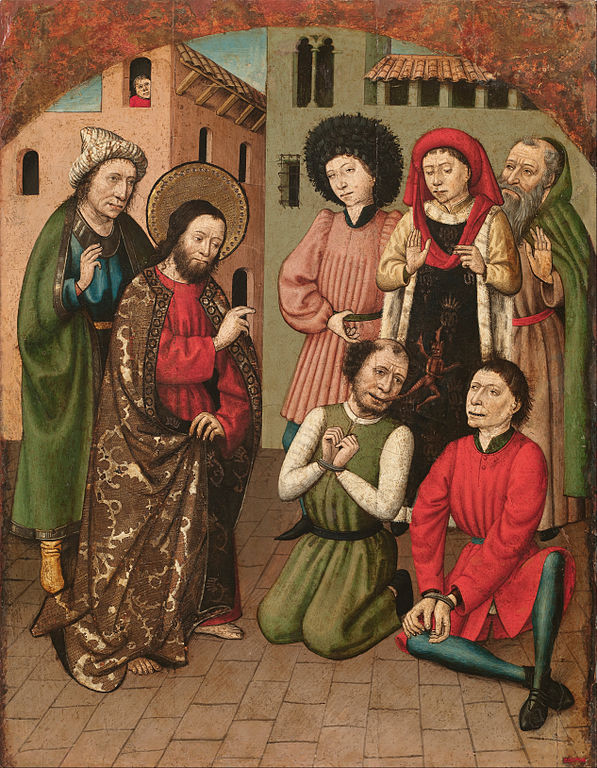
St. Bartholomew Exorcising, c. 1440-1460, the Master of the St. Bartholomew Altarpiece. Although we don’t know the identity of this painter, about 25 of his works have survived. It is presumed that he was trained in the Netherlands, although he worked in Cologne; he is considered to have been the last Gothic painter active in that city.

For all the stuff that is in there, “demonic possession” is not recognized in any versions of the Diagnostic and Statistical Manual of Mental Disorders (DSM). However, psychiatry, as a discipline, is a little more than 150 years old; exorcism has been with us since the dawn of time and spans religious barriers. It has been practiced historically in almost every major religion that believes that man has a soul.


Desperation, 1306. In this fresco, Giotto attributed suicide to the presence of a demon, top left.

Goya painted St. Francis de Borja performing the rite of exorcism at least twice. By the time he was painting, exorcisms were in sharp decline in the western world, ushered out by the Age of Reason. Oddly enough there has been a sharp rise in exorcisms since the middle of the 20th century. Perhaps this is a romantic notion spawned by television and movies, or it may represent our disaffection with psychiatry.


San Francisco de Borja attends a dying unrepentant sinner, c. 1788, by Francisco Goya. Fr. Francis was an early leader of the Jesuit order, and was widely regarded during his own lifetime as a saint. Goya depicted this 16th century exorcism from a more modern viewpoint than Fr. Francis's contemporary would have; the beasts waiting to devour the unrepentant soul are not concrete.


Let me know if you’re interested in painting with me in Maine in 2014 or Rochester at any time. Click here for more information on my Maine workshops!