 |
| Woman with Dead Child, 1903, Kathe Kollwitz. The majority of 20th century artists presented madness and grief as a terrifying spectacle. Kollwitz, uniquely, empathized with those who were suffering. |
Last week when I wrote about modern culture’s inexorable
squeeze toward a single mode of thinking, I had a vague idea that it might be
interesting to look at how madness has been painted. This proved
more difficult than I expected.
 |
| Insane Woman, 1822, Théodore Géricault, from his Monomania series. |
The modern era has just too much to choose from—Edward Munch’s
The Scream, Van Gogh’s self-portrait
sans ear, the entire oeuvre of German
Expressionism. Théodore Géricault’s Monomania series has a certain appeal,
since they were an experiment in using art in the service of science. The
trouble is, the subjects look less mad than grumpy, and they’re a singularly
uninviting bunch of paintings.
Géricault’s criminally insane subjects
seem almost normal in comparison with his Romantic
portraits, but he came of age during the French Revolution. In such circumstances, there is a blurred line between sanity and insanity. Géricault himself studied
the heads of guillotine victims because he believed that character was most revealed in extremis. Nothing nuts about that, is there?
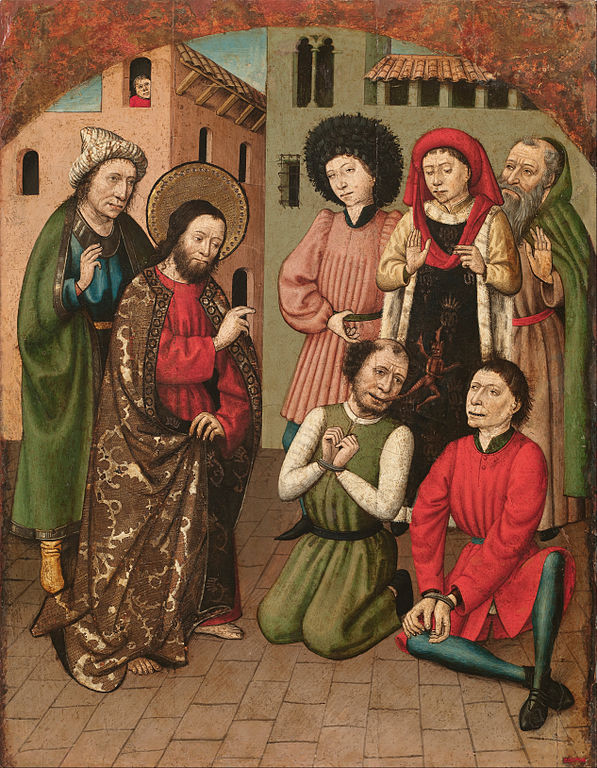 |
| St. Bartholomew Exorcising, c. 1440-1460, the Master of the St. Bartholomew Altarpiece. Although we don’t know the identity of this painter, about 25 of his works have survived. It is presumed that he was trained in the Netherlands, although he worked in Cologne; he is considered to have been the last Gothic painter active in that city. |
For all the stuff that is in there, “demonic possession” is not recognized in any versions of the Diagnostic and Statistical Manual of Mental Disorders (DSM). However, psychiatry, as a discipline, is a little more than
150 years old; exorcism has been with us since the dawn of time and spans
religious barriers. It has been practiced historically in almost every major religion
that believes that man has a soul.
 |
| Desperation, 1306. In this fresco, Giotto attributed suicide to the presence of a demon, top left. |
Goya painted St. Francis de Borja performing the rite of
exorcism at least twice. By the time he was painting, exorcisms were in sharp
decline in the western world, ushered out by the Age of Reason. Oddly enough
there has been a sharp rise in exorcisms since the middle of the 20th
century. Perhaps this is a romantic notion spawned by television and movies, or
it may represent our disaffection with psychiatry.
.jpg) |
| San Francisco de Borja attends a dying unrepentant sinner, c. 1788, by Francisco Goya. Fr. Francis was an early leader of the Jesuit order, and was widely regarded during his own lifetime as a saint. Goya depicted this 16th century exorcism from a more modern viewpoint than Fr. Francis's contemporary would have; the beasts waiting to devour the unrepentant soul are not concrete. |
Let me know if
you’re interested in painting with me in Maine in 2014 or Rochester at any
time. Click here for
more information on my Maine workshops!


No comments:
Post a Comment