I’ll be teaching in the Adirondacks on August 13-14. Be there or be square.
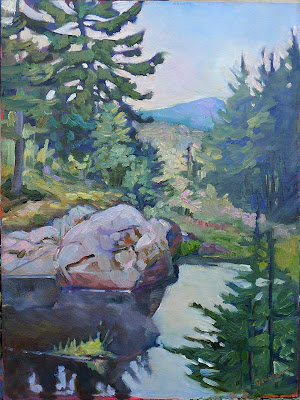 |
| Spruces and Pines in a Boreal Bog, painted at the Paul Smith's VIC and long since gone to a private collector. |
I cut my teeth teaching workshops in the Adirondack wilderness, so it’s with great pleasure that I’ll be doing that again, August 13-14, at Paul Smiths College in the High Peaks region. (For more information see here or contact Jane Davis.)
My Acadia workshop is sold out, so this is your only opportunity to study plein air with me here in the northeast. It's part of the Adirondack Plein Air Festival, but you do not have to be a participant in the festival to take the workshop.
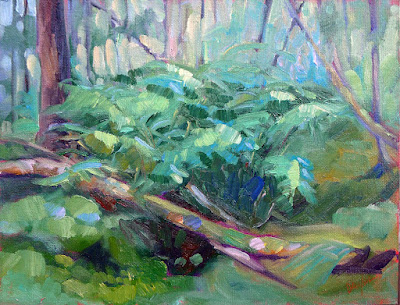 |
| Bracken fern, also painted at Paul Smith's VIC. 9X12, oil on archival canvasboard, $869 in a plein air frame. |
New Yorkers are justly proud of the Adirondack Park. It
covers most of the Adirondack Mountain massif and is the largest park in the Lower
48. Unlike most state parks, about half of the land is privately-owned, with
state land wrapped around towns, villages and businesses.
I’ve been visiting the Adirondacks since I was a baby, and have painted, hiked, canoed and driven countless hours within it. But nobody can know the whole park intimately. It’s just too vast.
There are 6.1 million acres with more than 10,000 lakes
and 30,000 miles of rivers and streams. There are boreal bogs and old growth
forests, mountain peaks and roaring rivers. I’ve visited (and painted in) many
wild places, and have found none wilder or more beautiful.
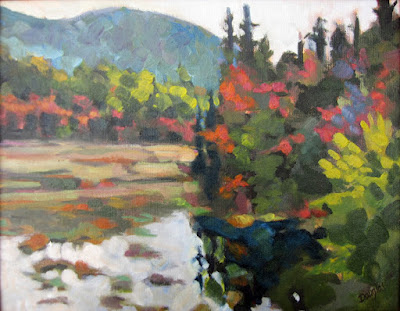 |
| The Dugs, painted in the Adirondacks near Speculator, NY. 9X12, oil on archival canvasboard, $869 in a plein air frame. |
As parks go, it’s pretty old. In 1885 the state legislature designated lands there and in the Catskills to be forever wild. This would come to be called ‘inside the blue line’. Those land protections were preserved in the state constitution in 1894. In contrast, the National Park System wasn’t formed until 1916.
There are about 130,000 full-time residents within the park and
another 7-10 million visitors every year. That puts tremendous pressure on the
land, but the relationship between residents, visitors, wilderness and
government somehow holds together.
Because the park has so much private land within its
borders, there are accommodations for every budget. You can stay at the newly-restored
Hotel
Saranac, or you can go back-country
camping at a state-owned campsite. (The popular camping sites sell out
fast, so don’t dither.)
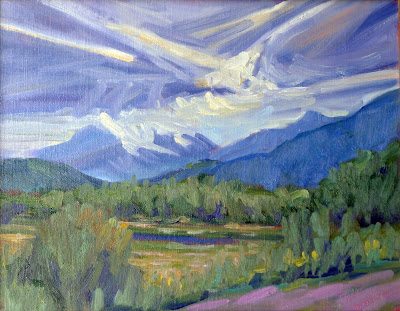 |
| Whiteface makes its own weather, 9X12, oil on archival canvasboard, $869 in a plein air frame. Whiteface Mountain is one of the 46 High Peaks of the Adirondacks. |
My workshop will be held at the Visitors Interpretive Center (VIC) at Paul Smith’s College, which is located in the hamlet of Paul Smiths, NY. Town and college are named after Apollos (Paul) Smith, who started as a humble Vermont fishing guide and ended up an entrepreneur.
The VIC is an assortment of Adirondack habitats. There’s a large
pond, running streams, a boreal bog, and lots of woodlands. Mountain peaks rise
in the distance. Luxurious for a backwoods workshop, there are bathrooms with running
water.
This teaching gig comes with the responsibility of being
juror of awards for the Adirondack Plein Air
Festival. Sandra Hildreth is
the grande dame of Adirondack painting and the founder of the festival. She
wanted a juror who was plugged into the ethos of wilderness and plein air
painting in general. These are two things I’m passionate about.
But my intimacy with the venue is also a potential downside—I
know many of the painters who participate. Could I be objective? After a point,
there are just too many of my acquaintances involved for me to favor anyone. I
think I’ll be fine.


