Paint Schoodic

To see more paintings, learn about workshops and classes, and more, visit my website.

Showing posts with label beauty. Show all posts

Wednesday, June 8, 2022

Good design is in the details

The people who made beautiful art in earlier eras weren’t focused on themselves, but on craft and how it fit into a greater whole.

The rood screen of York Minster featured the kings of England from William the Conquerer to Henry VI. That's the only reason these figures weren't smashed, and they give us an idea of what the saints in their niches might have looked like.

York was founded by the Romans, slumped into inconsequence under Anglian rule, was rebuilt by the Northumbrians, conquered by Vikings, was sacked by the Normans, and then rose slowly again, only to be pummeled during the Dissolution of the Monasteries and the English Civil War. It is, in short, deep and complex, and that is visible on the very fabric of the city.

York Minster contains three monuments designed by Grinling Gibbons. They don’t stand out. That’s not a slam on Gibbons, but rather a reflection of the depth and breadth of good design in the Minster. It’s hard to be moved by massive marble reliquaries to slumbering prelates, but they’re all masterworks. They make their point powerfully.
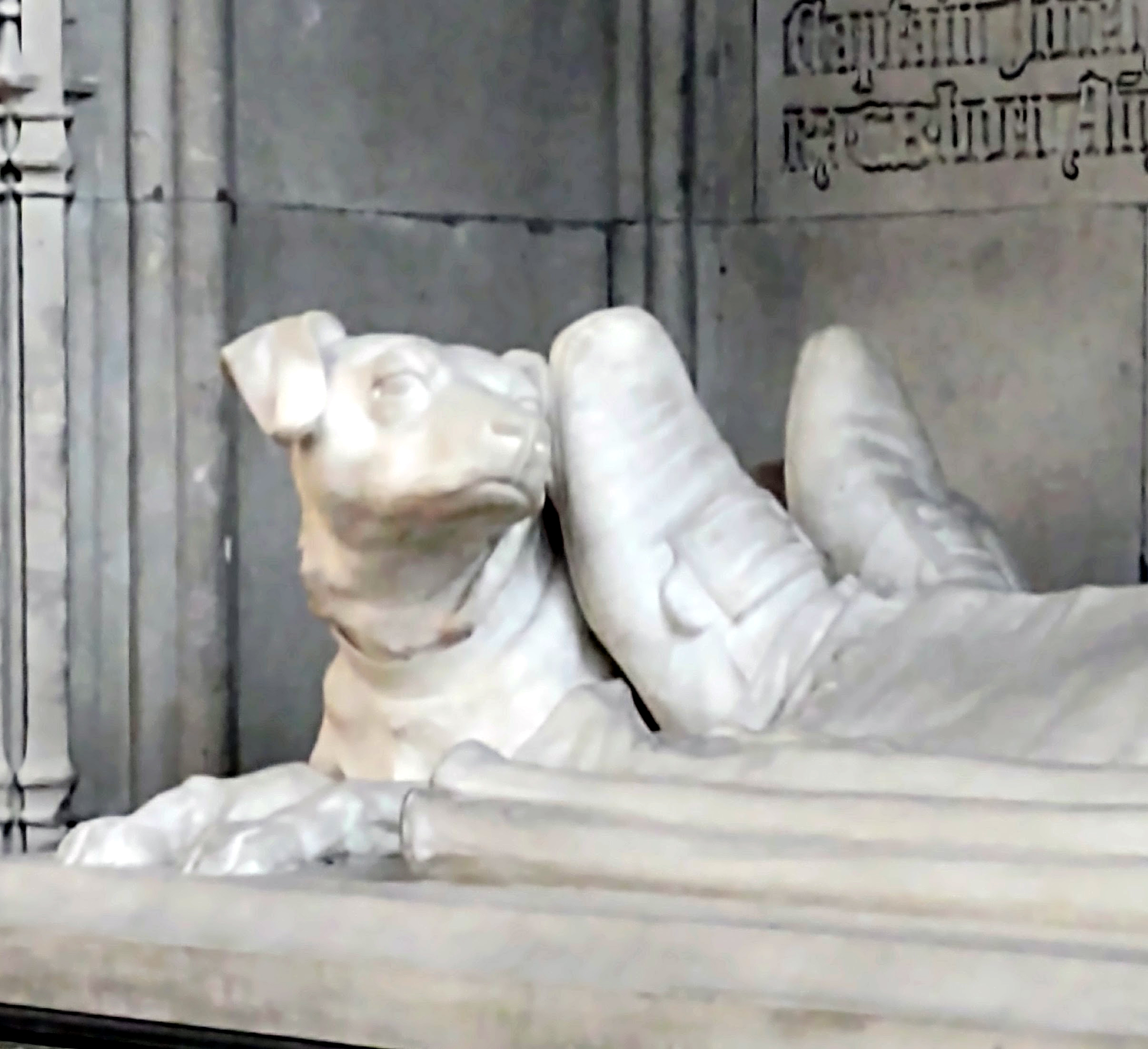
There are thousands of beautiful small details in the Minster.

The north transept contains the so-called Five Sisters window. Five long, narrow lancet windows are the largest example of grisaille glass left in the world today.  Grisaille glass came into vogue after a prohibition on the use of colored glass by the Cistercian Order in 1134, and these are dated to around 1260.

These windows are so contemporary in effect that I wondered if they were modern. Yet they are almost 800 years old. There’s a lesson there: if your art is solely about ideas, it’s unlikely that it hasn’t already been done.

The quire at York Minster.

York Minster survived the hacking and smacking of Henry VIII’s evil minions, but the saints in its innumerable niches did not. They stand empty to this day, a stark reminder of the dangers of iconoclastic fury. Still, one has a sense of the power of the cathedral’s design as it moves from broad concept to finest detail. First there is its standard cruciform shape, oriented to the east and balanced by a tower rising above the crossing. This became so standardized in ecclesiastical design that we sometimes forget that it was a new language then. So, too, was the inexorable visual sweep upward and the glorious light. It must have seemed amazing to people accustomed to squat wattle-and-daub or stone huts.

Contemporary needlework at York Minster.

It is impossible to describe all the layers of design that were integrated into this new cathedral form—arches, buttresses, niches, gargoyles, right down to tiny bits and bobs of sculpture. It has evolved over the centuries. Thus, the tiny headless saints dancing on the western wall seem as much a part of the fabric of the place as the Great East Window. The statues were sculpted in 2004 by Terance Hammill and they are sending a semaphore message with their haloes: Christ is here.

Semaphore Saints, 2004, by Terance Hamill, York Minster.

I was raised in the era of Brutalism and Scandinavian modern and have a fondness for stripped-down design, whether it’s in architecture or painting. But there’s something missing in that: the integration of detail and depth.

Part of that comes, I think, from the egocentricity of our own age. The people who made beautiful art in earlier eras weren’t focused on themselves, but on craft and how it fit into a greater whole. That’s as true of the metalwork of the Vikings and Romans as it is of the ecclesiastical art at York Minster.

The stonemason's yard is an eternal verity of a great cathedral as parts are constantly wearing out and must be replaced.

The Five Sisters window is too extensive to have been the work of any single man. It fits in an austere blind arcade of banded stone, and is topped by another group of five lancets. I expect the glassblowers, the men who leaded the windows, and the stone carvers each had their specific instructions, handed down to them by someone who, in turn, was following instructions. These plans would have been rigorous and limited. That ruled out the self-expression we consider basic in our own time, and yet it resulted in one of the glories of civilization.

Monday, May 6, 2019

Style versus substance


I wanna go north, east, south, west
Every which way, as long as I'm movin'…


My method of packing is to start with the important stuff, like vacuuming the floor joists in the basement. That’s excitement speaking. Like Ruth Brown, I'm happy as long as I'm moving. I’ve been home in Maine since February, when I went to Pecos, NM to paint with Jane Chapin. For my mid-Atlantic friends, the plein air season has already started in earnest, whereas we in the north are just starting to believe the snow is finally behind us.

My current adventure started with a deceptively-simple question. Could I do a portrait “in the manner of Francis Cadell?” That the inquirer differentiated between “style” and “manner” meant that he wasn’t asking me for an imitation Cadell painting. I wouldn't know how to do that.

Iona Croft, 1920, by Francis Cadell, courtesy National Galleries of Scotland
“In the manner of” has a specific meaning in art history, which is that it was done by a follower of a particular artist, but after the artist’s death.

Style, on the other hand, is the mark-making, composition, color palette and other visible attributes (or method of working) that give the appearance of the finished work. Style ties a painting to other works by the same artist, or to a specific period, genre or movement. It’s the art historian’s principle tool in classifying artwork. I can never be a Scottish colourist, any more than I can be a Canadian Group of Seven painter. Each of us is tied too closely to our own time and place in history, and imitating the Dead Masters is a sure path to mediocrity. But we can think seriously about the values those painters brought to their work.

Cadell had a palpable affection for his subjects: human, still life or landscape. Even so, people and objects were always somewhat subservient to their settings, which were frequently the Georgian rooms he occupied in Ainslie Place in Edinburgh’s New Town. Ironically, I’ll be painting just down the street, in a similar Georgian townhouse.
Full stop, by Carol L. Douglas. Well, we both like purple.
Cadell chose beauty over stylishness. The difference is depth and staying power. It takes some scratching to get down to fundamental truth. It’s easier to go for pretty scenes, cheap symbols or trendy commentary. But those things are only transient.

My old friend and model Michele Long used to say that figure painting was a collaboration between the artist and the model. I think that was a profound insight, but I’d add a third player: the audience, present and future. Art is primarily communication, and that requires that the subject, artist and audience all bring something to the engagement.

Michelle reading, by Carol L. Douglas
People sometimes ask me if there are paintings I would never sell. There’s one: my grandson Jake as an infant. (It was the last time he was ever still.) Once I’ve laid down my brushes, I don’t think of a painting as mine any longer. From that, it’s easy for me to realize that it was never really mine in the first place.

Thus, it isn’t about me, my skills, my whims, or my inadequacies, but about the subject and the viewer. That takes a lot of the ego out of the process, and makes me able to relax and enjoy painting.

Friday, November 3, 2017

The perfect body

What is the ideal of beauty in art? That's a moving target.

Death of Boudicca, by Carol L. Douglas. The sculpted female form is peculiar to our own time in history. Our ancestors would have found it déclassé.
I once had a perfect body, you know. Like most women, I didn’t realize that until I’d lost it to childbearing, cancer and that ultimate indignity, age.

I was reminded of this yesterday when a friend showed me new photos of her daughter, who’s an actress (and a great kid). Her publicity pictures focus on her long, articulated muscles, whippet-thin torso, and delicate fair hair. By contemporary standards, she is physically perfect.

Longing, by Carol L. Douglas
“You have to suffer to be beautiful,” my grandmother told me as she tried to tame my frizzy hair into submission. I must have told my own kids that without thinking, because I’ve heard it from their mouths.

“Perfection is ‘lean’ and ‘taut’ and ‘hard’ — like a boy athlete of twenty, a girl gymnast of twelve. What kind of body is that for a man of fifty or a woman of any age? ‘Perfect’? What’s perfect? A black cat on a white cushion, a white cat on a black one… A soft brown woman in a flowery dress… There are a whole lot of ways to be perfect, and not one of them is attained through punishment,” wrote Ursula K. Le Guin in The Wave in the Mind: Talks and Essays on the Writer, the Reader, and the Imagination.

Physical ideals change, but they are reflected by artists. That is their only tangible record. Sleeping Venus may have been painted by a woman (Artemisia Gentileschi) but it suggests all the tropes of female beauty of the time. She is soft, languid, deferential. She is young, because youth has always been associated with beauty.

Michelle reading, by Carol L. Douglas
Fashions in beauty were enhanced through whatever panniers, stays or padding were in style at the time. But it wasn’t until the 20th century that women started sculpting our own bodies in earnest. Dieting became a fact of life for most of us. In the 1980s, plastic surgery went mainstream, with women buying dental veneers, breast and buttocks augmentation, nose jobs and eye lifts.

Changes in beauty norms are more pronounced for women, but they’re true for men, too. Historically, the markers of male beauty were money, power and class. These were expressed through clothing, ornamentation, and setting. Sculpted muscles were considered vulgar, reflecting the hard work of the lower classes. The shift to beefcake as beauty corresponds historically with the shift to sculpted bodies in women.
The Laborer Resting, by Carol L. Douglas
As always, our ideals about beauty reflect our longing for something we cannot have. Only the wealthy have the leisure and money to afford personal trainers at expensive gyms, chefs to create careful, well-thought-out diet regimens, plastic surgery or tropical tans. The vast majority of us grab breakfast on the run and head in to work, where we sit all day.

“Beauty always has rules. It’s a game. I resent the beauty game when I see it controlled by people who grab fortunes from it and don’t care who they hurt. I hate it when I see it making people so self-dissatisfied that they starve and deform and poison themselves,” wrote Le Guin.

“There’s the ideal beauty of youth and health, which never really changes, and is always true. There’s the ideal beauty of movie stars and advertising models, the beauty-game ideal, which changes its rules all the time and from place to place, and is never entirely true. And there’s an ideal beauty that is harder to define or understand, because it occurs not just in the body but where the body and the spirit meet and define each other.”