Paint Schoodic

To see more paintings, learn about workshops and classes, and more, visit my website.

Showing posts with label figure. Show all posts

Wednesday, March 4, 2020

Figurative does not mean figure

Where do you fall on the continuum from representation to abstraction?
I Saw the Figure 5 in Gold, 1928, Charles Demuth, courtesy the Metropolitan Museum of Art
English (my daughter never tires of telling me) is a descriptive, rather than proscriptive, language. Words mean whatever most people agree that they mean. That’s why English is so endlessly adaptable—why, for example, we can suddenly accept the ungrammatical ‘their’ as a replacement for ‘his’ or ‘her’ without making a Federal case of it. English sees a need and answers it, and its users follow along.

There is one neologism I resist, however, and that’s the substitution of the word figurative for figure. As descriptions of art, they are not equivalent. Figure painting means painting the human form. Figurative painting means realism.

Rider, Attic red-figured cup, middle of 5th century BC, courtesy of Luynes Collection
Figurative is an old word in English, and comes to us from French. It has always had overtones of metaphor and meaning. It’s slightly different from figure, which has multiple meanings in English. Figure can mean a shape, the human body; a number, or a symbol. Think of the term figure eight and you begin to understand the complexity of the word.

Figurative art, or figurativism, however, is simple: it means representational art. The term was coined when abstraction came along, to describe abstraction’s opposite number. A painting of your car is as figurative as a painting of your spouse.

Nocturne in Black and Gold: The Falling Rocket, 1874, James Abbott McNeill Whistler, courtesy Detroit Institute of Arts 
What is the difference between figurative and abstract art? It’s not easy to draw a line. There have always been elements of abstraction in figurative art. This is why ancient art often surprises us with its modernity.

Even hyperrealism is a form of abstraction. It’s seemingly impossible for humans to represent nature exactly as it appears. Imperfect beings, we insist on putting our own spin on everything.

Likewise, there are often figures in abstract art, and much abstraction derives from observed figures in nature. The abstract geometry of Piet Mondrian, for example, resonates with us because we’ve observed such geometry in nature.

Premier Disque, c. 1912-13, Robert Delaunay, private collection
The ‘figure’ in Charles Demuth’s I Saw the Figure 5 in Gold is both a number and a symbol. And it’s both abstract and realistic. It was painted in homage to his friend William Carlos Williams’ poem, The Great Figure:

Among the rain
and lights
I saw the figure 5
in gold
on a red
firetruck
moving
tense
unheeded
to gong clangs
siren howls
and wheels rumbling
through the dark city.

Monday, September 16, 2019

Monday Morning Art School—adding figure to your landscapes

Animals, people, automobiles and other evidence of life add humanity to an otherwise static scene.
Erie Canal, by Carol L. Douglas. The figure is my daughter Julia.
Figures are best incorporated as part of the design, rather than added as an afterthought. Groups of people are such strong design elements that they can overwhelm a composition if they’re not planned in advance. In a different way, that’s equally true of a single animal in a landscape.

An individual figure can dominate a composition as well. We humans are innately curious as to what other people are doing, and a figure in a painting is an invitation for us to indulge in that curiosity.

Therefore, they’d better have a good reason to be where they are. Tossing in a figure or a gull or two to balance a composition is a Hail Mary pass that seldom works. Odds are, these last minute additions will overset your painting. It will look like it’s wearing one too many pieces of jewelry.
Tilt-a-Whirl, by Carol L. Douglas. Someday I'll write about how to paint a spinning subject en plein air.
Is the figure important to the scene? I think beaches and street scenes benefit from having people in them, because they are how we experience those places. Streets generally have cars; in fact, they’re so ubiquitous that we barely notice them. I generally limit my own animal drawings to dogs or horses, but there are western landscape paintings that would be far less compelling if they didn’t have animals in them.

Decide in advance whether you’re painting a landscape, or a figure in a landscape. If it’s the former, keep detail to a minimum. If it’s the latter, then perhaps you should redesign your painting to be a figural or animal painting. If it’s primarily a landscape, added figures, cars, or animals should be there to complement, not dominate.
59th Street Bridge approach, by Carol L. Douglas. It's impossible to paint in Manhattan without including cars.
That doesn’t mean you get away without drawing. In fact, drawing is paramount in these added elements. I’ve learned to stop painting and pick up my sketchbook when a figure nearby interests me. I draw it carefully and then insert it into the painting only when I’m sure it’s right, rather than trying to capture the person in two or three brushstrokes as they’re moving.

New Puppy, by Carol L. Douglas. This started as a sketch of the group; the beach is subservient. Available through Camden Falls Gallery.
The good news is that some of the details of drawing that bedevil the beginning artist---like fingernails, eye sockets or nostrils—must to be omitted. But proportion and placement are paramount, so it’s helpful to practice drawing people whenever you have the opportunity.
Castine lunch break, by Carol L. Douglas. Bicycles, cars, and boats are symbols of human activity that can stand in for the figure.
Even when the figure is the focal point, it must be integrated into the greater color scheme of the landscape. A fawn under the cool green canopy of the forest is not going to be as warm in tone as she would be nestled in a dry grass nest. The same is true for humans, and for their cars.

A critical aspect of figure is a sense of scale. That’s the most likely place to make a mistake. Often my figures are a pastiche of different people who’ve passed the site as I’ve been working. I start by drawing a dummy placeholder and checking its size in its position. (A few feet along a sidewalk can change the size dramatically.) Only when I have the scale right do I try to personify the character.

Monday, May 6, 2019

Style versus substance


I wanna go north, east, south, west
Every which way, as long as I'm movin'…


My method of packing is to start with the important stuff, like vacuuming the floor joists in the basement. That’s excitement speaking. Like Ruth Brown, I'm happy as long as I'm moving. I’ve been home in Maine since February, when I went to Pecos, NM to paint with Jane Chapin. For my mid-Atlantic friends, the plein air season has already started in earnest, whereas we in the north are just starting to believe the snow is finally behind us.

My current adventure started with a deceptively-simple question. Could I do a portrait “in the manner of Francis Cadell?” That the inquirer differentiated between “style” and “manner” meant that he wasn’t asking me for an imitation Cadell painting. I wouldn't know how to do that.

Iona Croft, 1920, by Francis Cadell, courtesy National Galleries of Scotland
“In the manner of” has a specific meaning in art history, which is that it was done by a follower of a particular artist, but after the artist’s death.

Style, on the other hand, is the mark-making, composition, color palette and other visible attributes (or method of working) that give the appearance of the finished work. Style ties a painting to other works by the same artist, or to a specific period, genre or movement. It’s the art historian’s principle tool in classifying artwork. I can never be a Scottish colourist, any more than I can be a Canadian Group of Seven painter. Each of us is tied too closely to our own time and place in history, and imitating the Dead Masters is a sure path to mediocrity. But we can think seriously about the values those painters brought to their work.

Cadell had a palpable affection for his subjects: human, still life or landscape. Even so, people and objects were always somewhat subservient to their settings, which were frequently the Georgian rooms he occupied in Ainslie Place in Edinburgh’s New Town. Ironically, I’ll be painting just down the street, in a similar Georgian townhouse.
Full stop, by Carol L. Douglas. Well, we both like purple.
Cadell chose beauty over stylishness. The difference is depth and staying power. It takes some scratching to get down to fundamental truth. It’s easier to go for pretty scenes, cheap symbols or trendy commentary. But those things are only transient.

My old friend and model Michele Long used to say that figure painting was a collaboration between the artist and the model. I think that was a profound insight, but I’d add a third player: the audience, present and future. Art is primarily communication, and that requires that the subject, artist and audience all bring something to the engagement.

Michelle reading, by Carol L. Douglas
People sometimes ask me if there are paintings I would never sell. There’s one: my grandson Jake as an infant. (It was the last time he was ever still.) Once I’ve laid down my brushes, I don’t think of a painting as mine any longer. From that, it’s easy for me to realize that it was never really mine in the first place.

Thus, it isn’t about me, my skills, my whims, or my inadequacies, but about the subject and the viewer. That takes a lot of the ego out of the process, and makes me able to relax and enjoy painting.

Monday, March 30, 2015

Stations of the Cross (1 of 5)

This week I am running a series of Stations of the Cross. They were completed during a deadly year, one in which I was being treated for an advanced cancer. For this reason—and because I was traversing new territory for myself—they’re uneven. But their power comes from the underlying story.

The language is simple, meant to be accessible to a child.

The originals are owned by St. Thomas’ Episcopal Church, 2000 Highland Avenue, Rochester NY 14618, and are traditionally displayed during Holy Week.

The night Jesus was arrested.
On the night Jesus was arrested, he was brought to the house of Caiaphas, the high priest. Caiaphas and his council were looking for a reason to put Jesus to death.

Caiaphas was afraid of Jesus. He did not want to give Jesus a fair trial. He told his council, "It is better for you to have one man die than to have the whole nation destroyed."

"Are you the Messiah?" Caiaphas asked Jesus.

"You have said so," Jesus answered.

"Why do we need witnesses?" Caiaphas asked the council. "You heard him! What is your verdict?"

"Death!" the council responded.

They spat in Jesus’ face, hit him and insulted him.

The priests brought Jesus to Pilate.
The members of the council took Jesus to the Roman governor, Pilate. They were careful to stop at the gates of Pilate’s palace. They did not want to go into a place where people were hurt. If they did, they would no longer be clean and they could not eat their Passover meal.

"Take him yourself and judge him by your laws," said Pilate. But the council could not have Jesus crucified, which is what they wanted.

The high priests carefully followed the law that God gave them. But they used the law to get what they wanted, not what God wanted. We choose how we use our gifts from God—whether for good or evil, to help others or to help just ourselves.

Pilate enthroned.
Pilate asked Jesus, "Are you the King of the Jews?"

"My kingdom is not of this world," said Jesus. "If it were, my followers would be fighting to save me."

Jesus did not wear a golden crown or command armies. He wore a crown of thorns and knew his power was in God.

When we follow Christ, our power comes from God and no one can see our riches.


Let me know if you’re interested in painting with me on the Schoodic Peninsula in beautiful Acadia National Park in 2015 or Rochester at any time. Click 
here for more information on my Maine workshops! Download a brochure here.

Wednesday, July 23, 2014

Censored. Me. Really.


Shuttered. Closed down. Censored. Moi? Really?

My duo show with Stu Chait, Intersections of Form, Color, Time and Space was closed on July 18 by RIT-NTID’s Dyer Gallery because the nude figure paintings might be offensive to young campus visitors. It seems like just yesterday that I was saying issues of censorship didn’t raise their ugly heads here in Rochester.

At our first meeting with the gallery, I specifically asked whether nude figure paintings would be a problem. I pointed out that the primary work dealt with difficult themes of how women are marginalized in the 21st century. I am a feminist, and my figure work deals with things like religious submission, bondage, slavery, prostitution, obesity, exploitation, etc.

The Laborer Resting, 36X48, oil on canvas. Available.
These paintings were reviewed, accepted and hung by the gallery with no problems. The opening was well-attended, and there were children present. (For that matter, my son regularly schleps paintings for me, and his biggest complaint is that he’d rather be using his computer.) The show was featured in RIT’s University News  and mentioned in City newspaper. It was not until administrators saw the work that it was deemed unacceptable.

The cynic in me thinks that if I painted coy, sexy Odalisques there would have been no objection to the show. Young people are exposed to sexually-charged but non-intellectual images every day; in fact, this is part of the problem I am painting about.

Meanwhile, kids who go to malls are exposed to images like this on an everyday basis. And this really is obscene, because it uses sex to sell clothing.
If difficult issues of women’s rights can’t be examined in a college gallery, where can they be examined?

I have occasionally pulled individual pieces that were too challenging. Last month I had a show at AVIV Café and Gallery at Bethel Church on East Avenue. The director pulled one work because its depiction of starving Africa frightened children. But since he left the bulk of the work intact, this was no problem.

Aviva Sleeping, 36X24, challenges the notion that an obese woman cannot be a beautiful one.
Of course, I’m in Maine, so Stu Chait and Sandy Quang had to deal with the work of pulling, wrapping and moving around 60 large paintings. And visitors to the show will find the gallery empty. What a pity.

Sorry, folks. My workshop in Belfast, ME is sold out. Message me if you want a spot on my waitlist, or information about next year’s programs. Information is available 
here.

Friday, July 11, 2014

Opening tonight: Intersections of Form, Color, Time and Space

The Laborer Resting, by Carol L. Douglas, oil on canvas, 36X48, $3,750.
Several friends have sent me stories about Leena McCall’s oil painting of her friend, Portrait of Ms Ruby May Standing, being removed from a Society for Women Artists show in London because it was deemed to be pornographic. McCall painted her work in the flat style of mid-century English painters, and that’s the best part of the painting. She’s baiting a censorship that vanished decades ago. It’s her great luck (or planning) that she found someone—anyone—to object to it in this day and age.

The painting—although obvious—hardly dings my porn meter. I’m a born-again Christian who sometimes paints on the subject of women’s bondage. The only person who complains is my husband, who blocks them on his newsfeed so they don’t violate his employer’s policy.

The Joker, by Carol L. Douglas, oil on canvas, 30X40, $2,500.
My nudes, by the way, are on view at RIT-NTID’s Dyer Art Center this month. The show, Intersections of Form, Color, Time and Space, opens tonight, from 4-7 PM. I hope you’ll come out and say hello. RIT’s campus is lovely, and this would be a fantastic evening to be out there.

Unlike McCall, I’m taking an anti-pornographic stance. I’m painting about the abuse and objectification of women. You would think that a culture that aspires to complete equality for women would see less of this, not more, but these two trends have increased, not decreased, in my lifetime.

Submission, by Carol L. Douglas, oil on canvas, 24X20, $1,500.
I nursed all four of my kids and nobody ever tried to shame me about it. So I’m amazed at the stories my young friends tell about women being harassed for nursing in public. My friend Tim Vail pointed out that there are centuries of images of nursing mothers. “It seems like the more sexualized our culture gets, the more repression there is over what used to be completely normal.”

I’m afraid we’re living at the high-water mark of women’s rights worldwide. And that’s what I’m painting about. The more I paint, the less able I am to explain the material in words, so I hope you come out tonight to see them.

The Dyer Arts Center is in Lyndon Baines Johnson Building at Rochester Institute of Technology, 52 Lomb Memorial Drive, Rochester, NY 14623Intersections of Form, Color, Time and Space, featuring abstract-expressionist Stu Chait and realist Carol Douglas, is in all three galleries during the month of July.


I’m leaving for Maine next week. Come join me! I have two openings left for my 2014 workshop in Belfast, ME. Information is available here.

Friday, June 20, 2014

It's all about Michelle


Michelle will be happy that she finally has a face in this painting. (From my upcoming show with Stu Chait at RIT-Dyer.)

The other day I wrote about photographer Terry Richardson and allegations that he abused his models. I said, “Artists and their models can be friends; sometimes they're even lovers. But every artist-model relationship also involves an implied balance-of-power calculation.”

I’ve worked with a lot of models over the years, and I think my relationships with them have been professional and courteous. Over the years, several of them have become my friends, including Kate Comegys, Gail Kellogg Hope and Michelle Long.

Michelle as a sort of Madame X character. (From my upcoming show with Stu Chait at RIT-Dyer.)
Michelle is as close to an international model as Rochester has. She collaborated on a project with Keith Howard called “Eve’s Garden: The Lost Creation.” I wish I’d thought of this idea, because it revolved around the idea of printmaker Howard sending his painting work offshore to China. The result was visually pleasing and perfectly in tune with the zeitgeist.

Usually my skin-tones are modulated with grey, but I want the illusion of florescent light, so I'm using blue. Note there is no true red on my palette right now.
I’m finishing a painting of Michelle for my upcoming duo show with Stu Chait at RIT-Dyer. True to form, Michelle won't be there; she is leaving to work in Uganda. If you want to support her at the Ugandan Water Project, go here.

This painting has been sitting unfinished for a long time, because I was mad at it. It taught me the limits of drafting huge paintings in my 18X18 studio. I ended up having to redraft her head and shoulders to correct the severe foreshortening.

Yep, those are my skintones. Along with my modulating colors, they gave me the faces above.
Occasionally someone asks me how to mix skin tones for different races. I think that’s a funny question, because I use exactly the same paints for everyone; only the proportions change. For that matter, I’m using the same paints I use to paint foliage.

I have three openings left for my 2014 workshop in Belfast, ME. Information is available 
here.

Thursday, June 19, 2014

What you do when nobody’s looking

Ellwanger Berry Garden, 12X16, $650, by Carol L. Douglas.
Sure, I get to drive around and visit with fascinating people and go to interesting shows and occasionally pick up a brush and paint something, but I spend more time than I’d like on bookkeeping and that bugaboo of all sales: inventory control.

Stu Chait and I are putting the final details together for our upcoming show at RIT-NTID’s Dyer Arts Center, which opens July 11 from 4-7 PM. If you’re in town, you should really find a way to get there, since this is a sprawling show.

Manipulation in Red by Stu Chait.
Stu and I met at the Ellwanger Garden here in Rochester. We were the only painters there, so we stood at opposite ends of the garden and painted facing each other. I’ve long since sold that painting, but I painted another painting with him at the same place, which will be in this show.

It’s been years since I pulled out all my work to organize a show, but since the passage of time is part of our theme, I inventoried every piece of work I have in play right now. That is nearly a hundred pieces, which is less absurd when you consider that I have three separate bodies of work: landscape, figure, and faith-based. (Even with all those paintings, I am actually scant on work to meet specific summer commitments.)

The Servant, 36X40, $3000, oil on canvas, by Carol L. Douglas.
What surprised me even more is how many paintings are no longer in my inventory.  Next winter I’m going to go through my photo archives and sales records and try to piece together a comprehensive catalogue. I loathe that kind of task, but if I don’t do it soon, I’ll never get it done.


I have three openings left for my 2014 workshop in Belfast, ME. Information is available 
here.

Wednesday, April 30, 2014

Just a travelin’ man

Midsummer dance, Anders Zorn, 1903
This morning I’m off with my pal Brad Marshall to see Anders Zorn: Sweden’s Master Painter at the National Academy. Before Brad suggested this, I knew absolutely nothing about Zorn. That’s ironic, because at the turn of the last century he was one of the world’s most renowned painters. In fact, he painted three American presidents: Grover Cleveland (and his wife), William Taft, and Theodore Roosevelt, along with many other of the social luminati of the time.

Portrait of Hugo Reisinger, Anders Zorn, 1907
Anders Zorn was raised on the family farm in rural Sweden. He studied at local grammar schools before enrolling in the Royal Swedish Academy of Arts.  His painting and social skills must have been prodigious, because he rapidly became a luminary in the Stockholm art world. His wife, Emma, was from a wealthy and cultured family; they met through his work.

Not content to be a big fish in a small pond, Zorn traveled to the world’s major cultural centers.  He was feted internationally while still in his twenties. (He in turn became a notable art patron upon his return to Sweden.)

Sensitive to cold, Anders Zorn, 1894.
Like John Singer Sargent, Zorn was a highly-skilled watercolorist; like Sargent and Joachim Sorolla, he was known for his loose, lyrical paint handling. Unlike them, his fame has flamed out, at least here in the United States.  What will I think of his work? Only one way to find out.

Anders Zorn: Sweden’s Master Painter runs until May 18, 2014 at the National Academy of Art, XX Park Avenue, New York, NY.

Let me know if you’re interested in painting with me in Belfast, Maine in August, 2014 or in Rochester at any time. Click 
here for more information on my Maine workshops!

Monday, May 6, 2013

That fine line between art and erotica

Hermaphrodite, Mateo Bonarelli, 1652, Prado

“Son of Hermes and Aphrodite, Hermaphrodite was a singularly handsome youth. According to Ovid (Metamorphoses 4, 285 ff.) Salmacis, the nymph from a lake in Caria, was enthralled by his beauty and passionately embraced him while he was bathing. Their two bodies merged as one, with double gender.

“This sculpture, commissioned by Velasquez in Italy for the decoration of Madrid's Alcázar Palace, is a copy of the classic marble from the Borghese Collection in Rome, now in the Louvre Museum. The high technical quality of this piece makes it a masterwork that surpasses the original.” (From the Prado website)

 I watched this news story about a kerfuffle about nude photographs in a gallery window in Belfast, ME last week. The culture snob in me would have liked to believe that it was a small-town issue, except that a proposal for a show of my nudes was summarily rejected at the same time by a local college gallery because they have a no-nudity policy.

Despite what the photographer says on the video, there is no clear line between art and pornography, because there have always been painters whose primary goal was to titillate, and because sexuality is part of our humanity. It cannot be simply excised from the model or the process.

Consider the dancing girls in this fragment from ancient Thebes (c. 1350 BC). One presumes that the serving girls and dancers are naked for Nabamun’s amusement in the afterlife, but it is not overtly sexual.
A feast for Nebamun, the top half of a scene from the tomb-chapel of Nebamun, Thebes, Egypt, Late 18th Dynasty, around 1350 BC, The British Museum

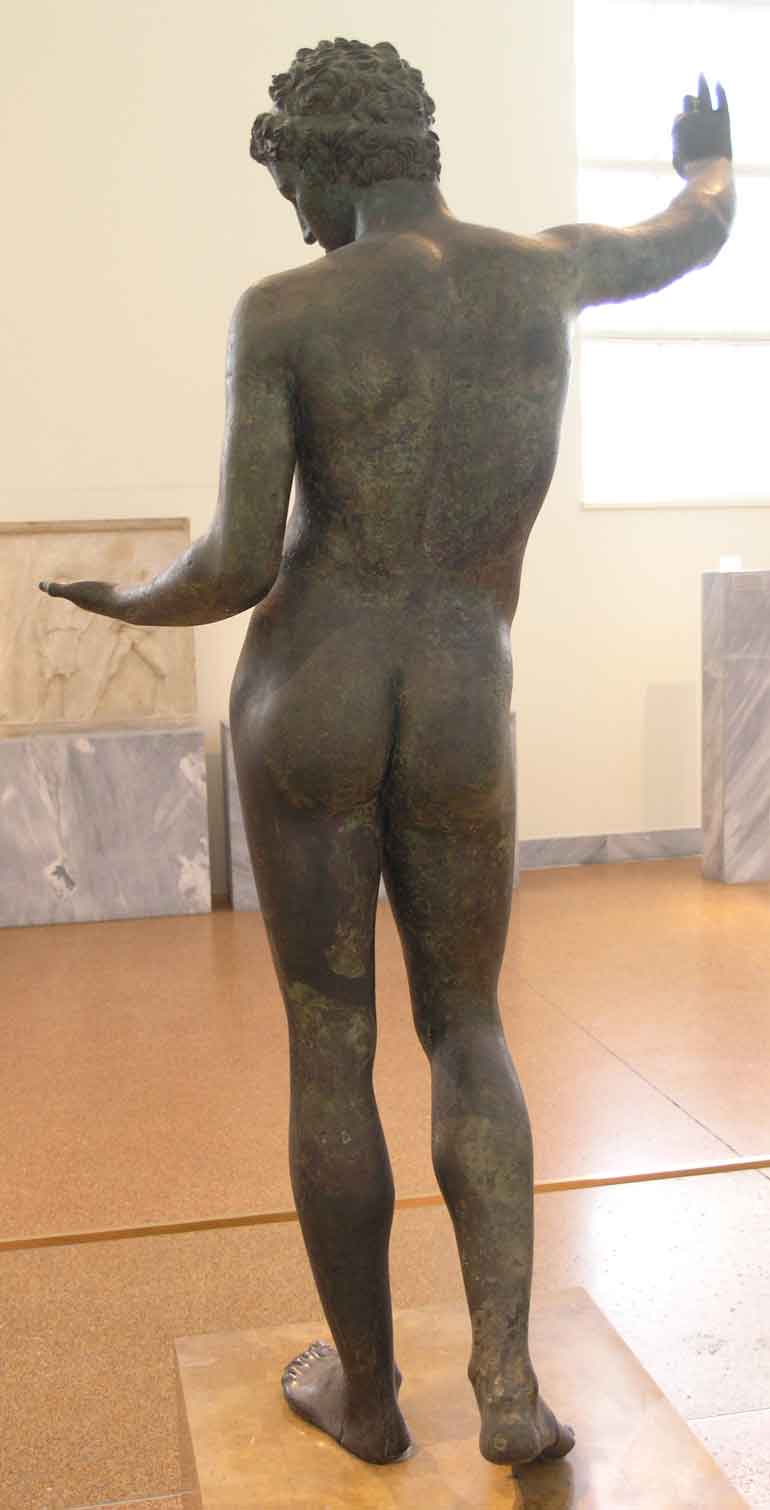
Compare that to the Ephebe of Marathon, which is a sculpture of a boy (perhaps the god Hermes). The school of Praxiteles was interested in presenting a new view of the gods: more accessible, naturalistic, humanistic. These sculptors were perhaps even more interested in the aesthetic issues of contrapposto, which basically means putting the model’s weight on one foot. (This is a convention we use to this day.) I can’t even figure out how to frame the question of whether the Ephebe was intended to be erotic; their social, religious, and cultural milieu didn’t make the same distinctions we do.

Ephebe of Marathon, School of Praxiteles, c. 325-300 BCE, National Archaeological Museum of Athens

Then there’s Da Vinci’s Vitruvian Man (which in addition to being an exquisite drawing, has to be one of the most enduring bits of graphic design in the history of art). Here, I think the intention is quite clear: Da Vinci is attempting to write a canon of measurement for the human body.

Vitruvian Man, Leonardo da Vinci, c. 1490, Gallerie dell'Accademia

Friday, April 26, 2013

Fool for love

Stanley Spencer, Self portrait with Patricia Preece (Fitzwilliam Museum, London), 1936

I would hate to have anyone thing that only women are hoisted on the petard of sexuality. Today, I am writing about the loveliest—and perhaps the strangest—of 20th century painters, Sir Stanley Spencer.

Spencer has three distinct bodies of work. They are so unlike each other that the uninitiated would be forgiven for not realizing they’re by the same artist. First are his religious paintings, to which I will return later, but which range from the austere beauty of the Sandham Memorial Chapel to the Botero-like figures of his Biblical narratives (except, of course, that he was doing these figures before Botero was born). Second are his landscapes, which are perfectly drafted, intimate views of the English countryside. But today I want to talk about his destructive obsession with the artist Patricia Preece.

By 1925, when Spencer married fellow artist Hilda Carline, he was already a respected British painter. The couple had two daughters, Shirin and Unity and by all appearances seemed happily married. In 1929, Spencer met Preece, and became infatuated with her.  Divorced by his wife in 1937, he married Preece a week later. Preece continued to live with her partner, Dorothy Hepworth. 

While she frequently posed nude for her Spencer, the marriage was unconsummated. Despite this, Spencer signed his house over to Preece.

Nude Portrait of Patricia Preece by Stanley Spencer, 1935. Is it obsession, loathing, or what?
Spencer remained, in his way, devoted to his ex-wife, Hilda Carline, visiting her during her mental breakdown and writing her letters after her death from cancer in 1950.

I've never decided what was driving him in this relationship. Was it obsession, loathing, self-loathing, or what? Regardless, the paintings themselves are brutally honest, and brilliant in that honesty.

Have a wonderful weekend. I promise to get off the subject of figure painting before next week.

Meanwhile, if you're interested in joining us for a fantastic time in mid-Coast Maine this summer, check here for more information.

Thursday, April 25, 2013

Woman as vegetable, draped in Saran-Wrap

My first successful nude in a naturalistic style, as a student in Cornelia Foss' class. Foss intentionally arranged the model to make her insecurity apparent. I draw much better now, but I still like this painting.

I received an email yesterday asking, “What do you mean your house is full of paintings of ‘women commodified, bent, begging, enslaved, wrapped in plastic, suspended, dancing, resting, exhausted…’?”

Well, really, why the heck not?

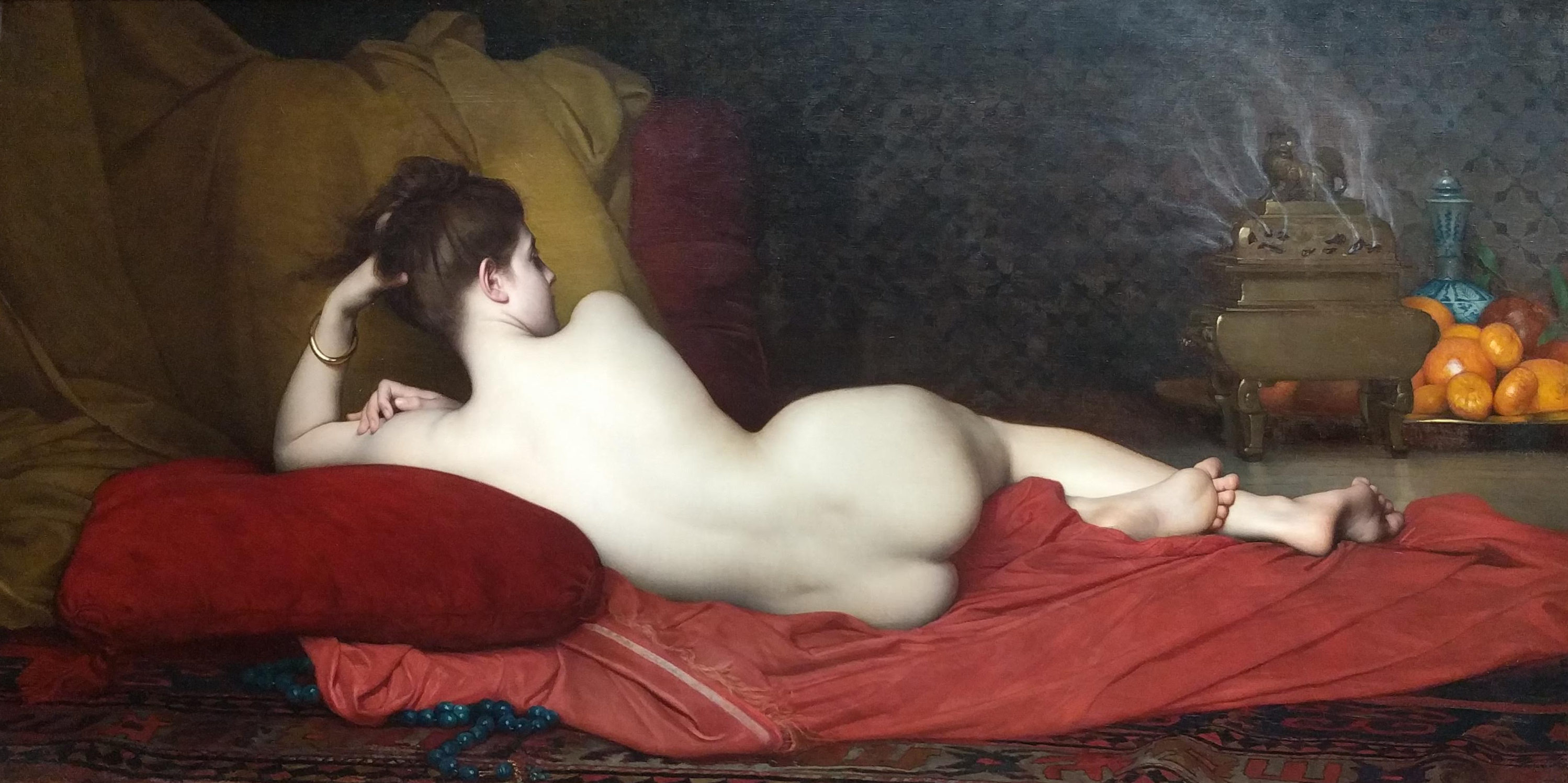
Most studios do figure with artfully arranged spot lights, arranging the figure in some variation of an Odalisque. In some ways, this is easier on the beginning artist, but I haven’t liked it since Cornelia Foss turned me on to natural-light, naturally-posed figure when I studied with her at the Art Students League.*

After all, if the figure is supposed to tell us something about our humanity, what can we learn from woman-as-sexual object, happily twisted into an archetype of the female ideal?
 
Odalisque by Jules Joseph Lefebvre,1874. This same pose is being duplicated in studios across America even as we speak.

The Odalisque is also a portrait of commodification, but its primary purpose is titillation. Consider this portrait of Marie-Louise O'Murphy de Boisfaily by Francois Boucher:

Louise O'Murphy by Francois Boucher, c. 1752

If the model looks absurdly young, that’s because she was 15. By that age, she’d been passed around between Casanova and King Louis XV of France for two years. She went on to a long and illustrious career as a courtesan and wife, but, really, who wants to glorify that career path?

*Two other objections: artificial light narrows the chromatic range of human skin. Gone are the lovely greys, blues, and greens, the subtle interplay of warm and cool on the skin. Instead, there are two colors—highlights and shadows. Every subtlety is blown away by that demanding light. Furthermore, the pattern of shadows is pre-determined. You might as well paint from a photo.

There are still spots open in our mid-coast Maine plein air workshops! Check here for more information.

Wednesday, April 24, 2013

When I had No Clothes On

Not our anonymous naturalist, alas, since I haven't any pictures of her. A nude by little ol' me.

After dusk last night, a shifty-looking fellow rang my front bell and abruptly thrust a sheaf of paper bound in hemp string into my hands. It was a leaked copy of a memoir by a local naturalist.

It’s much too long to quote in full here, and not all the people mentioned are dead. But I thought you might enjoy a few passages that relate to yesterday’s interview with Michelle Long:

If I had ever given the matter a passing thought, I suppose I had always assumed, vaguely, that models tended to be either Parisian waifs like George Du Maurier’s Trilby, characters from Anaïs Nin’s erotica, or at the very least, the glamorous mistresses of painters.  But it is not so at all. 

Wherever there are art classes, there are also intelligent and creative naturists picking up a few spare bucks by modeling, it seems.  Since my salary at [excised] was piteously small, I had realized at once that some moonlighting would have to be done. I had considered baby-sitting, but now that I knew modeling was a possibility, it struck me as the very best possible night-time job: fancy being paid perfectly good money for sitting around with no clothes on and doing absolutely nothing![1]

Modeling was almost always good fun, and only occasionally did I have to struggle with my sense of the absurd.  One day, I looked down from the model-stand and found myself face-to-face with [excised], who had been my high school Girl Scout troop leader!  A very strange feeling indeed.  Modeling at Nazareth College initially made me a bit nervous; there is something deeply weird about being nude in the same room with a nun…

Then there was the public nature of the work.  Now and again, I would go to a restaurant or an art film, and people would recognize me…  Sometimes I would unexpectedly come upon myself at an art exhibit or a gallery opening. Once, this happened when I was out with colleagues from [excised], and I was reduced to hiding behind partitions and doing what I could to distract them from looking too closely at the nudes.  When a particularly striking recumbent semi-nude charcoal sketch of me happened to be reproduced in the Rochester Democrat & Chronicle, I thanked my lucky stars that it did not include my face.  My mother, however, could not be fooled: ‘I’d know that bottom anywhere,’ she said…         

Our photographer also liked the idea of re-creating classical paintings with live models.  Mount Hope Cemetery, that great Victorian necropolis, is the perfect setting for this sort of thing.  More than one mausoleum there is a dead ringer for the Treasury of the Athenians at Olympia.  Thus it came about that two female naturist buddies and I half froze ourselves impersonating the Three Graces (minus the conventional diaphanous peploi), dancing hand in hand before the classical portals of some wealthy family’s tomb on a chilly day in early spring.  The pictures are really very pretty, though I cannot remember precisely why one of us[2] had chosen to wear a spangled feathered 1920’s headband for the occasion...[3] 

Nude modeling in cemeteries is not for the faint of heart.  Every time we heard a car approaching, we all had to race behind the mausoleum to put on our bathrobes, knowing perfectly well that there was some poison ivy back there.  Better a case of poison ivy than an arrest for public nudity, in however artistic a cause.[4]  We managed to get in about half an hour’s uninterrupted work at one point, but then a car actually came up the hill right towards us!  We dove for our bathrobes and hid behind the mausoleum, hearts in our throats, fearing that it was the police.

But no!  It was our friend [excised], who had heard about the project, and had been so eager to be part of it that he had apparently driven to the graveyard and through the graveyard in the all-together![5]  We managed to get in about twenty solid minutes of being The Judgment of Paris before the light faded.[6]  Freezing cold, we all gratefully and hastily put on our clothes, then drove over to my place, cranking the heat in our cars at full blast …

Each of us knew a few other models, for Rochester Institute of Technology often holds two life-drawing classes simultaneously, and models, although they tend not to be very chatty with the students, do talk with one another on breaks.[7]
           
Hence, when the opportunity arose, we were able to put together an artistic Feast of Misrule that is probably still remembered as far away as Syracuse and points beyond.[8]  The charming and persuasive [excised] had somehow managed to talk the local branch of the YMCA into renting their entire building to the Rochester naturists for a whole evening, one a month or so, for a whole winter….  In an ideal world, every urban naturist group would simply own its own YMCA.  Most of us, I think, were childish enough to take an enormous delight in using the other sex’s locker room.  The pool was enormous, and the gymnasium offered plenty of room for (sigh) volleyball.[9]  I seem to remember that one month, we were even able to hold a nude dance, with waltzes, of course, between the sets of squares and contras.[10]

The Feast of Misrule was billed as a workshop for artists and models, but its main goal was to allow everyone a chance to get on the other side of the easel, if only for a night.  We did end up with more models who wanted to paint and draw than artists who were willing to take a shift on the podium, but that worked out perfectly well: one or two models at a time are about all beginning artists can cope with.
 
The ploy worked brilliantly; we models turned out to be no worse at life-drawing than your average beginners are.  We were merciful to our brave artists, who were mostly modeling for the first time.  In a spirit of charity, we did not insist on any long and difficult poses.  All of us who wanted to attempt it had the chance to take part in a two-person pose, and everyone who felt up to it tried to draw one.  Finally, when we had amassed a large enough collection of portraits of one another, we posted our work on the walls of the big front room, and, for a touch of authenticity, added a few curatorial-looking labels on white three-by-five cards.  One optimist even added a price-tag.  I seem to recall that the Head Naturist of Syracuse mounted one of his drawings on a larger piece of paper and drew it an ornate baroque frame.[11] 

Then we poured out the wine and arranged fruit and cheese on the table, and opened the great double doors to invite all of the other naturists in.  It was, I expect, Rochester’s very first all-nude art gallery opening.  If only we had been able to find a nice naked string quartet, it would have been absolutely perfect.  As it was, the Feast of Misrule was an event to remember; a truly star-studded evening out, and a delightful change from horrible, horrible work. (© 2013, Amy Vail, Rochester, NY.)

Yes, we have a good time in our studio!  And if you're interested in joining us for a fantastic time in mid-Coast Maine this summer, check here for more information.


[1] There are very few genuinely enjoyable jobs that you can do with your clothes off.  Babysitting is not one of them.   I have always hated babysitting.  Indeed, I earned eternal exemption from changing any and all family diapers by throwing up on one of my dear nephews halfway through the process.
[2] Not I.
[3] Incidentally, doing normally private things in a graveyard has fine, if not entirely respectable Classical antecedents. If Catullus and Martial are to be believed, the less expensive Roman professional ladies did this kind of thing all the time.
[4] Even my liberal parents would have been grieved by such an arrest.  Worst still, it would have become an humiliating family joke for the next two or three generations.
[5] Driving naked is very good fun, but it is not legal in all states.  (I cannot believe it is legal in any cemetery.)  I believe my dear Head Naturist of Syracuse only avoided an indictment for driving naked in West Virginia by dying before the date of his trial.  May he rest in peace, nude, as he would have wished.
[6] All right, then, the Judgment of Craig.  The pictures are striking and not unattractive, but Craig has too many tattoos to be an entirely convincing Paris.
[7] Not all models are naturists.  It takes more than a willingness to take your clothes off to be a true naturist.  You also have to put up with volleyball (shudder) and be willing to participate in an annual chocolate pudding war.  I always tried to avoid the volleyball, but it was not always possible.  The pudding, however,  wasn’t  bad at all; it is an excellent conditioner for the hair, though devilishly tricky to get out of your ears.
[8] I adore Syracuse.  Ah, Syracuse, City of Lights!  Would I were back there now!
[9] What is it with some naturists and volleyball?  Don’t they know that they are just catering to conventional stereotyping?
[10] Now, nude waltzing is witty and original, and far to be preferred to boring old volleyball.
[11] I lost my heart to him that evening.  He is enshrined him forever in the Detrimental Hall of Fame.