 |
Pietà, (1498-99) Michelangelo.
There’s been speculation that Michelangelo was somewhere on the autism spectrum.
His hygiene was abysmal, he didn’t like talking to others, and he was monomaniacally
focused on his work. And yet he exerted an unparalleled influence on western
thinking, as a sculptor, painter, architect, poet, and engineer.
|
I meet myself in the Diagnostic
and Statistical Manual of Mental Disorders with tiresome regularity. The creative
personality (and I’m no exception) is frequently impulsive, non-conformist, and motivated by what
less-enlightened minds might call fantasy.
In the past, people actually understood that as a thinking
pattern. Today, we define impulsivity and fantastical thinking as personality
disorders. No child with this personality type will be allowed through school
without being subjected to a program of therapy and drugs to ‘normalize’ him or
her.
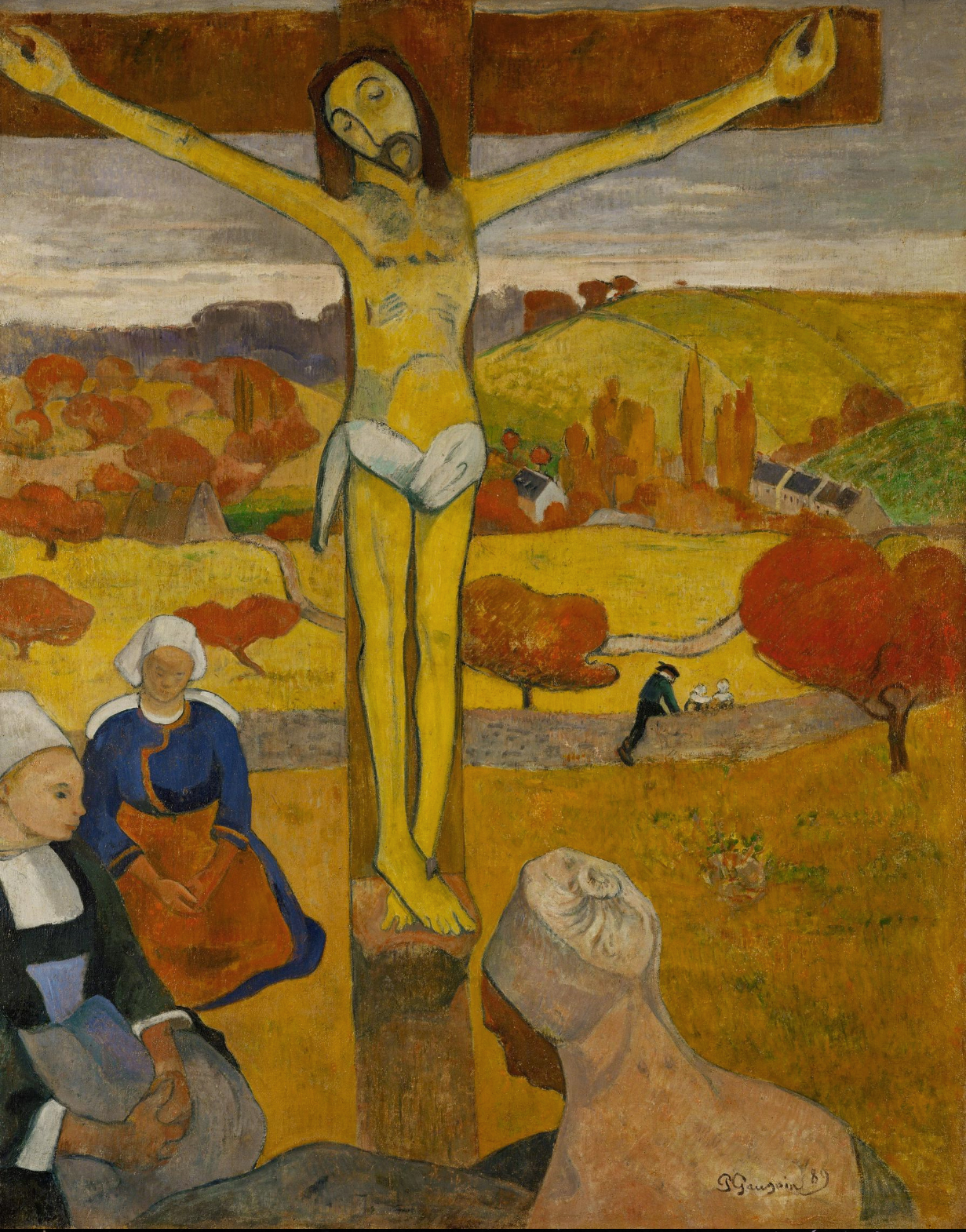 |
The Yellow Christ, 1889,
Paul Gauguin. Despite his success, Gauguin
was certainly crazy by our standards, suffering from depression and alcoholism
until he abandoned civilization for Tahiti, where he spent the last few years
of his life painting in peace.
|
An exasperated educator once told my husband and me that
they needed to prepare our kids for the “real world.” What does an educator know
about reality? He works in a highly-regimented environment whose goals are not
the goals of the larger world.
At the time, my husband was telecommuting with a Boston
software start-up; I paint full time. Our “normal” wasn’t even in most people’s
viewfinder. We didn’t have a typical life, but we certainly had a
self-sufficient, productive and respectable one.
 |
St. Catherine of Alexandria, 1595-1596, Caravaggio. Psychoanalyzing Caravaggio is a popular activity
now, but there’s no doubt that even his contemporaries found him unsettling. The
model for this painting was Fillide Melandroni, who posed for several works by
Caravaggio. He tried to castrate her pimp, Tomassoni, and struck his femoral
artery instead, killing him. Among the bully boys of 16th century Rome, if a man
insulted another man’s woman, the penalty was castration. It was an age of
brawling, and any attempt to interpret it by our social code is bound to fail.
|
Our schools can’t cope with the creative kid who doesn’t fit
into any mold. In the past, that child might have gone on to be a Bill Gates,
Rachael Ray, or Ingvar Kamprad (founder of IKEA), but in the modern world, most
avenues are closed to people without education.
Then there’s the question of what happens when something
goes wrong. As a society, we have a knack for pathologizing absolutely normal
human responses.
I have the personality of a terrier. I bite first
and ask questions later; however, as with my dog, my instincts are usually
spot-on. Like a watchdog, when things go wrong, I stay awake. Both times I have
been sick, my first response was insomnia. That is commonly
treated with antidepressants. I fell for that the first time, with awful
results. This time, I’m recognizing my insomnia for what it is—a normal
psychological reaction—and just enduring it.
Our ancestors used to formally identify the emotionally-bruised
and set them apart so they didn’t have to experience the full thrust of human
interaction. Nobody expected you to behave normally when you were traumatized, which
in part obviated the need for antidepressants. Today we don’t even wear black
to funerals; to wear it for a year after a loss is unthinkable. Yet, when one in ten Americans are taking antidepressants, one might
conclude that unrecognized and unprocessed grief comes back to bite us.
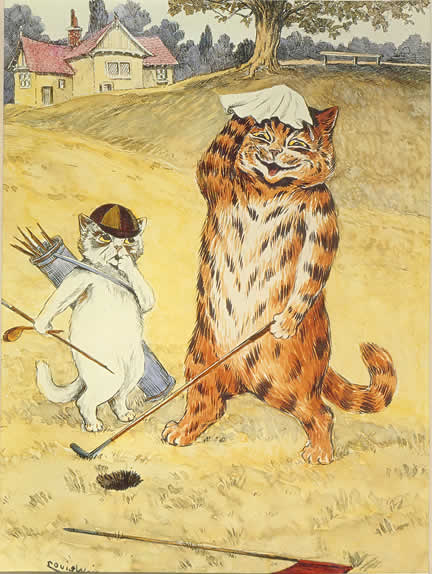 |
| Cats by Louis Wain. He spent time in an asylum, but his artistic skills never diminished. That indicates that whatever was going on, he wasn't schizophrenic. Today he wouldn't be considered mentally ill; he would be a star on social media, with its outsized interest in cats. |
Similarly, there is a lot to make us anxious in the modern
world. Every adolescent I’ve ever known has in some degree suffered from an
anxiety disorder, because the natural state of the adolescent is anxiety. Much
of this is emotional noise and just needs to be waited out. It’s helpful to
point that out to a kid; it’s not as helpful to tell him that he’s
fundamentally flawed and can only function with drugs.
More seriously, post-traumatic stress disorder is what
happens when a healthy human mind is traumatized. How, then, is it an illness? Is
it not in fact a normal response to an intolerable situation? If so, does it
not make sense that the human mind also has an answer to it in its own depths?
How useful is it to tell its sufferers that they’re somehow irretrievably
broken, especially since there’s no good comprehensive treatment for PTSD?
In the past—ironically enough—the deeply traumatized individual
might have been guided to write or paint or otherwise express his or her fears
through creative expression. Too bad that we now want to just wipe that out with drugs.
Let me know if you’re
interested in painting with me in Maine in 2014 or Rochester at any time.
Click here for
more information on my Maine workshops!
