A world without shadows is disconcerting; objects seem to float in space. Shadows give objects form and ground them.
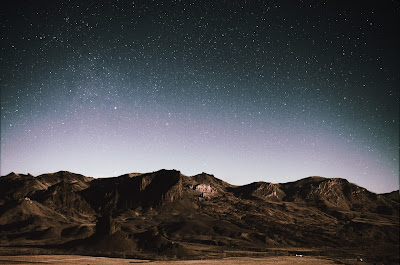 |
| My son Dwight Perot took this photo of the Wyoming night sky last year at this time. It's almost like this winter jaunt down US 90 is getting to be a habit. |
It’s a balmy -2° F as I type this on Thursday afternoon in Blue Earth, Minnesota. These are temperatures we don’t typically encounter in the northeast, where our idea of deep cold is somewhat warmer. But it is, as they say, a dry cold. It’s miserable.
The Prius is ticking along quite beautifully, although we
seem to have lost the front valance and lower grill somewhere in that snowstorm
in Ohio. It was a typical winter storm, dumping about a foot of powder in
Chicago, but it was preceded by a warm front which made wicked ice. That effectively
encased the car, necessitating a quick windshield-wiper swap today. A few
minutes without our gloves on, trying to manhandle the frozen clips loose, and our
fingers were frozen.
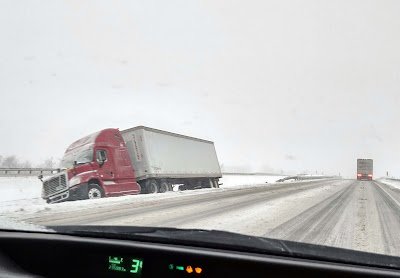 |
| The trucks follow each other into the median like lemmings. I rapidly lost count of the wrecks along the Indiana Toll Road. It was just the same last year. |
“There’s nothing to paint in the Midwest,” is a lament I sometimes hear, and one I adamantly disagree with. The sky is so spacious and the earth so flat that all spatial relationships are upended.
In the tropics, the summer solstice sun sits directly
overhead at noon for just two days a year. The only American state that
experiences this is Hawaii; the rest of us are too far north. A
world without shadows is disconcerting; objects seem to float in space. Shadows
give objects form and ground them.
Here in the north, the drifting snow drops down along the
roadside, creating a curling ribbon of blue shadow that plays against the
golden light of the sun. I’m not here to paint, but if I were, I’d stop and
paint that.
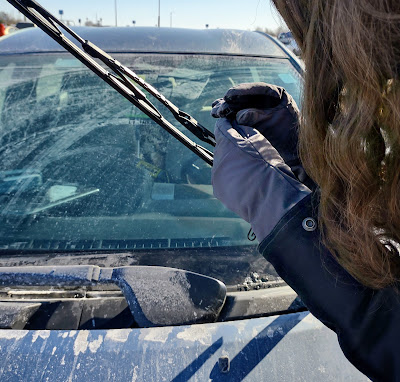 |
| The ice storm shredded what was left of Dwight's windshield wipers, necessitating a quick change. |
There are solitary farms set within copses of trees, and power lines marching resolutely toward the horizon. A windsock is frozen in the last storm’s position.
The snow isn’t deep. Its surface is marbleized like sand
dunes. That makes sense because they’re both sculpted by wind. But unrelated natural
forms also mimic each other. The map of a river tributary system bears, for
example, a striking resemblance to a tree. Why is that? Chance? Mathematics?
Intelligent design?
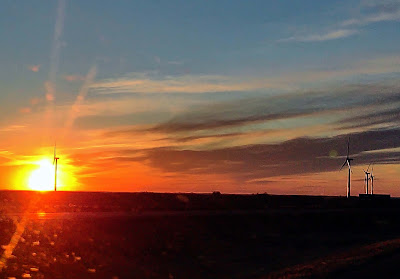 |
| Windmills are part of the prairie landscape. |
The grain elevators of Minnesota are mostly metal, unlike the frame elevators of the Canadian prairie just to our north. The prairie states and provinces developed with the same cultural, economic and environmental influences, so why did wooden elevators persist in Canada and not here? Are human beings that much more idiosyncratic than nature?
West of Illinois, rest stops become more austere. You no
longer run a gauntlet of goods and services to reach the washrooms. But at the
Missouri River in South Dakota, there’s a surprise: art and a small display about
the Lewis and Clark Expedition.
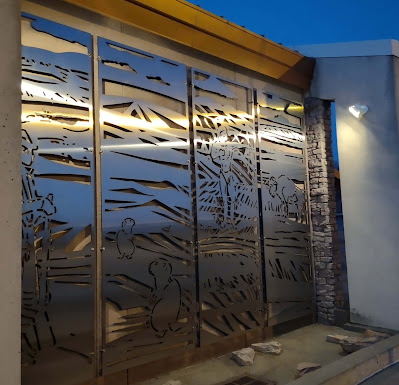 |
| At the Camp Pleasant rest stop above the Missouri River. |
I-90 is the longest and coldest east-west road in the national interstate system. It was started in 1958 and not completed until 1978. It’s been part of my life for as long as I can remember, because the New York and Massachusetts sections are older than me. I know the section from Boston to Buffalo intimately, and that from Buffalo to Chicago quite well. I’ve driven the western section to Wyoming, but not often. The piece from Idaho to Washington is a mystery to me.
After yesterday’s storm, the sky is utterly clear. It would
make for perfect night-sky photography, and both Dwight and I have cameras with
us. However, we didn’t shoot any pictures. It was too miserably cold out there.


