Paint Schoodic

To see more paintings, learn about workshops and classes, and more, visit my website.

Sunday, December 30, 2012

Mind control; thought control

A very typical boy illustration of a "smoking gun," albeit better executed than most.
From the sketchbook of one of my former students.
I’m particularly fond of teenagers and especially that creature-in-crisis, the teenage boy. I’m currently the proud owner of a 16-year-old model, and I’ve taught others in my studio. And of course you know that I’ve been assiduous in telling my students to draw, draw, draw—to draw in class, to draw on the bus, to draw on dates. I don’t care what they draw; I don’t care where they draw; I just want them to draw.

So imagine my shock and dismay when I read in Salon that a 16-year-old high school student in Egg Harbor City, NJ, was arrested after doodling in his notebook. The boy drew what has been variously described as either weapons or a flamethrower hand (which is the second most-common trope among teen boy artists, after guns).

Another drawing, same kid.
Having clearly never before seen a teenage boy, a staffer called the local cops, who—instead of rolling their eyes—searched both the school and the kid’s home with sniffer dogs. There they found chemicals which when combined could create an explosion, and pieces of electronics which when rebuilt could have been used to make detonators.
Boys of that age live in a
comic-book universe.

(I am glad they didn’t stop by my house, since they would have found electronic parts and chemicals strewn all over the kitchen, this being our week to refinish the kitchen cabinets and repair the light fixtures.)

This would all be the makings of a ridiculous story, except that the boy was sent to juvenile detention while the so-called crime was investigated.

(Read more here, here, here, and here.)

I’m not much of a believer in gender differences, but having taught a lot of teenagers to draw and paint, I know there are distinct differences in what they draw when they’re not being ordered around by the likes of me. Teen girls draw archetypal faces and bodies (often in Regency clothes). Teen boys draw weapons and fight scenes. This is universal, and I’m shocked that anyone working with kids doesn’t know this.

Last year I had a sweet kid in my studio, SH, who has graciously allowed me to share some of the gun doodles from his sketchbook. SH is every mother’s dream kid—handsome, kind to others, involved in extracurricular activities, a competitive swimmer, camp counselor, and having excellent manners. But when he was bored, he drew guns—just like every other boy I’ve ever known.

This is a typical girl drawing of the same age, again better executed than most.
By my daughter.
Drawing is a form of thinking as well as communicating, and in the hands of most people is primarily therapeutic and cathartic, rather than descriptive. A kid who draws a flamethrower is dealing with the stress of sexuality in a time-honored manner. A kid who draws a monster clawing off Mrs. Addlepate’s face has in fact found an excellent way of dealing with the stress of Mrs. Addlepate’s inanities. On the other hand, the kid who is prohibited from expressing his frustration, his zeal, his intelligence, his adolescent hormones and his pain is a kid who’s more likely to quite literally “go ballistic.”

Sunday, December 23, 2012

A brief foray into indirect painting

"Adirondack autumn grove," 12X16, oil on canvasboard, 2012
(please excuse the reflections; my camera isn't back yet)
I had a few minutes in my studio the other day and was contemplating some “fails” from the field—plein air paintings that didn’t really work. Now, I have stacks of these, and they don’t bother me in the least… they are the pictorial record of experiences and impressions, rather than finished paintings. But occasionally I find one I want to touch up.

Just as it came from the field.
This one was done in the company of Marilyn Fairman last autumn, and while I liked the overall composition, the structure somehow got lost in the moment (it happens).

With changes marked out.
I decided to seek and restate the darks using a transparent glaze. I first learned to paint indirectly— using many thin layers of paint and medium to achieve one’s desired visual effects—and it’s a technique I generally reject in my dotage. Nevertheless, there are times when such indirect painting is the fastest way to fix a painting. This is almost always when the problem area has to go darker; although one can glaze with zinc white, it’s usually just easier to repaint the offending passages with your usual muck.

As often as I say I don't make up my own medium, sometimes I do...
this time with a small amount of paraffin wax added to kill the gloss.

I've been studying the Maine seascapes of Winslow Homer, in particular his use of the dark diagonal, and it seemed it would be just the thing to fix this painting. After noting the passage I wished to make darker, I mixed a palette of three transparent pigments: Indian yellow, transparent earth red, and dioxazine purple. With these I was able to quickly make the shadows cool and the highlights warm.
Transparent glazing colors--Indian yellow, transparent red oxide, dioxazine purple .

The whole repair took less than five minutes. Now, I don’t know if this qualifies any longer as a “plein air” painting, since I adjusted the values in the studio. Nor do I care. The issue is whether it satisfies the viewer, and I’d say it is now closer than it was on that lovely autumn day.

Merry Christmas to all my dear friends!

Wednesday, December 19, 2012

Of sidekicks and teenagers who sleep in class

He's fifteen... I asked him.

I had the good fortune to have lunch yesterday with two of my former sidekicks, Marilyn Feinberg and Matthew Menzies. A good sidekick is a beautiful thing, and these two are among the best. In some ways, they're polar opposites: she is a middle-aged intellectual; he is a rather rowdy teenage boy. 


I love teen boys' oversized puppy paws.
Matt went straight from our lunch to speak—as a grown-up, second-year RISD student—to Brighton High School’s AP art class. I was pleased but not surprised to hear that he emphasized drawing, for Matt drew in all his classes. In a nutshell, this is why he's such a fine draftsman today, and it's a pity that his school now discourages students from doing so.

This one I know is fifteen. He's mine.
I frequently draw in church, because it helps me to concentrate on the sermon. In recent weeks a group of teenagers has caught my eye—the teenagers who “concentrate with their eyes closed.”

Along with drawing in class, looking as if you’re sleeping is absolutely verboten in high school (evidently, the students are all expected to look as if they’re on a Synchronized Learning Team). In church, however, the congregation isn’t a captive audience, and our preachers work to retain interest, so lounging, drawing, and other out-of-the-ordinary behavior is tolerated.

Really too far away for me to see their faces in detail. 
Having taught Sunday school as well as watched teenagers in church over the course of many years, I’m convinced the kids are actually hearing more than most adults credit them with, since they always seem to perk up when it gets interesting. Anyway, the proof is when teenagers continue to come to church as young adults. That indicates that their teacher was someone who worked to earn their attention and respect. 


Not a child at all, and a totally different setting:
a bailiff at Monroe County Hall of Justice.
But there was something boyish in his oversized solidity.
You might think drawing a sleeping kid would be easier than most surreptitious figure drawing, but these kids actually wiggle as much as their attentive neighbors (another clue that they aren’t really sound asleep). I usually have about five minutes, tops, before my subject moves, and I plan accordingly. No great detail—if I get the gesture and measurement right, I’m happy.

Saturday, December 1, 2012

The Quality of Light

"Michelle in incandescent light," 36X24, oil on canvas.
(Photo credit, Brad Van Auken)

Last week I went to a figure group which used incandescent spots and Odalisque poses. Here I never set up with either, and haven’t since I studied with Cornelia Foss. When I returned to my studio after my trip, I was wondering whether I was missing anything, so yesterday I decided to set up with a spotlight.

Students like spotlights because at the beginning painting with them seems easier. Most of the major color and value decisions are made before one ever picks up a brush. There are only two fundamental colors to worry about—the color of the light and the color of the shadow, since all of the natural, accidental, reflected tones are blown away by the color of the spot.

The problem is that one can go a certain distance quickly, but then can go no farther. I painted the above in three hours. It was impossible to find any real color range. Gone were the delicate blues and greys and olives of Michelle’s skin; she was rather like one of those Thomas Kinkade lighthouses that are apparently on fire from within. To be honest, I cheated with the warm midtones—they didn’t even exist. As I said to Michelle, “I am painting what I want to be true, not what is actually here.”

With incandescent spots, the pattern of darks and lights is spelled out by the lighting itself, and one need not work for it. That seems easier at the beginning, but it makes new discovery next to impossible. This is especially true in all the variations of the Odalisque pose.

Make no mistake: the history of the Odalisque is erotic. The word comes from the Turkish 'odaliq’, or chambermaid, which in the west was understood to mean a harem concubine, and to refer to the whole sensualized artistic genre in which the model lies on her side on display. (If you doubt this, just do a Google search of Odalisque and imagine the models writhing.)

The art world has historically been deeply misogynistic. Art has been made by some very competent women— Artemisia Gentileschi, Berthe Morisot, Mary Cassatt, Judith Leijster, Käthe Kollwitz, Gabriele Münter, and so many others—but art is generally made by men and purchased by men. The Odalisque is sexual objectification, but a higher-rent version of it than the porn available on the internet. Sometimes it is done brilliantly, but it’s certainly nothing I’m interested in perpetrating (and I wonder sometimes why so many women are acolytes at the feet of its proponents).

For the next three weeks we will be working on one long pose, and I have set high-school student MB the task of creating the pose, having assigned her five artists to study: Goya, Manet, Degas, Modigliani, and Freud. That will give us nine hours to paint in this pose, and that’s an opportunity not to be missed. I should note that the times are slightly changed to accommodate MB’s schedule.

Friday, December 7, 2012: 3-6 PM
Thursday, December 13, 2012: 3-6 PM
Friday, December 21, 2012: 3-6 PM

Tuesday, November 27, 2012

One Morning in Maine


With apologies to Robert McCloskey

"Sunset at Marshall Point," 8X6, oil on canvasboard, private collection
People say, “Paint what you know,” but I’m more for knowing what I paint. That said, my knowledge of Maine has until now been surface deep. I’ve painted in Eastport and Lubec and the mid-coast region, but not in the last few years, and never with the kind of intense concentration that you get from being in the same place day after day.  I freely admit that I don’t understand the Maine landscape with the same intensity that I understand Keuka, but that doesn’t mean I can’t learn.

Sunset over Penobscot Bay.
I’ve been invited to teach plein air in mid-coast Maine next summer. The only way from here to there is to pull out my brushes and paint there, intensively, day after day. Most sane people do NOT do that in November, but I believe in striking while the iron is, er, stone cold.

Cold it is during the two weeks leading up to Thanksgiving, no matter where in the Northeast you’re painting. One morning I was painting on a commercial wharf and thought it was warming up enough to doff the gloves, until I reached for a baby wipe and found it frozen solid to the ground. (An aside: the good news about painting all day in that kind of cold is that you sleep like a baby.)

"Pine trees at sunset near Owl's Head, ME," 8X6, oil on canvasboard, private collection.

Maine is iconic, and there are subjects which are almost verboten because they are clichés—lighthouses, lobster boats, surf, lobster traps, and buoys. Yet those things are also integral to what Maine is, and in the hands of good painters, are both transformed and transformative. Maine resonates with many of us precisely because it is a place whose hard work is on display. We Americans revere and respect work. To ignore that would be almost as clichéd as the worst lighthouse painting.

"Surf," 8X6, oil on canvasboard, available.
I frequently fall into two compositional traps when painting the ocean, something I never worked out satisfactorily before this trip. The first is getting caught in the perfect ellipse of the shore, and the second is the triangle formed by ocean silhouetted by land. After ten days or so of fighting this, I drove two hours to see a wonderful show, “Weatherbeaten: Winslow Homer and Maine,” at the Portland Museum of Art. As one entered, one first saw “The Artist's Studio in an Afternoon Fog,” which is owned by Rochester’s own Memorial Art Gallery. This painting is an old friend, and one I frequently use to teach composition.

Homer used two devices to organize his Maine paintings: a strong dark diagonal, and vast simplification. I use that diagonal in figure-painting all the time; why did it never occur to me as a solution here?

Maine in November bears little resemblance to the traffic jam that is US 1 in July. The plein air painter has to know two things—how to get off the beaten path, and where to find toilets and coffee. I spent much of my two weeks figuring out these details. Much of my painting was, therefore, less about painting than about planning to paint. But then I would see seals gamboling in the ocean, and it was about the joy of God’s creation and my grateful heart.

My wee little paint kit on a cold day in Belfast, ME.
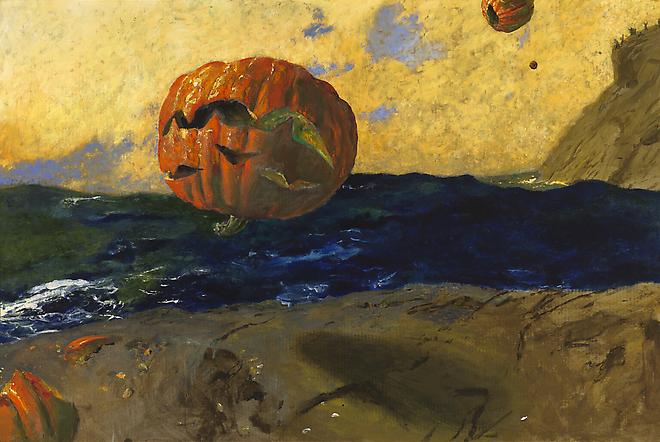
The Farnsworth in Rockland has to be flat-out the best museum in a city of its size (7,297 people, I kid you not), anywhere. When I visited, they were simultaneously featuring Louise Nevelson and Frank Benson, which was a stretch for my limited brain. I was most moved and surprised by the Jamie Wyeth-Rockwell Kent show. I am a big fan of surrealism in literature, but in painting it generally leaves me cold. Wyeth has an iteration of this painting (in oil) which is simply the best surrealist painting I have ever seen. I was also quite taken by his The Seven Deadly Sins as expressed through seagulls.

Near Port Clyde, ME.
I am about the same age as Jamie Wyeth and like him was taught to paint by my father. (There, obviously, the similarity ends.) I was rather surprised to find in his mature work such a strong resonance with his grandfather, the great narrative painter NC Wyeth. All those Wyeths are story-tellers, but there’s a romanticism that skips from grandfather to grandson.

In my wanderings, I met Robin Seymour, gallery manager for Eric Hopkins, who is a joyful, lyrical and yet very intellectual painter. Robin is a true art historian, worlds away from the typical gallerista, and I got a tremendous kick out of talking to her. I also met Hopkins himself, who demonstrated looking at things upside down by lying on his back on his credenza; it’s a sign of the Mainer’s resilience that he was able to get back up. Robin introduced me to her neighbor, Yvette Torres, who in turn introduced me to the fantastic work of Winslow Myers. Later that week, painter Alison Hill of Monhegan took me along to her weekly figure session, which was in Yvette Torres’ gallery. When life moves in circles like this, it’s simply wonderful.

"Marshall's Point," 12X16, oil on canvasboard, available.
To say I’m looking forward to teaching there next year is to vastly understate the case. Watch this spot.