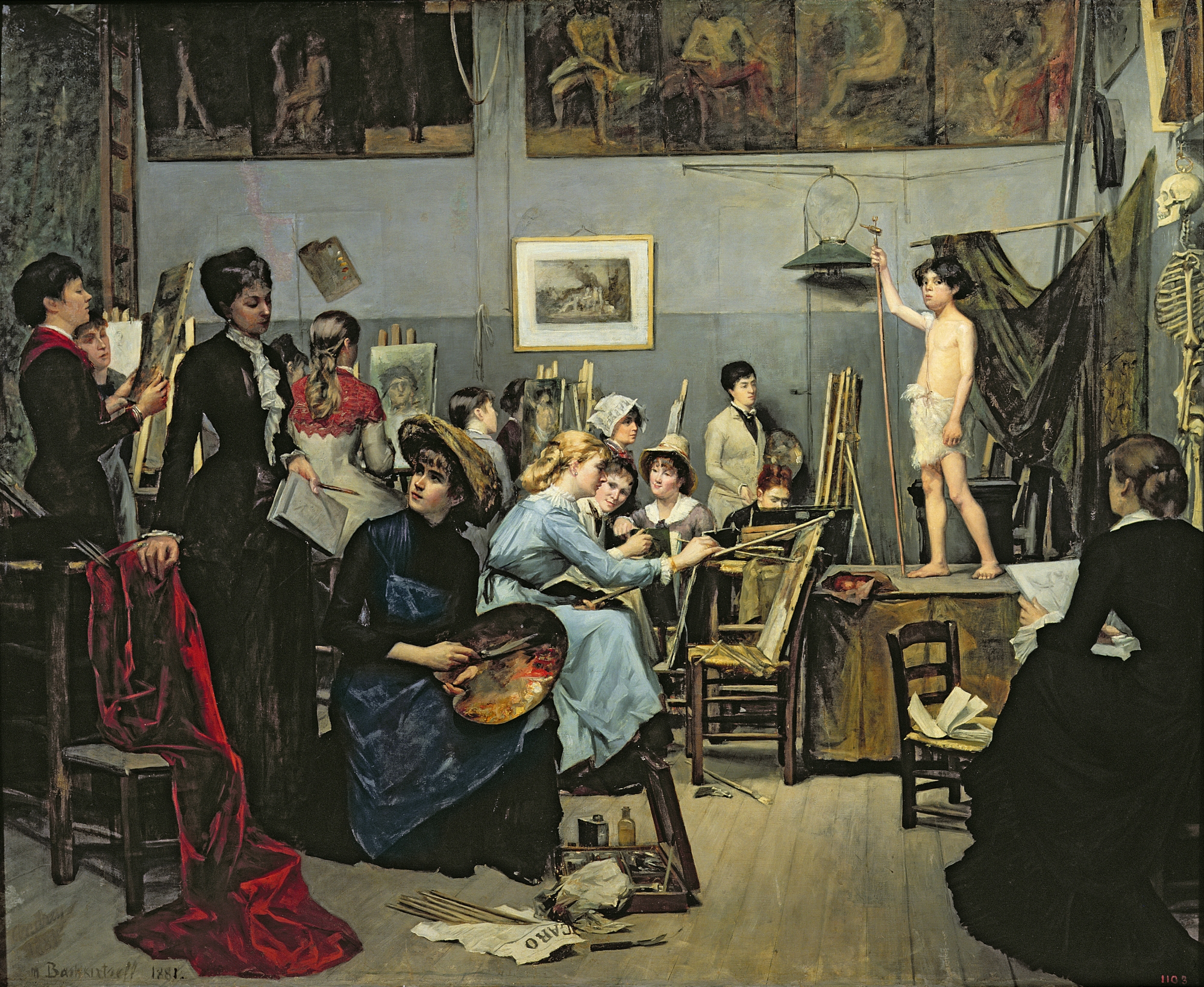
 |
In the Studio, by Marie Bashkirtseff , 1881
|
Thomas Sudhof, who shares this year’s Nobel Prize for
medicine and physiology, told The
Lancet in August 2010 that he owes his powers of analysis and
concentration to studying a musical instrument.
“Who was your most influential teacher, and why?” he was
asked.
“My bassoon teacher, Herbert Tauscher, who taught me that
the only way to do something right is to practice and listen and practice and
listen, hours, and hours, and hours,” he responded.
I mention this (which I read here)
because I’ve been ruminating this week on a disturbing report
in the Wall Street Journal that, while U.S. baby boomers held their own against
workers’ skills in other countries, younger people are lagging behind their
foreign peers.
“The study, conducted by the Organization for Economic
Cooperation and Development, tested 166,000 people ages 16 to 65 and found that
Americans ranked 16 out of 23 industrialized countries in literacy and 21 out
of 23 in numeracy. Both those tests have been given periodically and while U.S.
results have held steady for literacy, they have dropped for numeracy. In a new
test of ‘problem solving in technology rich environments,’ the U.S. ranked 17
out of 19.”
That’s impressively bad, considering that we are the world’s
biggest spenders on education.
Is it coincidence that our educational system has been
deteriorating ever since we started centralizing it? The boomers who hold their own
against their foreign peers, by and large, went to local schools. These answered
to a local Board of Education who in turn answered to their local communities.
Now—as teachers, parents and students will tell you—there is
no flexibility whatsoever in the system, because administrators answer to central
planners. Success is defined as meeting bureaucratic expectations.
In such a worldview, the arts exist only for “enrichment.”
They are always the first area trimmed when the pressure is on.
This happens even when all the evidence shows that the arts
succeed. Consider the fate of Rochester’s School of the Arts (SOTA). By far the
best school in a failing district, it had a graduation rate comparable to the
best suburban districts. But when Rochester’s school budget was in trouble in
2009, the first response was to cut more than half of SOTA’s art teachers.
Intellectual gavage isn’t how the human brain functions best,
and we clearly have lost something by teaching in this way. If there is such a
thing as American exceptionalism, it derived from American creativity. Yes, we need
scientists and engineers and Nobel prize-winners, but maybe we’d have more of them if we concentrated
more on bassoon playing.
One more workshop
left this year, and it starts next Sunday! Join me or let me know if
you’re interested in painting with me in 2014. Click here for
more information on my Maine workshops!

No comments:
Post a Comment