 |
| A possible Matisse among the paintings exhibited at a press conference in Munich (from AFP/Getty Images via the Telegraph website). |
As the entire world knows by now, a cache of 1400 Nazi-looted
artworks was found in 2012 in the apartment of an elderly man in Munich.
The pensioner first
came under the suspicion of customs officials on 22nd September 2010 when he
was seen traveling to from Munich to Zurich and back, with large amounts of
cash, in a single day.
When they conducted
further inquiries they discovered that he barely existed on official records:
he paid no tax, held no social security records, and had never worked.
They then searched his
flat and found the piles of paintings hidden behind cans of food in a squalid
apartment. (The Telegraph)
 |
| Another painting displayed at the press conference (from AFP/Getty Images via the Telegraph website). |
Cornelius Gurlitt apparently also owns a derelict house in an affluent
suburb of Salzburg, Austria:
The gate to the back
garden yawns open and a large crack in the backward-facing outer wall has been
boarded up from the inside. Only this and some rusty latticed iron bars on the
windows stand to deter intruders. (The Telegraph)
Leave aside the questions of how Gurlitt’s father acquired
the work, what the Nazis really thought of so-called ‘degenerate art’, and why
German authorities haven’t publicly identified the work so it could be
repatriated to its former owners.
Ask instead what drove this man to hoard a billion dollars of
stolen art while living in a hovel. These paintings—intended to bring joy and
life—instead brought imprisonment and isolation. To me, that sounds like a
spiritual problem.
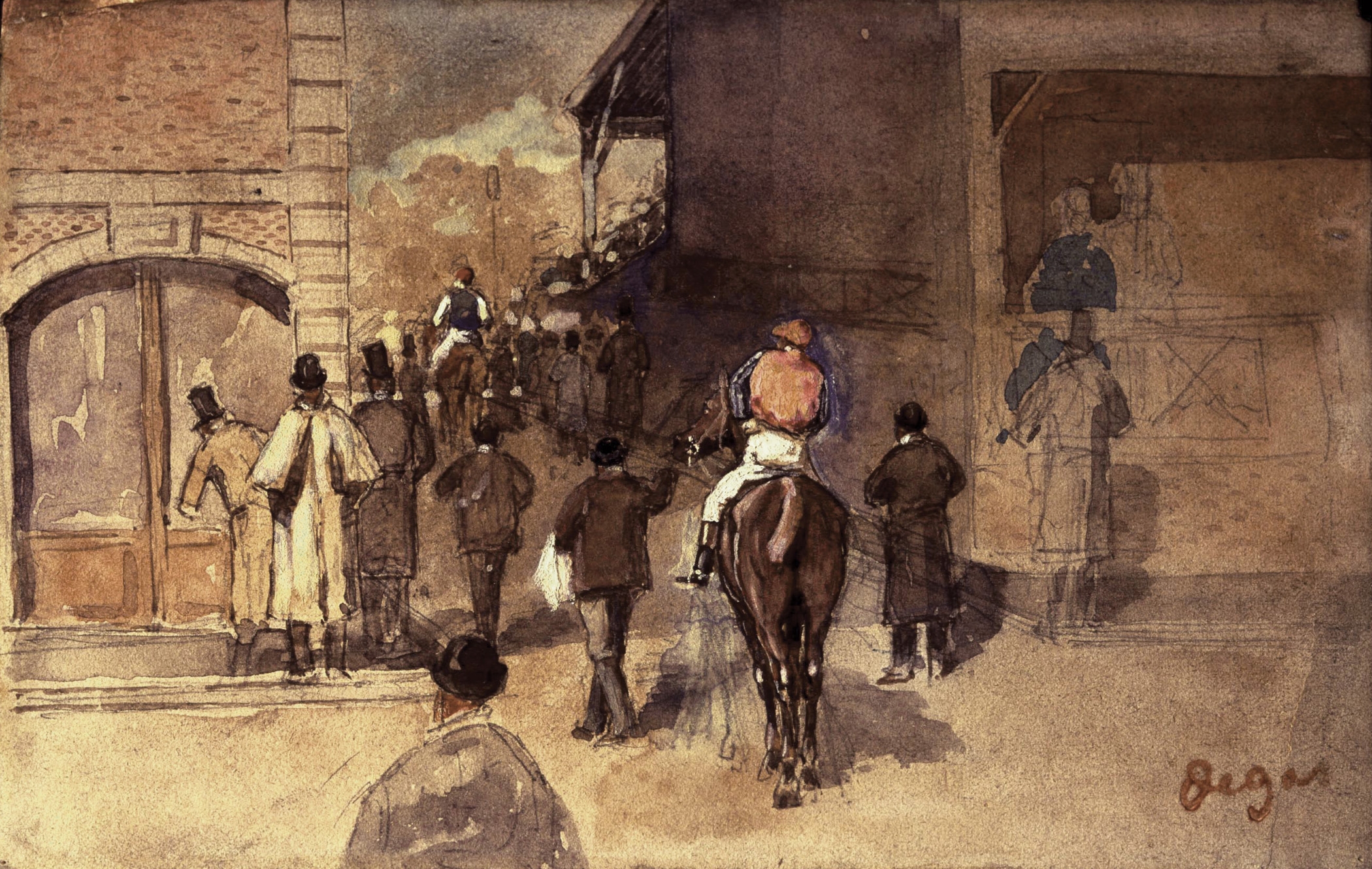 |
| La Sortie de Pesage by Edgar Degas.. One of the many works stolen from the Isabella Steward Gardner Museum on St. Patrick's Day, 1990. At an estimated loss of $500 million, it was the largest private heist of paintings ever, and included a Vermeer, several Rembrandts, a Manet, and five Degas drawings. |
“Artists tend to produce art as a vain bulwark against time,
a gamble on posterity; and for many of the artists whom Hitler loathed, art was
an explicit attempt to prevent him from getting the last word,” wrote Michael
Kimmelman in the New York Times.
This may or may not be true, and it’s worth asking why we
produce art. (Myself, I don’t know.) But it’s also worth asking why clients
collect art, and what that means when the acquisitional urge is perverted. Obviously
Gurlitt’s soul was somehow twisted by being the recipient of these paintings,
but how, exactly, did that happen?
Let me know if you’re interested in painting with me in Maine in 2014 or Rochester at any time. Click here for more information on my Maine workshops!

No comments:
Post a Comment