 |
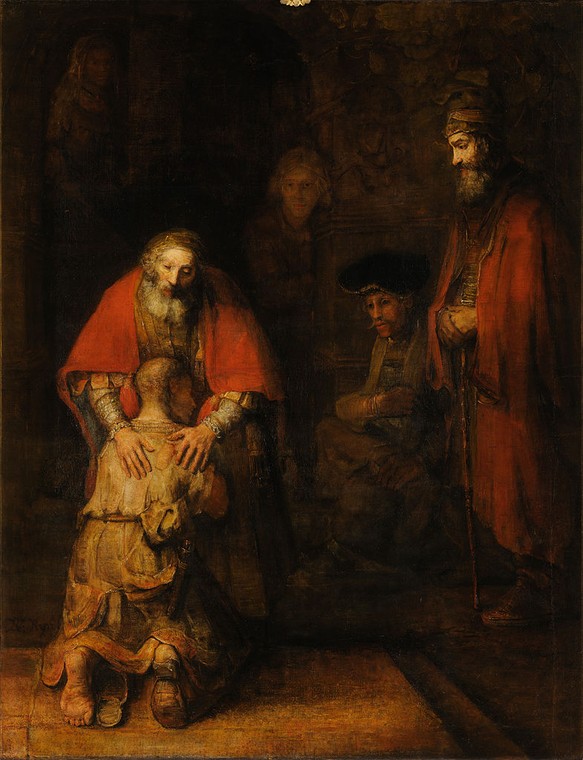
Rembrandt van Rijn’s The
Return of the Prodigal Son, c. 1661–1669,
was used for a devotional on Luke 6:37-38 and Luke 23:34.
|
The liturgical church has two seasons of preparation:
Advent, which leads to Christmas, and Lent, which leads to Easter. Advent is an
unabashedly joyous time, in the arts as well as in life. Paintings of the census
at Bethlehem, the Annunciation, the birth of Jesus, the shepherds in the fields—these
all make us smile. The Madonna with her infant child is the most painted subject
in art history. And even the non-musical among us can croak along to Christmas
carols that are centuries old.
 |
Crying Triptych, by Patty Wickman, was paired with a sonnet by John Donne and Psalm 51.
|
We don’t usually associate Lent with the arts, perhaps
because the arts are essentially sensory and we see this season as being about
repudiation of the sensual. Still, artists have been drawn to the themes of
Christ’s crucifixion and resurrection.
Holy Week will see some of us walking the Stations of the Cross or
listening to Bach’s St. Matthew’s Passion,
and both are fundamentally Lenten themes.
The Lent Project by
Biola University has assembled a series of daily Lenten devotionals using
layered art, music, and Scripture. It continues through the Sunday after
Easter. This being its first year, the jury is still out about the selections
and their treatment, but why not try it out for yourself? You can subscribe here.
A note: the credits for music, text and paintings are in an About link at the bottom right corner of each entry. It’s easy to miss.
 |
The Pharisee and the Publican, by James Tissot, was used to amplify Luke 18:9-14.
|
Let me know if
you’re interested in painting with me in Maine in 2014 or Rochester at any
time. Click here for
more information on my Maine workshops!

No comments:
Post a Comment