 |
| Daniel Chester French's colossal Lincoln in Washington's Lincoln Memorial |
Daniel Chester French’s name is not widely known today, but a
century ago he was one of America’s most prolific and popular sculptors. His
most famous work is the colossal statue of Abraham Lincoln in the Lincoln
Memorial in Washington, DC, completed in 1920.
The National Mall sees about 24 million visitors a year, and
the Lincoln Memorial is the most-visited of its presidential monuments.
The strangest thing about
it, though, is the quiet that descends over the tourists who climb the wide
sweeping stairway and step into the cool of the marble chamber. Before long
their attention is drawn to one or both of the two Lincoln speeches etched in
the walls on either side of the famous statue. After all this time I am still
astonished at the number of visitors who stand still to read, on one stone
panel, the Gettysburg Address, and, on the other, Lincoln’s second inaugural
address.
What they’re reading is a summary of the
American experiment, expressed in the finest prose any American has been
capable of writing. One speech reaffirms that the country was founded upon and
dedicated to a proposition—a universal truth that applies to all men
everywhere. The other declares that the survival of the country is somehow
bound up with the survival of the proposition—that if the country hadn’t
survived, the proposition itself might have been lost. Sometimes the tourists
tear up as they read; they tear up often, actually. And watching them you
understand: Loving Lincoln, for Americans, is a way of loving their country. –Andrew Ferguson,
author of Land of Lincoln
There
is a legend that Lincoln’s hands are positioned to form his initials in
American Sign Language. (French’s son was deaf.) This may or may not be true, but the
story points out that, even 150 years after his death, we each feel a special affinity
to Lincoln.

Detail of Augustus Saint-Gaudens' Robert Gould Shaw Memorial, Boston, MA
Augustus Saint-Gaudens worked on his Robert Gould Shaw
Memorial, now in Boston Commons, for 14 years. Although it officially commemorates Col. Shaw, the monument is in fact a portrait
of both him and the black soldiers who served under him in the 54th
Massachusetts (Colored) Volunteer Infantry Regiment.
On July 18, 1863,
almost half of the 54th Massachusetts were killed, wounded or
captured in an assault on Ft. Wagner in South Carolina. Col. Shaw—a newlywed
25-year-old—was among the dead. The fort’s defenders said his body had been
dumped in a mass grave “with his niggers.” It was meant to humiliate, but Shaw’s
father publicly said that he considered it the highest honor that Shaw was
buried with his men.
The frieze
captures Shaw and his men marching out of Boston and into eternity. We are at
street-side, watching a parade; we understand that this line of soldiers extends
both in front and behind the narrow frame.
Joshua Benton
Smith, a veteran of the 54th Massachusetts, conceived of the
memorial to “commemorate the great event… by which the title of colored men as
citizen-soldiers was fixed beyond recall.” Today hundreds of thousands of people walk Boston’s Black History Trail
each year and see Saint-Gaudens’ memorial.
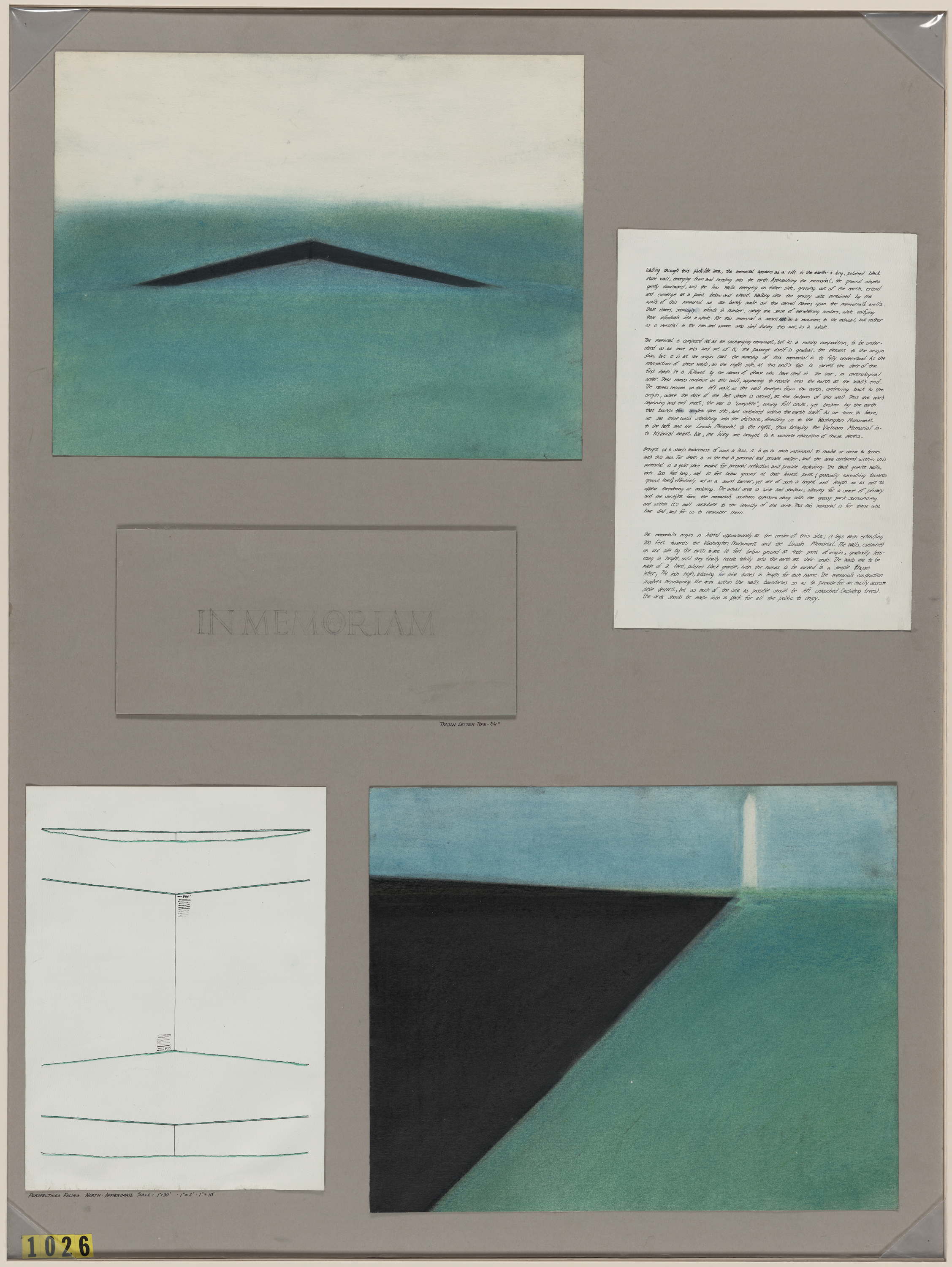
Maya Lin's plan for the Vietnam Memorial. I am awed by the people who recognized the genius in it.
Maya Lin was a 21-year-old architecture student when her design
was selected for the Vietnam Memorial in Washington. Her design
submission was highly controversial, with great public outcry against its
nihilism and austerity.
Photos don’t do the
Memorial justice, since it is experienced spatially rather than viewed like
sculpture. One descends into the earth to honor the dead, and one generally
shares this experience with others who are experiencing real, not abstract, grief for the war’s
dead.
The Vietnam
Memorial has since become a much-loved public shrine. There have been at least
six different portable copies and three fixed copies of the Vietnam memorial.
It's important to remember that all three artists were trained artists. (Lin, the "greenest" of them, was halfway through her schooling and the daughter of the dean of Ohio University’s College of Fine Arts.) Do you think artists of their caliber could be made under an educational system that penalizes students for not meeting unreal standards by depriving them of art enrichment?
Society
may have forgotten the importance of art education, but we haven’t!
Join me in October, 2013 at Lakewatch Manor—which is selling out fast—or
let me know if you’re interested in painting with me in 2014. Click here for
more information on my Maine workshops!

No comments:
Post a Comment