 |
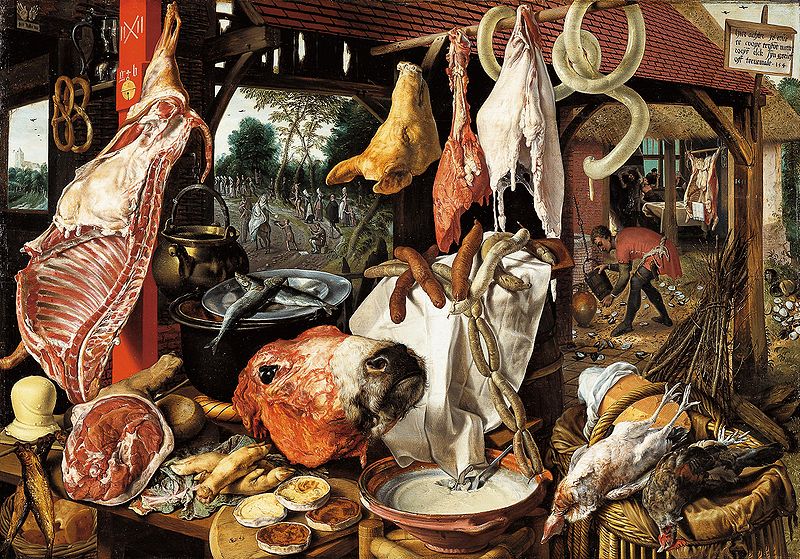
| Butcher's Stall with the Flight into Egypt, 1551,Pieter Aertsen |
My friend Dan Gowing was writing his Sunday school lesson this week when he realized just how efficient Jesus was with the miracle of
the loaves and the fishes. The Gospel of Mark records that there were twelve
baskets left after feeding 5,000 men and their families. Dan’s conclusion is
that you can’t actually get anything you want from Jesus’ restaurant but you
just might find you get what you need.
My holiday motto generally is, “What’s worth doing is worth
doing to excess.” In that I am a typical American. Our Thanksgiving dinner alone
usually has about twelve baskets of leftovers.
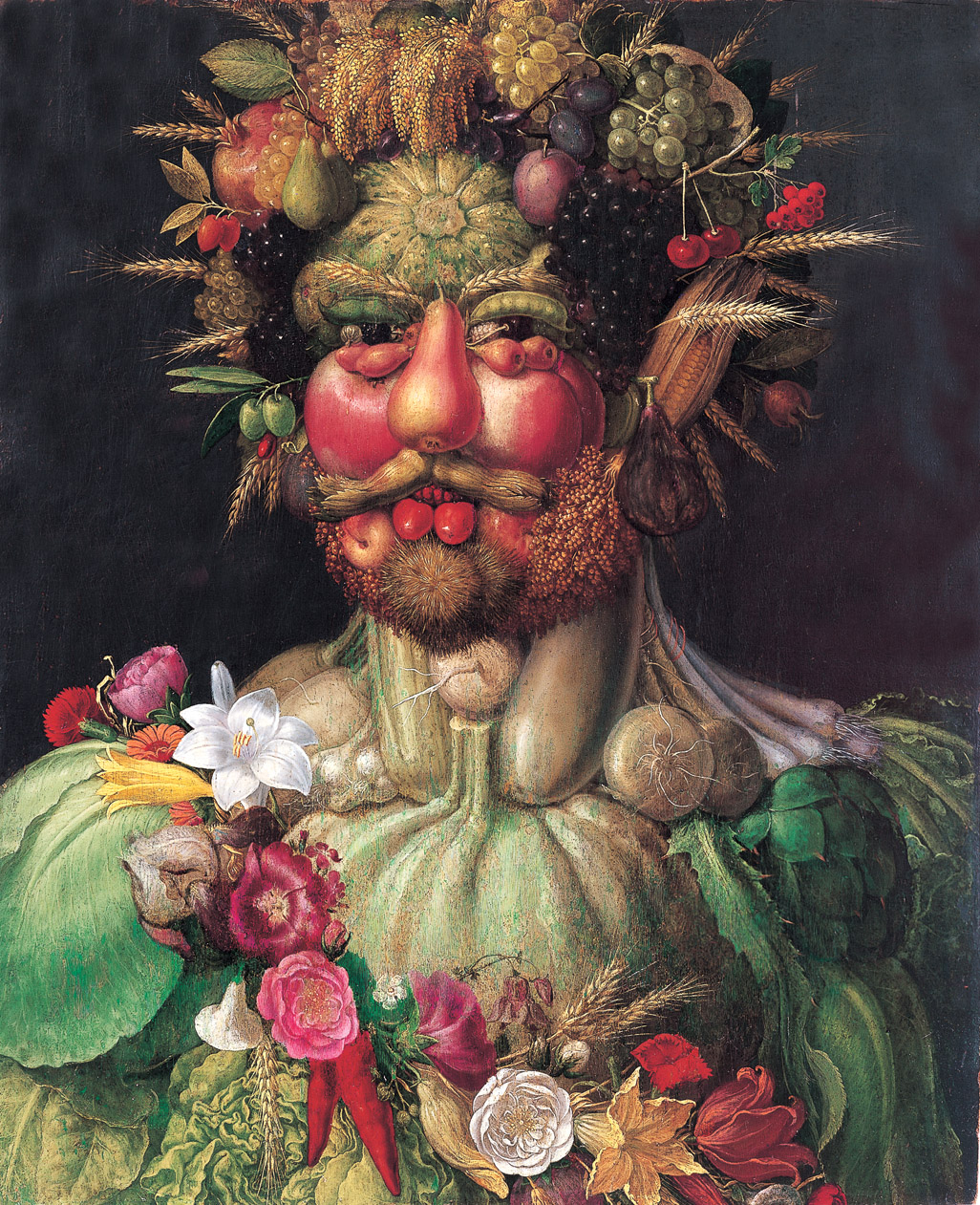 |
Giuseppe Arcimboldo’s Rudolf
II as Vertumnus, 1590, takes “you
are what you eat” to its ultimate level. It’s not mere whimsy, but symbolizes
“the majesty of the ruler, the copiousness of creation and the power of the
ruling family over everything.” (Thomas DaCosta Kaufmann) He's not Dutch, but he sure is good.
|
In November, I posted
about Norman Rockwell’s iconic Freedom
from Want and how its table is almost bare by modern standards. When
Rockwell painted this a mere 70 years ago our self-identity was still Puritan.
Today we wallow in outsized appetites, and we’re all pretty fat. In fact, we’re
far more like the Dutch Golden Age than our own recent ancestors. Of course, back then
the Dutch were rich like us.
On the other hand, most of us miss the point of those Dutch
paintings entirely. If we see them just as a celebration of bounty or a cock’s
crow of vanity, we’re missing the warning sign buried in them.
Shop, with the Flight
into Egypt, top, is in fact an allegory. The Holy Family, inset in a window
frame, distributes alms to the poor as they leave. A merry group is seen eating
shellfish (a symbol of lust) through the other window. The sign at the top
tells you that the land is for sale, leading you to understand that all of this
is available at a moral price.
 |
| Still life, 1644, Adriaen van Utrecht. This canvas includes almost all the elements common to great Dutch still lives. The presence of so much exotica points to the great wealth of the Dutch Republic. However, within this epic are buried memento mori: the seashell represents human frailty; the spotted fruit, our own aging and decay; the music, the brevity of life. Like life, the peeled lemon is pretty to look at but bitter to taste. |
Several cultural forces in the Dutch Republic led to their love of still life. The rise in interest in natural science in the 16th century
supported a concurrent rise in realism in painting (trompe l'oeil being the highest
expression of this). By the 17th century, the Dutch Republic
dominated world trade and had a vast colonial empire. They
operated the largest fleet of merchant ships in the world.
But while they were rich and famously religiously tolerant,
they were also strictly Calvinist. Icons were forbidden in the Dutch
Reformed Protestant Church. Painters were forced to deal with religious
subjects through symbolism. Their vanitas
paintings point out the transience of our earthly pleasures.
 |
| Flowers in a Silver Vase, 1663, by Willem van Aelst, includes a pocketwatch (time), poppies (death), roses (Christian faith), tulips (folly), dragonfly (transience), and butterfly (resurrection). |
This was particularly easy with flowers. A language of flower symbolism had developed through the Middle Ages. These were both positive (such as the rose and lily representing love in
both its divine and human manifestation) and negative (the poppy representing
death).
The presence of symbols of impermanence, such as candles, hourglasses,
a book with pages turning, or buzzing flies, reminded the viewer that sensory
pleasures are ephemeral.
The modern equivalent, of course, is the food photograph. Its
similarity is in the excess, but it lacks self-awareness.
Let me know if
you’re interested in painting with me in Maine in 2014 or Rochester at any
time. Click here for
more information on my Maine workshops!

No comments:
Post a Comment