 |
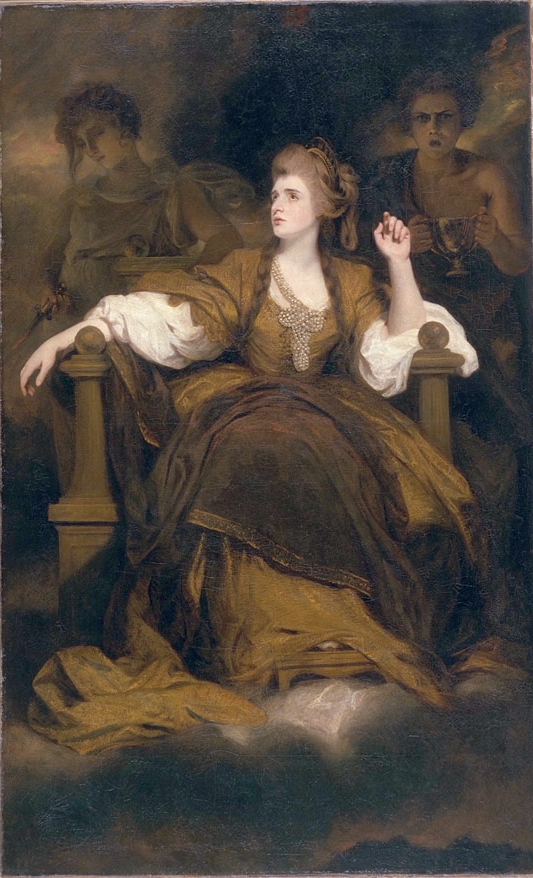
Mrs. Siddons as the
Tragic Muse, by Sir Joshua Reynolds, 1783. A Welsh former lady’s maid, Sarah
Siddons went on to be recognized as the greatest tragedienne of her age. As an
actress she was outside social mores. She was painted by both Gainsborough
and Reynolds, whose portrait of her is more typical of a male “status portrait”
of the time.
|
In the late 18th and early 19th century, women were essentially invisible in the public sphere. This was in part due to society's selective embrace of Roman values.
The ancient Romans, although in some ways progressive for
their time, were explicitly patriarchal. The paterfamilias maintained strict authority over his family and
household. Nevertheless, Roman women did have important rights and privileges,
such as the right to carry on business, remarry, and own property. Women played
a prominent role in the official cults, including the Vestal Virgins, who
were Rome’s only full-time professional clergy.
 |
Comtesse de la Châtre (Marie Louise Perrette Aglaé Bontemps),
1789, painted by Élisabeth Louise Vigée
Le Brun, who was the most famous woman painter of the 18th century. This is a
more typical female portrait in that the subject’s social status is conveyed by
her dress and surroundings.
|
What a surprise that the men of the Enlightenment selectively chose what Roman virtues to apply! Once again, we can look to Jean-Jacques Rousseau’s Émile for
insight into their interpretation of Roman
patriarchy. Émile, as the ideal man, is
educated to be self-governing. Sophie,
the ideal woman, is educated to be ruled by her husband.
Who can possibly
suppose that nature has indifferently prescribed the same advances to the one
sex as to the other and that the first to feel desire should also be the first
to display it. What a strange lack of judgment! Since the consequences of the
sexual act are so different for the two sexes, is it natural that they should
engage in it with equal boldness? How can one fail to see that when the share
of each is so unequal, if reserve did not impose on one sex the moderation that
nature imposes on the other, the result would be the destruction of both and
the human race would perish through the very means ordained for its
continuance. Women so easily stir men's senses and awaken in the bottom of
their hearts the remains of an almost extinct desire that if there were some
unhappy climate on this earth where philosophy had introduced this custom,
especially in warm countries where more women than men are born, the men
tyrannized over by the women would at last become their victims and would be
dragged to their deaths without ever being able to defend themselves.
Is it any wonder that Mary Wollstonecraft felt compelled to
write A Vindication of the Rights of
Woman, in 1792? Not that it had much of an immediate impact: Feminism would not get traction until the middle of the 19th
century.
 |
Mme de Wailly,
sculpted by Augustin Pajou, 1789. After the second century BC, the wearing of
togas by respectable women was a faux pas associated with prostitution and adultery. Women wore the stola, which
was a long, pleated dress, worn over an undergarment called the tunica
intima. In other words, real Roman matrons did not wander around with their
breasts hanging out.
|
This week I am considering six forms of portrait painting
that reached maturity during the intellectual ferment of the Enlightenment.
These posts are based closely on the Royal Academy of Art’s 2007 show, Citizens and Kings: Portraits in the Age of
Revolution, 1760-1830.
Let me know if you’re
interested in painting with me in Maine in 2014 or Rochester at any time.
Click here for more information on my Maine workshops!

2 comments:
Nice post Carol, I find history and especially art history full of everything we need, it's also interesting that human nature never changes. Thanks again for these art tutorials! Matt
Thanks, Matt. I love writing them, too.
My friend Jane Bartlett, who studied art history at the University of Delaware (great school for it) told me yesterday that she loves art history because of what it tells us about history as a whole. I think that's part of my liking for it. But I also think it helps me see my own place in the continuum of painting. For example, reading and writing about these 18th century painters makes me question the overt symbolism I’ve been using until now. A little goes a long way.
Post a Comment