Paint Schoodic

To see more paintings, learn about workshops and classes, and more, visit my website.

Showing posts with label Stations of the Cross. Show all posts

Friday, April 2, 2021

Courage, friends

If you have a fear-hangover from COVID, perhaps Easter is the season in which you should make a conscious choice to drop it.

Working together, our best intentions can yield some astoundingly damaging results. That, in so many ways, defines the past year. With largely good intentions, we’ve managed to significantly dent the world’s economy, infringe on personal liberties, isolate the elderly and marginalized… and still COVID marches on.

It’s been rotten for the body religious, which was already hurting. Here in America, we reached a grim milestone in 2021: fewer than half of Americans consider themselves to be members of a church, synagogue, or mosque. That’s shocking for the nation widely considered to be the most religious in the western world.

I learned this week that St. Thomas’ Episcopal Church in Rochester will remain shuttered for the second Easter in a row. As I wrote about galleries last week, I doubt that many institutions will survive two years of closure.

In summer, 1999, I was asked to do a set of Stations of the Cross for St. Thomas’. By that September I’d been diagnosed with colon cancer. I had four kids, ages 11 to 3. My primary goal was to stay alive long enough to see them raised.

Finishing an art project seemed frivolous, and darned near impossible. I was especially disinterested in one that dealt with the violence leading up to the crucifixion. The following year was a late Easter, so by the time Holy Week arrived, I had a rough version finished.

I drew in my hospital bed, from my couch, during chemotherapy. I wasn’t at all engaged or enthused. When I was well enough, I arranged a massive photoshoot and took reference photos. The final drawings were finished two years later. They weren’t my best work, but at least they were done.

And yet, they’ve been in use for two decades. Every Holy Week, I got notes from a parishioner telling me how much they appreciated them. I’ve certainly gotten more meaningful mail about them than any other work of art I’ve ever done.

Except last year. Last Easter, the churches of America were closed. Their people observed the rites from afar. That was appropriate then, but we’ve lived out our penance for a year now. It’s almost unbelievable that the faithful among us don’t see the urgent necessity of gathering together to celebrate the risen Lord, this year of all years.

But that’s getting ahead of ourselves. Today is Good Friday. It commemorates Jesus taking the punishment intended for all mankind’s sin onto his own, all-too-human, body. It culminates in death and hopelessness. That’s what the Stations of the Cross are about, whether they’re in the Catholic, Episcopal or any other tradition.

Are you still afraid to go to church on Sunday? It’s hard to reconcile that with the promise of eternal life that Easter represents.

I’ve traveled as much this year as any year. I’ve taken sensible precautions, including at least a dozen COVID tests, all of which were negative. Although I have the same fears and griefs as anyone else, there’s a part of me that’s simply not afraid. I respect death; heaven knows I’ve seen enough of it. I have lost people I love to COVID. But I choose life.

Fear is a prison, a mighty weight, and the brake that stops all forward motion. If you’ve been left with a fear-hangover from COVID, perhaps Easter is the season in which you should make a conscious choice to drop it.

The Stations can be walked virtually here:

Set 1

Set 2

Set 3

Set 4

Set 5


Friday, April 10, 2020

Painting through the dark places


Art has allowed me to look at pain, grief and dislocation obliquely, instead of confronting them head-on.
Carrying the cross, by Carol L. Douglas, courtesy St. Thomas' Episcopal Church, Rochester, NY.
You may have noticed that I haven’t done much this week. I finally collapsed from the ailment we dragged back from South America. Despite a slew of tests, no pathogen has yet been identified. However, our nurse-practitioner treated the symptoms. I’m almost back in fighting form, albeit very tired. Hopefully, my fellow travelers will recover as quickly.

Yesterday I attended a virtual meeting. One of my fellows, normally a very cheerful woman, was awash with anxiety. “I can’t paint!” she confessed. “I go in my studio and start, and then I go back and turn on CNN.” Later, I asked her if there was anything I could do to help. She elaborated. Her daughter has had COVID-19; she knows a young person currently on a vent and has lost another friend from it. She—like me—is from New York, the epicenter of this disease. That’s where our kids, friends and family are, and there’s nothing we can do to help them.

My heart goes out to her. It’s an awful thing to feel helpless in the face of disaster.
The Curtain of the Temple was Rent, by Carol L. Douglas, courtesy St. Thomas' Episcopal Church, Rochester, NY.
When we were waiting out our confinement in Buenos Aires, I was thoroughly disinterested in the non-existent landscape. It was not until the end that I decided to start painting what I felt instead of what I saw. That’s not necessarily easy for a realist to do directly (although we’re all doing it indirectly). That’s why I started with the idea of home, and then moved to Blake’s Jerusalem for inspiration. I could look at my feelings of grief and dislocation obliquely, instead of confronting them head-on.

Twenty years ago, I was asked to do a set of Stations of the Cross for St. Thomas’ Episcopal Church in Rochester, NY. The request was made in the summer; by September I’d been diagnosed with a colon cancer that had perfed the bowel wall and spread to nearby lymph nodes. I had four kids, ages 11 to 3. My primary goal was to stay alive long enough to see them raised.

Finishing an art project seemed almost frivolous in the circumstances. I was especially disinterested in one that dealt with the horrific events leading up to the Crucifixion. That year was a late Easter, too, so by the time Holy Week arrived, I had a rough version finished, which I delivered in book form. (In some ways, I prefer it to the final Stations, for its very rawness.)

Veronica, by Carol L. Douglas, courtesy St. Thomas' Episcopal Church, Rochester, NY. And before you correct me, I'm perfectly aware that Veronica is medieval fan-fic, but I think it points to a very human need to ameliorate suffering.
I drew in my hospital bed, from my couch, during the hours of chemotherapy. I wouldn’t have told you I was engaged or enthused in the least. When I was well enough, I arranged a massive photoshoot and took reference photos. The final drawings were finished the following year. They weren’t my best work, I thought, but at least they were done.

And yet, and yet… they’ve been in use for two decades since. And every Holy Week, I get a note from a parishioner telling me how much they appreciate them. I’ve certainly gotten more meaningful mail about them than about any other work of art I’ve ever done.

This year, St. Thomas’—like the rest of Christendom—is shuttered, its people observing the rites from afar. I’m not sure how I’m going to approach Good Friday in a season already penitential in the extreme, but there’s something to be said for routine, ritual, habit and movement. That goes for painting as much as for faith. 

May God bless you this weekend with a radical new way of seeing things, in Jesus’ name, amen.

Friday, April 19, 2019

A Good Friday reflection


It turned out to be much more work than I imagined, but it has proven to be an enduring tradition.

Carrying the Cross, pastel, by Carol L. Douglas
Twenty years ago, a member of my church approached me with an apparently-simple request: could I write and illustrate a Stations of the Cross for our Sunday school students? While we used a liturgy similar to Catholics, our belief system was very much Protestant.

Catholic Stations take the form of artwork hanging in or near the nave. They are generally in the form of bas-relief. My mother’s family is Catholic (although we were not) so I’d had plenty of time to contemplate the Stations growing up.

Gambling, pastel, by Carol L. Douglas
The Stations grew from the tradition of pilgrims walking the Via Dolorosa in Jerusalem. This dates from the time of Byzantium. During the late Middle Ages, Franciscans built a series of outdoor shrines across Europe so that common people could also experience this meditation. By the 17th century, stations were being built within churches. They were a popular printed devotional; Albrecht Dürer’s Great Passion and Little Passion are the Stations in book form.

Eventually, Catholic Stations evolved into the fourteen scenes that are used by Catholics today. They include scenes that aren’t Biblical; rather, they are an imagining of that bitter, difficult walk to Calvary. In my naivete, I figured I’d just ‘correct’ them to make them more Biblically accurate. That was about as feasible as making a few quick adjustments to the Book of Kells for the modern reader.

The Crucifixion, pastel, by Carol L. Douglas
No, a rewrite was in order. With the Gospels in one hand and a children’s book about the Holy Land in the other, I set out to make a new set of Stations.

And then disaster struck. I was diagnosed with a big, fat, robust bowel cancer. I spent the following year being radiated, poisoned and cut apart. Concentration was difficult. I sketched out the bones of the project, wrote the text and assembled my sketches into a first iteration. That was all I could do.
Piercing his side, pastel, by Carol L. Douglas
In all, it took two years for me to finish the Stations. The church hung the pictures in the nave during Holy Week. I moved along to an evangelical church, and ultimately to Maine.

It gives me great joy that, this many years later, they still hang the paintings every year. Each year I get tagged in a photo from one old friend or another, with a note saying, “your stations are up.” There are children in those illustrations who have now graduated from college. Many of my older models have died, but others continue to worship in that same church. I still get a kick out of looking at the pictures and remembering them.

Stations hanging in the nave of St. Thomas Episcopal Church, Rochester.
If you’re in Rochester, you can see the Stations today, at St. Thomas' Episcopal Church, 2000 Highland Avenue. If you want to read them this Good Friday, the opening pages are here. Just hit the “newer post” button at the bottom of the page to continue. And have a blessed Easter weekend!

Friday, April 3, 2015

Stations of the Cross (5 of 5)

This week I am running a series of Stations of the Cross. They were completed during a deadly year, one in which I was being treated for an advanced cancer. For this reason—and because I was traversing new territory for myself—they’re uneven. But their power comes from the underlying story.

The language is simple, meant to be accessible to a child.

The originals are on display at St. Thomas’ Episcopal Church, 2000 Highland Avenue, Rochester NY 14618.

Jesus died.
The sky grew dark. At three o’clock, Jesus cried, "My God, my God, why have you forsaken me?"
"He is calling for Elijah," the people said. Someone got a sponge, filled it with sour wine, and lifted it on a stick for Jesus to drink.

"Father, into your hands I commend my spirit," cried Jesus, and he died.

At that moment, the sun’s light died, the curtain of the temple was torn in two, and there was an earthquake. When the soldiers felt the earthquake, they were terrified. "This man must have been God’s son," one said.

People disagree about what Jesus meant when he said, "My God, my God, why have you forsaken me?"

The crowd did not know what Jesus meant, either. They did not understand he was God’s son, so they thought he was calling for Elijah.

The soldiers recognized the earthquake as a sign of God’s power. But there were other people who still would not see.

Jesus’ side was pierced.
The crowd did not want the bodies left on the crosses during the Sabbath. They asked Pilate to break the legs of the three men so they would die faster. Since Jesus was already dead, the soldiers did not break his legs. One soldier took his spear and pierced Jesus’ side.

After Jesus died, he stopped talking, but he was not quiet. The things that happened to him were signs.

The blood that came from his side was the blood of the new covenant. The water was the water of baptism. "On that day a fountain shall be opened to cleanse them from sin and impurity," said Zechariah.

Jesus was taken down from the cross.
Joseph of Arimathea was a secret disciple of Jesus. He went to Pilate and asked him for Jesus’ body.
Joseph took Jesus’ body from the cross and wrapped it in a clean linen cloth. A man named Nicodemus helped Joseph.

The people who had come to watch returned to their homes, making a big show of their grieving. But the people who loved Jesus stood at a distance and waited.

Joseph was a member of the council. He was a rich but good man. Nicodemus was a religious leader. Both were secret followers of Jesus.

When they asked for Jesus’ body, their secret was known. They risked losing their power and money—even their lives.

Joseph and Nicodemus could not help Jesus without showing their faith to the world. Sometimes we are afraid of what other people think of our religion. But we cannot serve God if we keep our faith hidden.

Jesus was laid in the tomb.
Joseph and Nicodemus laid the body in Joseph’s own new tomb. They rolled a large rock over the opening. They had to work very quickly because the Sabbath was starting.

Mary Magdalene and Jesus’ mother Mary kept watch nearby.

The next day, the priests and Pharisees went to the tomb and sealed the stone shut. "Otherwise his disciples may steal the body and say ‘He has been raised from the dead," they told Pilate.

On that Saturday, did Caiaphas, the council, and the people believe they had finally silenced Jesus? 

Let me know if you’re interested in painting with me on the Schoodic Peninsula in beautiful Acadia National Park in 2015 or Rochester at any time. Click here for more information on my Maine workshops! Download a brochure here.

Thursday, April 2, 2015

Stations of the Cross (4 of 5)

This week I am running a series of Stations of the Cross. They were completed during a deadly year, one in which I was being treated for an advanced cancer. For this reason—and because I was traversing new territory for myself—they’re uneven. But their power comes from the underlying story.

The language is simple, meant to be accessible to a child.

The originals are on display at St. Thomas’ Episcopal Church, 2000 Highland Avenue, Rochester NY 14618.
Jesus was nailed to the cross.

When they came to Golgotha, the soldiers offered Jesus wine mixed with myrrh. He would not drink it.

They crucified him between two criminals.

Pilate put a sign on Jesus’ cross that said "Jesus of Nazareth, King of the Jews".

Jesus said, "Father, forgive them for they do not know what they are doing."

The wine with myrrh would have made death less painful and scary. But it also would have made Jesus confused. Jesus did not drink it.

Golgotha must have been a scary place that day. Perhaps the two criminals screamed in pain. Jesus’ friends and followers wept. The crowd shouted and laughed.

All around him, people lost control. But Jesus kept a clear head. The crowd was lost in their feelings. Jesus was not. Jesus forgave his enemies. He showed us that forgiveness is a choice, not a feeling.

The soldiers divided Jesus’ garments.
The soldiers took Jesus’ clothes and divided them among themselves. Jesus’ tunic was woven in one piece. They said, "We won’t tear it. We will gamble to see who will get it."

For the soldiers, this was just another workday. If we could ask them what they were thinking, they might say, "I’m doing what I’m told," or, "I need this job."

There will always be people who take advantage of weak or defenseless people. Sometimes we do it ourselves. But Jesus told us, "Whenever you refused to help these least important ones, you refused to help me."

Jesus spoke from the cross.
A crowd of people stood watching. Many shouted at Jesus, saying "Save yourself! If you are the Son of God, come down from the cross!"

One of the criminals who was dying with Jesus said, "If you are the Messiah, save yourself and us!"

The other criminal said, "We are getting what we deserve, but Jesus has done nothing wrong." Then he said to Jesus, "Remember me when you come into your Kingdom."

"Today you will be with me in Paradise," Jesus told him.

The crowd thought that if Jesus were the Son of God, he would take care of himself first. But he put himself last, not first.

In the world, we are called powerful when we can get other people to do things for us. In God’s kingdom, we are powerful when we are like Jesus—using our gifts for others.

Let me know if you’re interested in painting with me on the Schoodic Peninsula in beautiful Acadia National Park in 2015 or Rochester at any time. Click here for more information on my Maine workshops! Download a brochure here.

Wednesday, April 1, 2015

Stations of the Cross (3 of 5)

This week I am running a series of Stations of the Cross. They were completed during a deadly year, one in which I was being treated for an advanced cancer. For this reason—and because I was traversing new territory for myself—they’re uneven. But their power comes from the underlying story.

The language is simple, meant to be accessible to a child.

The originals are on display at St. Thomas’ Episcopal Church, 2000 Highland Avenue, Rochester NY 14618.

Jesus took up his cross.
The place where prisoners were crucified was called Golgotha, or the Place of the Skull. It was outside the city. Jesus picked up his cross to carry it to Golgotha himself.

Jesus did not pick up his cross and carry it for us because we are lovable. He did it to lift the weight of our sins from us and put it on his own shoulders.

It’s one thing to love someone who is good. It’s another thing to love someone who is bad. There are some very unlovable people in this world. Can you pray for them? Be their friend? Forgive them? Love them?

Simon of Cyrene was forced to carry Jesus’ cross.
As the soldiers left the palace with Jesus they saw a man named Simon. The soldiers forced Simon to carry the cross for Jesus.

Sometimes God whispers and sometimes God demands. We believe we choose to serve Jesus. But Simon was forced to serve Jesus. When Simon picked up Jesus’ cross, his life was changed forever.

A person from Cyrene is from North Africa. The Bible does not tell us what color Simon was. If color doesn’t matter to God, how much should it matter to us?

Jesus spoke to the women following him.
A crowd gathered. They followed Jesus and Simon as they left the city. Some were Jesus’ enemies. Others cried for him. Jesus turned to them and said, "Daughters of Jerusalem, do not weep for me, but weep for yourselves and for your children."

There is a story that a woman named Veronica reached out to Jesus and wiped his face with a cool cloth; later that cloth developed a picture of Christ.

It wasn’t the cloth but Veronica herself who was a picture of Christ. She reached out to another person who needed help. Can others see Jesus reflected in us?

Probably the women who wept for him along the road did reach out and offer him water, encouragement, and love. Even in his suffering, though, Jesus understood that they were the ones in need.


Let me know if you’re interested in painting with me on the Schoodic Peninsula in beautiful Acadia National Park in 2015 or Rochester at any time. Click here for more information on my Maine workshops! Download a brochure here.

Tuesday, March 31, 2015

Stations of the Cross (2 of 5)

This week I am running a series of Stations of the Cross. They were completed during a deadly year, one in which I was being treated for an advanced cancer. For this reason—and because I was traversing new territory for myself—they’re uneven. But their power comes from the underlying story.

The language is simple, meant to be accessible to a child.

The originals are on display at St. Thomas’ Episcopal Church, 2000 Highland Avenue, Rochester NY 14618.

Jesus was beaten.
"This man is innocent," said Pilate. "He has done nothing to deserve death. I will have him beaten and released." Pilate had his soldiers whip Jesus.

Pilate went out from his palace. "You have a custom of having a prisoner released for Passover. Should it be Jesus or Barrabas?" The crowd chose Barrabas.

"Then what should I do with Jesus?" he asked them.

"Crucify him!" they answered. 

Pilate hoped that by beating Jesus, he could satisfy the crowd and save Jesus from dying. It didn’t work. It was the first of many sufferings Jesus bore that day.

We all suffer—some of us as children, some as adults. Sadly, some suffer their whole lives. 

Sometimes we can see when people suffer. Other times, it is hidden.

When we reach out to those who suffer, we reach out to Jesus himself.

Jesus was mocked.
The soldiers dressed Jesus in a crown of thorns and a purple robe. They hit him on the face, saying "Hail, King of the Jews!"

Pilate did not want to kill Jesus. "Why won’t you answer me so I can let you go?" he asked Jesus. 

"Don’t you realize I have the power to have you killed?"

"You have no power except that which comes from God," Jesus answered.

What could Jesus have said that would have changed the mind of the crowd? Their hearts were set against the truth.

There are times when what we do is far more important than what we say. We don’t just spread the good news by talking about Jesus. We also spread it by doing good things in Jesus’ name.

Jesus was condemned.
Pilate led Jesus outside to the judge’s bench. He said to the council, "Here is your King!"

"Crucify him!" they answered.

"Shall I crucify your king?" he asked.

"We have no king but the emperor," said the priests.

So Pilate handed Jesus over to be crucified.

Pilate was a smart man. He did not want to kill Jesus. He could have saved Jesus. But he did not stand up to the crowd when he knew they were wrong.

It is easy to do the right thing when people around you agree with you. It is hard when other people think you are wrong. Most of us worry about what our friends think. But public opinion will never tell you if something is right or wrong.

Let me know if you’re interested in painting with me on the Schoodic Peninsula in beautiful Acadia National Park in 2015 or Rochester at any time. Click here for more information on my Maine workshops! Download a brochure here.


Monday, March 30, 2015

Stations of the Cross (1 of 5)

This week I am running a series of Stations of the Cross. They were completed during a deadly year, one in which I was being treated for an advanced cancer. For this reason—and because I was traversing new territory for myself—they’re uneven. But their power comes from the underlying story.

The language is simple, meant to be accessible to a child.

The originals are owned by St. Thomas’ Episcopal Church, 2000 Highland Avenue, Rochester NY 14618, and are traditionally displayed during Holy Week.

The night Jesus was arrested.
On the night Jesus was arrested, he was brought to the house of Caiaphas, the high priest. Caiaphas and his council were looking for a reason to put Jesus to death.

Caiaphas was afraid of Jesus. He did not want to give Jesus a fair trial. He told his council, "It is better for you to have one man die than to have the whole nation destroyed."

"Are you the Messiah?" Caiaphas asked Jesus.

"You have said so," Jesus answered.

"Why do we need witnesses?" Caiaphas asked the council. "You heard him! What is your verdict?"

"Death!" the council responded.

They spat in Jesus’ face, hit him and insulted him.

The priests brought Jesus to Pilate.
The members of the council took Jesus to the Roman governor, Pilate. They were careful to stop at the gates of Pilate’s palace. They did not want to go into a place where people were hurt. If they did, they would no longer be clean and they could not eat their Passover meal.

"Take him yourself and judge him by your laws," said Pilate. But the council could not have Jesus crucified, which is what they wanted.

The high priests carefully followed the law that God gave them. But they used the law to get what they wanted, not what God wanted. We choose how we use our gifts from God—whether for good or evil, to help others or to help just ourselves.

Pilate enthroned.
Pilate asked Jesus, "Are you the King of the Jews?"

"My kingdom is not of this world," said Jesus. "If it were, my followers would be fighting to save me."

Jesus did not wear a golden crown or command armies. He wore a crown of thorns and knew his power was in God.

When we follow Christ, our power comes from God and no one can see our riches.


Let me know if you’re interested in painting with me on the Schoodic Peninsula in beautiful Acadia National Park in 2015 or Rochester at any time. Click 
here for more information on my Maine workshops! Download a brochure here.

Wednesday, March 12, 2014

Dürer's Small Passion

Small Passion: 23. Christ Being Nailed to the Cross, by Albrecht Dürer.
As noted yesterday, there are typically 14 Stations of the Cross in the modern church, and they have become formalized into a specific order (which tends to meander a bit from the Gospel texts). That was not always the case.

Albrecht Dürer produced three print cycles of the Passion. Two were in woodcut: the Large Passion containing twelve scenes, and the Small Passion containing 37 scenes. His engraved Passion contained 16 scenes.

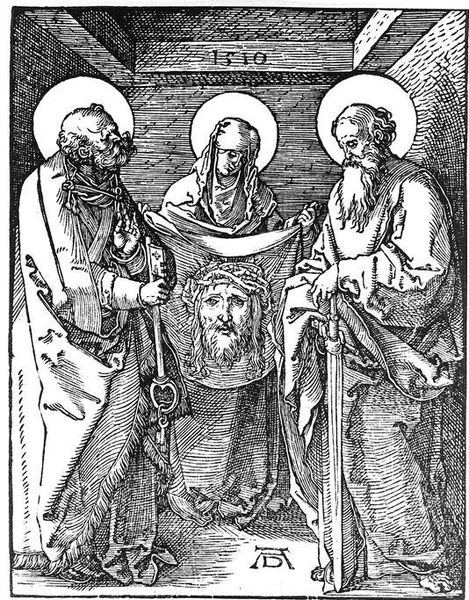
Small Passion: 22. The Sudarium of St Veronica, by Albrecht Dürer.
These were famous and popular works, distributed throughout Europe. Not only did they shape what the viewer expected in a Passion, they were widely copied by other artists, and by forgers as well.

The Small Passion starts with The Fall of Man and ends with The Last Judgment. The few plates that Dürer dated suggest that he started with Palm Sunday and moved forward in an historical way through Easter Week. As he was finishing, he added The Fall of Man, The Expulsion from Eden, The Annunciation, The Nativity, and Saints Peter, Paul, and Veronica holding the Suderium.

These plates changed the focus from The Passion to a history of mankind culminating in salvation through Jesus Christ.

Small Passion: 29. The Resurrection, by Albrecht Dürer.
Dürer was a perfectionist, so it is no surprise that he cut his blocks himself until he could train professional woodcutters to work within his technique. The quality of his work can be seen in part in the fact that impressions were printed from his original woodblocks for more than a century.

You can see the Small Passion here.

Let me know if you’re interested in painting with me in Maine in 2014 or Rochester at any time. Click here for more information on my Maine workshops!

Tuesday, March 11, 2014

The Way of the Cross

Carrying the Cross, from St. Thomas' Stations of the Cross, now up for Lent.
A friend who is a parishioner at St. Thomas Episcopal Church in Rochester sent me this clipping from their parish newsletter:

The Way of the Cross (also known as Stations of the Cross) is a traditional devotion during the season of Lent, particularly on Fridays. Originally, pilgrims to Jerusalem would walk the path of Jesus from his arrest to his crucifixion and burial, pausing at significant locations along the way. At a later date, fourteen "stations" were often erected in parish churches, so that all could join in this spiritual pilgrimage.

The Curtain of the Temple was Rent,  from St. Thomas' Stations of the Cross, now up for Lent.
St. Thomas' is fortunate to have sixteen original Stations of the Cross by noted local artist Carol Douglas. While some of the traditional stations are based on pious legend, Carol's renderings closely follow the scriptural account of our Lord's passion.

A booklet with prayers and readings for each of the stations is available in the church. You are invited to come at your convenience to walk the Way of the Cross this Lent.

Veronica, from St. Thomas' Stations of the Cross, now up for Lent.
Thank you for your kind words about a project that was dear to my heart.

These Stations are up only during Lent. For more information, call St. Thomas’ at 585-442-3544 or email the parish administrator.

Let me know if you’re interested in painting with me in Maine in 2014 or Rochester at any time. Click here for more information on my Maine workshops!

Thursday, November 21, 2013

Working under duress

Annunciation to Joseph, c. 2000, by little ol' me. Who likes hearing upsetting news?
I was recently diagnosed with cancer. It’s kept me from doing much of anything these past few weeks, as I'm in a sort of paralysis of awe and anxiety. This is why I’ve been writing about art theory and history and not so much about practical painting.

Yesterday my doctor was reviewing the charts from my 1999 bout with a different cancer. “And you were running 900 miles a week,” he finished up.

I laughed. “I was actually running 30 to 36 miles a week then,” I said. “And the odd thing is, I’ve been ramping up my mileage all summer, and now I’m doing 25 miles a week.”  Last winter I realized that scrambling around rocks while teaching plein air painting in Maine would require a lot of endurance, so I started training harder.

Carnations and Clematis in a Crystal Vase, Édouard Manet, 1883. Manet dealt with illness by painting some exquisite small florals; you just know they are flowers from his bedside table. I don’t think I have this kind of ‘sweet’ in my character, but, then again, Manet probably didn’t think he did either.
When I had cancer in 1999, I made exercise my top priority. If I wasn’t hooked up to an IV, I walked or ran. It was how I kept sane. And my first resolution with this round of cancer is to do the same, even if it uses up all my limited energy. In retrospect, running is probably why I’m still here.

Twice now I’ve ramped up my workout the year before I learned I had cancer. No, exercise doesn’t cause cancer. Rather, sometimes God tells us to do something that we don’t understand at the time. Listening to the voice of God is pretty hard for people who have been trained to think rationally rather than intuitively. But when we succeed at it, we rapidly realize God has his hand firmly on our shoulders.

Carrying the Cross, from A Child Walks With Jesus, 1999-2000, St. Thomas' Episcopal Church, Rochester.
Right before my last diagnosis, I agreed to do Stations of the Cross for St. Thomas’ Episcopal Church in Rochester. It took me ten months to do 26 sketches, but in retrospect, I think the cancer shaped the work in ways I couldn’t have foreseen. The work also shaped my faith, because it addresses the fundamental question of the Christian experience: did Jesus really give us an end run around the inevitability of sin and death?

Oddly enough, I recently made a commitment to do seven large paintings on the subject of God and man in the environment. I have no idea how being sick can affect this work; I won’t know until I break this paralysis. But I will, and it will. That I know.


Let me know if you’re interested in painting with me in Maine in 2014 or Rochester at any time. Click here for more information on my Maine workshops!

Wednesday, March 14, 2012

A Child Walks With Jesus


This morning, I was in the sanctuary at St. Thomas’ Episcopal Church when I realized with surprise that the Stations of the Cross are on display—well, they would be, since they were made for Lent. (I don’t attend a Lenten-observing church anymore, and the calendar gets away from me.)


(If you would like to walk the Way of the Cross, it is done each Friday at 5:30 PM. The address is 2000 Highland Avenue, Rochester. Their full Lenten schedule is here.)

I made these Stations during my own personal annus horribilis, a year in which I was being treated for colorectal cancer. The quality is—looking back—uneven. No surprise there, since there were many days I could barely lift a pencil.

I was surprised to realize that they are also no longer on the internet in any form, so I dug deep into my archives and found copies of the illustrations and the original text, which I have reproduced here:


The idea of the Stations of the Cross originated in pilgrimages to Jerusalem, in the form of was later called the Via Dolorosa or “Way of Suffering”. This was an effort to understand in some small way the suffering of Christ by following him on the route of his conviction and execution.


 Gaudenzio Ferrari, Statue of Jesus climbs the Praetorian Steps, Polychrome wood, ca. 1510 Italy, Sacro Monte di Varallo (VC), Chapel XXXII


Of course, most devout Christians never get to Jerusalem. Attempts to replicate the Via Dolorosa experience for the rest of us appeared as early as the 5th century. Eventually these took the form of connected shrines, bas relief carvings on indoor or outdoor church walls, or woodcuts in bound books.

 Albrecht Dürer (1471 -1528), 'The Large Passion: The Crucifixion', Germany, About 1498

For both the points on the Via Dolorosa and the images disseminated throughout Europe, the term “Stations” was in use after about the 15th century.

By the 16th century, out-of-door Stations of the Cross were a regular sight on the approaches to many large churches—most commonly with seven settings, but ranging up to 30.


by Adam Kraft (1490) in Nuremberg

In 1731, Pope Clement XII fixed the number of stations at the modern 14. These are:

  1. Jesus is condemned to death
  2. Jesus accepts the cross
  3. Jesus falls the first time
  4. Jesus meets His Mother
  5. Simon of Cyrene carries the cross
  6. Veronica wipes the face of Jesus
  7. Jesus falls the second time
  8. Jesus meets the women of Jerusalem
  9. Jesus falls the third time
  10. Jesus is stripped of His garments
  11. Crucifixion: Jesus is nailed to the cross
  12. Jesus dies on the cross
  13. Jesus' body is removed from the cross (Deposition or Lamentation)
  14. Jesus is laid in the tomb and covered in incense.

The problem for we literalist Protestants is that Stations 3, 4, 6, 7, and 9  have no clear basis in the Bible.

So how does an evangelical proceed when asked to make Stations of the Cross for an Episcopal church? The Episcopal Church frequently hearkens back to what it calls its three-legged stool, which is in itself a recapitulation of Richard Hooker’s hierarchical ranking of doctrine:

  1. “What Scripture doth plainly deliver.”
  2. That which may be concluded “by force of reason.”
  3. That which “the church by her ecclesiastical authority” thinks and defines as true.

No room there for Veronica, no matter how lovely the story is.

Ironically, I could have just waited for the Catholics. In 2007, Pope Benedict approved a new set of Stations for Catholics, called the Scriptural Way of the Cross. Those Stations are:

  1. Jesus in the Garden of Gethsemane,
  2. Jesus is betrayed by Judas and arrested,
  3. Jesus is condemned by the Sanhedrin,
  4. Jesus is denied by Peter,
  5. Jesus is judged by Pilate,
  6. Jesus is scourged and crowned with thorns,
  7. Jesus takes up His cross,
  8. Jesus is helped by Simon to carry His cross,
  9. Jesus meets the women of Jerusalem,
  10. Jesus is crucified,
  11. Jesus promises His kingdom to the repentant thief,
  12. Jesus entrusts Mary and John to each other,
  13. Jesus dies on the cross,
  14. Jesus is laid in the tomb.
One thing—the originals are the property of St. Thomas’ Episcopal Church, but the right of reproduction resides with me, the artist. And that I share freely with the world. Go ahead and share them with anyone who might enjoy it.