It’s immediate and visceral, in a way that incorporates the lessons of abstract-expressionism, but it’s also grounded in reality. In short, it’s painting for our times.
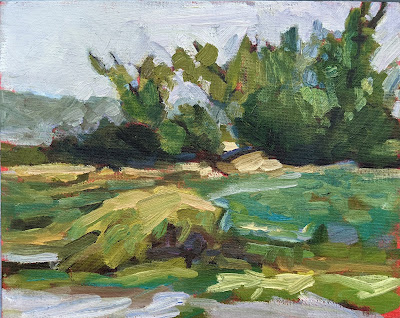 |
| Spring Greens, oil on canvasboard, 8X10, $652 in a plein air frame. |
Last week Mary Byrom asked me, “Why is plein air painting significant?” I was at a loss for an answer. Then she sent me this essay, What’s the Point of Painting from Life? It sets out a compelling argument for why we should paint from real objects, rather than from photos. I hope my students all read it. But it glances off Mary’s question, rather than answering it.
There’s a lot of dreck in the plein air movement. It’s
hindered by its sheer volume. But that was also true in the Dutch Golden Age
and other periods in art history. Dreck is the inevitable consequence of lots
of work, but that’s also what gives us brilliance. Time winnows out the worst
paintings.
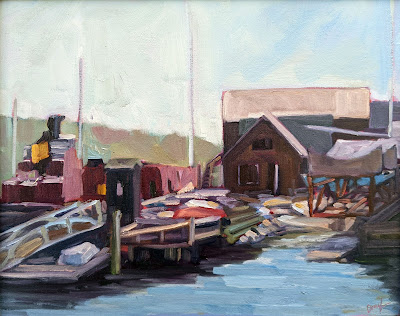 |
| Belfast harbor, 14X18, oil on canvasboard, $1594 in a narrow black presentation frame. |
Plein air painting is largely ignored by the contemporary Academy, by which I mean our university and museum culture. It’s a movement of the people, and it takes the artist down a few pegs, from intellectual to craftsman. Its training is done mostly in the old atelier system, by which I mean the workshops and classrooms of working artists. That’s in contrast to the university system, which teaches kids to be post-modern artists.
Our university system has no interest in teaching people to
paint. Until the explosion of interest in plein air, traditional
painting was perilously close to being a lost art. Yes, there are colleges in
America teaching it, but they are rare and absurdly expensive.
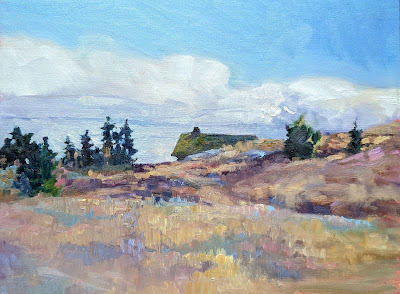 |
| Early Spring on Beech Hill, 12X16, oil on canvasboard, $1449 in a plein air frame. |
In the twentieth century, meaning in painting took a radical turn. It stopped being about symbols and became about the artist’s own psyche. Odilon Redon, for example, wrote that he wanted to place “the logic of the visible at the service of the invisible.” Pablo Picasso famously said, “I paint objects as I think them, not as I see them.” Everything Picasso painted was autobiographical.
From there it was a short jump to the position of the later
20th century, when meaning was banished from art entirely. It became
about form and color, rather than anything the artist wanted to say.
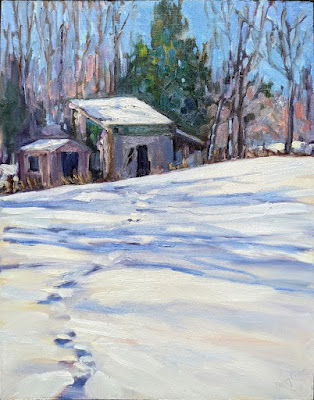 |
The Woodshed, 11x14, oil on birch, $869 unframed. |
Stubbornly, the human mind has an insatiable desire for narrative and meaning—both in the telling and in the listening. It’s a great relief for all of us to leave the nihilism of the 20th century behind.
Plein air painting surged just as we Americans were
learning that we can’t take our natural world for granted. In my lifetime the
population of the United States has doubled. Fields and farms that I roamed as
a child are now housing developments. Streams have been fouled, natural
reserves of fish and wildlife depleted. Plein air painting is a both a
record of these changes and a plea for the natural world.
The rise of plein air painting is inextricably tied
to the development of internet culture, where museums and universities are no
longer arbiters. There’s been an explosion of painting workshops, classes, books and videos
to teach painting to the masses. And what do people want? Not abstraction, but
representational painting grounded in real life.
I studied figure because I was taught that it was the most difficult
genre, and the
basis of the most important kinds of painting. After a lifetime of drawing
and painting, I know that’s not true. Landscape is the most challenging, and
therefore the most instructive, form of painting. It’s immediate and visceral,
in a way that incorporates the lessons of abstract-expressionism, but it’s also
grounded in reality. In short, it’s painting for our times.


