 |
Hermaphrodite, Mateo Bonarelli,
1652, Prado
“Son of Hermes and
Aphrodite, Hermaphrodite was a singularly handsome youth. According to Ovid (Metamorphoses 4,
285 ff.) Salmacis, the nymph from a lake in Caria, was enthralled by his beauty
and passionately embraced him while he was bathing. Their two bodies merged as
one, with double gender.
“This sculpture, commissioned by Velasquez in Italy for the decoration of Madrid's Alcázar Palace, is a copy of the classic marble from the Borghese Collection in Rome, now in the Louvre Museum. The high technical quality of this piece makes it a masterwork that surpasses the original.” (From the Prado website) |
Despite what the photographer says on the video, there is no clear line between art and pornography, because there have always been painters whose primary
goal was to titillate, and because sexuality is part of our humanity. It cannot
be simply excised from the model or the process.
Consider the dancing girls in this fragment from ancient
Thebes (c. 1350 BC). One presumes that the serving girls and dancers are naked
for Nabamun’s amusement in the afterlife, but it is not overtly sexual.
 |
A feast for Nebamun, the top half of a scene from the
tomb-chapel of Nebamun, Thebes, Egypt, Late
18th Dynasty, around 1350 BC, The British Museum
|
Compare that to the Ephebe
of Marathon, which is a sculpture of a boy (perhaps the god Hermes). The
school of Praxiteles was interested in presenting a new view of the gods: more
accessible, naturalistic, humanistic. These sculptors were perhaps even more
interested in the aesthetic issues of contrapposto, which basically
means putting the model’s weight on one foot. (This is a convention we use to
this day.) I can’t even figure out how to frame the question of whether the Ephebe was intended to be erotic; their
social, religious, and cultural milieu didn’t make the same distinctions we do.
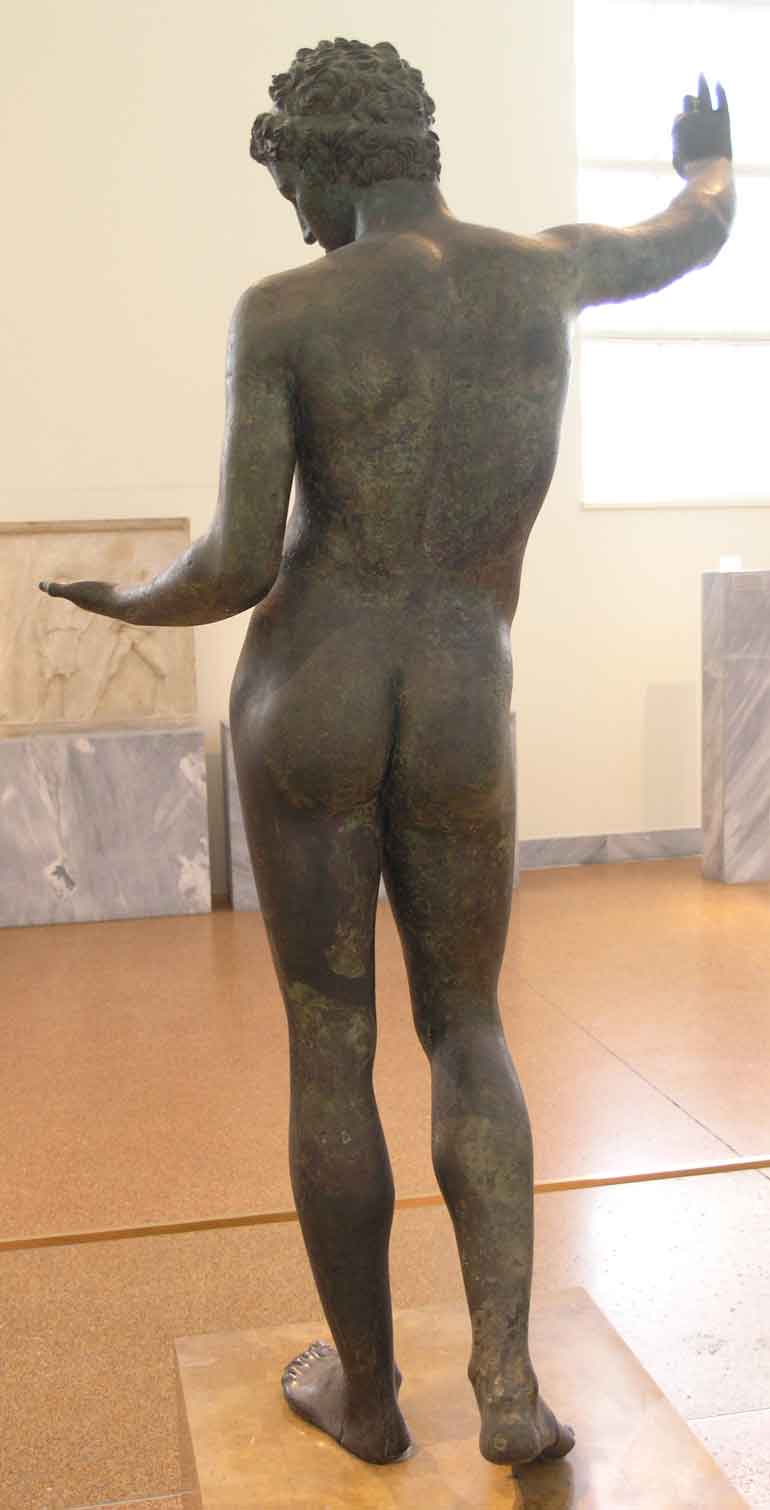 |
Ephebe of Marathon, School
of Praxiteles, c. 325-300 BCE, National Archaeological Museum of Athens
|
Then there’s Da Vinci’s Vitruvian Man (which in addition to
being an exquisite drawing, has to be one of the most enduring bits of graphic
design in the history of art). Here, I think the intention is quite clear: Da
Vinci is attempting to write a canon of measurement for the human body.
 |
Vitruvian Man, Leonardo
da Vinci, c. 1490, Gallerie dell'Accademia
|


